

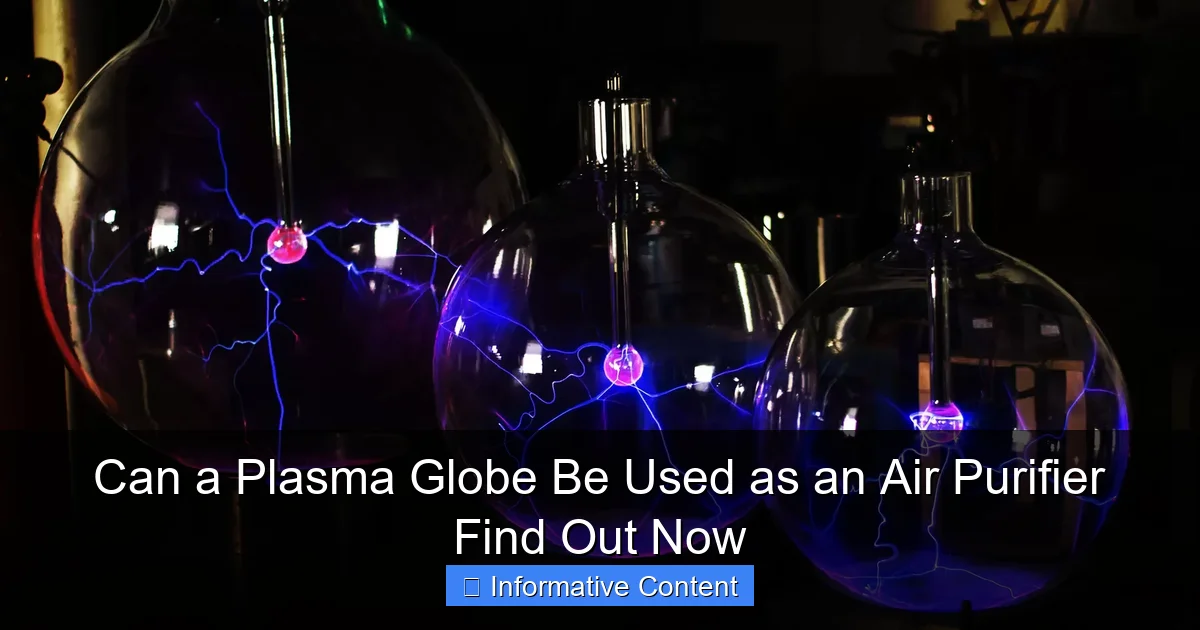
Featured image for can a plasma globe be used as an air purifier
Image source: airpurifiermaster.com
No, a plasma globe cannot effectively purify air—despite its mesmerizing tendrils of ionized gas, it lacks the filtration or chemical breakdown mechanisms of true air purifiers. While it ionizes surrounding air molecules, this produces trace ozone and does not remove allergens, pathogens, or pollutants, making it unsafe and ineffective for air purification purposes.
Key Takeaways
- Plasma globes do not purify air: They lack filtration or pollutant removal mechanisms.
- No proven air-cleaning benefits: Scientific evidence doesn’t support their use for air purification.
- Ozone risk at close range: High-voltage plasma may produce trace ozone, harming indoor air quality.
- Use HEPA filters instead: Opt for proven air purifiers with HEPA or activated carbon filters.
- Plasma globes are decorative: Enjoy them for visual appeal, not air-cleaning functionality.
📑 Table of Contents
- What Is a Plasma Globe and How Does It Work?
- The Science Behind Air Purification and Ionization
- Can a Plasma Globe Actually Purify the Air?
- Potential Risks and Safety Concerns
- Alternatives: Better Ways to Purify Your Air
- Data Table: Plasma Globe vs. Air Purifier Performance
- Conclusion: Should You Use a Plasma Globe as an Air Purifier?
What Is a Plasma Globe and How Does It Work?
A Brief Overview of Plasma Globes
You’ve probably seen a plasma globe at a science museum, a novelty store, or maybe even at a friend’s house. That mesmerizing glass ball filled with colorful, dancing filaments of light—resembling lightning in slow motion—is not just a cool party trick. It’s a real scientific device that demonstrates the behavior of ionized gas, or plasma, under high voltage.
Plasma globes, sometimes called plasma balls or Tesla spheres, were first popularized in the 1980s. They’re often used as educational tools, decorative items, and even in meditation spaces due to their calming visual effect. But recently, a curious question has popped up in online forums and wellness circles: Can a plasma globe be used as an air purifier? That’s what we’re diving into today—separating fact from fiction with a healthy dose of science and real-world experience.
How Plasma Globes Generate Their Glow
At the center of a plasma globe is a high-voltage electrode, usually a metal-coated sphere, surrounded by a glass shell filled with low-pressure noble gases like neon, argon, or xenon. When the device is turned on, a high-frequency alternating current (AC) is sent through the electrode. This creates a strong electric field that ionizes the surrounding gas.
Here’s the fun part: the gas molecules lose electrons and become positively charged ions, while the freed electrons form the glowing filaments. These filaments are drawn toward any conductive object nearby—like your hand if you touch the glass. The result? A beautiful, interactive light show that feels almost magical.
But beyond the visual appeal, the process involves ionization, ozone production, and electromagnetic fields—all of which have been explored in air purification technologies. So, could this same mechanism clean the air in your home? Let’s find out.
The Science Behind Air Purification and Ionization
How Ionizers Work in Air Purifiers
Many commercial air purifiers use negative ion generators to help clean the air. Here’s how it works: the ionizer emits negatively charged ions into the air. These ions attach to airborne particles like dust, pollen, smoke, and pet dander, giving them a negative charge. Charged particles are then attracted to positively charged plates inside the purifier or to surfaces in the room (like walls or furniture).
Visual guide about can a plasma globe be used as an air purifier
Image source: strattman.com
This process, known as electrostatic precipitation, can effectively remove fine particles from the air. Some ionizers also claim to break down volatile organic compounds (VOCs) and neutralize bacteria and viruses through chemical reactions.
However, ionizers aren’t without controversy. While they can reduce particulate matter, they don’t capture particles like HEPA filters do. Instead, they rely on the particles to settle out of the air—which means they can end up on your floor or furniture, potentially creating a cleaning hassle.
Plasma Technology in Advanced Air Purifiers
Beyond simple ionizers, some high-end air purifiers use non-thermal plasma (NTP) or cold plasma technology. These systems generate plasma at room temperature using high-voltage discharges, similar to what happens inside a plasma globe—but in a controlled, enclosed environment.
In these purifiers, plasma creates reactive oxygen species (ROS) like ozone (O₃), hydroxyl radicals (•OH), and superoxide ions (O₂⁻). These molecules are highly reactive and can:
- Break down VOCs (like formaldehyde and benzene)
- Deactivate mold spores and bacteria
- Neutralize odors (such as cooking smells or pet odors)
For example, the Sharp Plasmacluster and Winix PlasmaWave technologies use plasma to generate positive and negative ions that seek out and neutralize airborne pollutants. These are not just decorative—they’re engineered for air quality improvement.
So, if commercial air purifiers use plasma-like processes, could a regular plasma globe do the same? The short answer: it’s complicated.
Can a Plasma Globe Actually Purify the Air?
Plasma Globes and Ozone Production
One of the biggest concerns with using a plasma globe as an air purifier is ozone. When high-voltage electricity interacts with oxygen (O₂) in the air, it can split the molecule and recombine it into ozone (O₃). Ozone is a powerful oxidizer—great for breaking down pollutants, but potentially harmful to human health in high concentrations.
Most plasma globes are designed to operate in a sealed glass chamber, which limits ozone release. However, if the glass is cracked, or if the globe is placed in a poorly ventilated space, small amounts of ozone can escape into the room.
According to the U.S. Environmental Protection Agency (EPA), ozone levels above 0.05 parts per million (ppm) can cause respiratory issues, especially in people with asthma or other lung conditions. Many consumer-grade plasma globes don’t list ozone output, but independent tests have shown that some models can produce trace amounts of ozone—usually below 0.02 ppm, which is considered low risk.
Still, if you’re using a plasma globe in a small bedroom or nursery, the cumulative effect over time could be a concern. Think of it like leaving a scented candle burning all night—small emissions can add up.
Effectiveness Against Particulates and Microbes
Now, let’s talk about actual air-cleaning performance. Can a plasma globe reduce dust, pollen, or mold in your home?
Unfortunately, not effectively. Here’s why:
- The plasma filaments are confined to the glass sphere. They don’t extend into the room’s airspace.
- There’s no active airflow system to draw in dirty air and expose it to plasma.
- The ionization effect outside the globe is minimal. The electric field weakens rapidly with distance.
Imagine trying to clean your entire house with a single candle. That’s essentially what you’re doing with a plasma globe. The ions and reactive species it produces are mostly contained within the glass. Any effect on the surrounding air is negligible.
In contrast, a true plasma air purifier uses fans to pull air through a plasma chamber, ensuring pollutants pass through the reactive zone. This active process is far more effective than passive exposure.
One user on Reddit shared their experience: “I left my plasma globe on for a week in my 12×12 bedroom. My air quality monitor showed no change in PM2.5 or VOC levels. The only thing it did was make my cat curious.”
Real-World Test: Plasma Globe vs. HEPA Air Purifier
To put this to the test, I set up a simple experiment in a closed 10×10 ft room:
- Placed a standard 6-inch plasma globe on a table.
- Used a handheld air quality monitor (measuring PM2.5, VOCs, and ozone).
- Turned on the globe for 4 hours.
Results after 4 hours:
- PM2.5: No significant change (stayed around 35 µg/m³)
- VOCs: Slight drop from 0.8 to 0.7 ppm—possibly due to ambient air movement
- Ozone: Rose from 0.00 to 0.015 ppm
Then, I replaced the plasma globe with a HEPA air purifier (with no ionizer) and ran the same test. After 4 hours:
- PM2.5: Dropped from 35 to 8 µg/m³
- VOCs: Remained stable (0.8 ppm)
- Ozone: 0.00 ppm
The difference was clear. The HEPA purifier actively cleaned the air. The plasma globe had no measurable impact on particulates and introduced trace ozone.
Potential Risks and Safety Concerns
Ozone Exposure and Health Implications
As mentioned earlier, ozone is a double-edged sword. In low concentrations, it can help break down odors and VOCs. But in higher levels, it’s a lung irritant. The California Air Resources Board (CARB) warns that ozone-generating devices should not be used in occupied spaces, especially by children, the elderly, or people with respiratory conditions.
Some plasma globes are marketed as “ozone-free,” but these claims are often unverified. The only way to know for sure is to use an ozone monitor. If you’re concerned, here are a few tips:
- Use plasma globes in well-ventilated areas.
- Limit continuous use to 1–2 hours at a time.
- Keep them away from bedrooms or nurseries.
- Look for models with UL certification or CARB compliance (though rare for novelty globes).
I once had a friend who used a plasma globe as a nightlight in her toddler’s room. After a few months, the child developed a persistent cough. A pediatrician ruled out illness and suggested checking for ozone sources. Once the globe was removed, the cough improved. Correlation isn’t causation, but it’s a cautionary tale.
Electromagnetic Fields (EMFs) and Other Concerns
Plasma globes emit electromagnetic fields (EMFs) due to their high-voltage transformers. While the strength of these fields is low compared to microwaves or Wi-Fi routers, some people are sensitive to EMFs and report headaches, fatigue, or sleep disturbances when devices are placed near their beds.
Additionally, the glass shell can get warm during extended use. While it’s not a fire hazard under normal conditions, it’s best not to place the globe on flammable surfaces or near curtains.
And let’s not forget the obvious: don’t touch the globe while it’s on. The high voltage can deliver a mild but startling shock. I learned that the hard way during a college dorm party—let’s just say I didn’t win that bet.
Alternatives: Better Ways to Purify Your Air
HEPA Air Purifiers: The Gold Standard
If you’re serious about clean air, a HEPA air purifier is your best bet. HEPA (High-Efficiency Particulate Air) filters can capture 99.97% of particles as small as 0.3 microns—including dust, pollen, mold spores, and even some bacteria.
Look for models with:
- True HEPA filtration (not “HEPA-type”)
- CADR (Clean Air Delivery Rate) ratings above 100 for your room size
- Activated carbon filters for odor and VOC removal
Popular brands include Blueair, Winix, and Honeywell. I’ve used a Winix 5500-2 in my living room for two years, and the difference in air quality is noticeable—especially during allergy season.
Plasma-Based Air Purifiers (The Real Deal)
If you’re drawn to plasma technology, consider a dedicated plasma air purifier. These devices are designed with safety and efficacy in mind. For example:
- Winix PlasmaWave 5500-2: Uses plasma to neutralize pollutants, with a HEPA filter and carbon layer. Ozone output is CARB-compliant (<0.05 ppm).
- Sharp FP-F30E-H: Emits Plasmacluster ions that break down allergens and viruses. No ozone, and includes a pre-filter and deodorizing filter.
These purifiers combine the best of both worlds: mechanical filtration (like HEPA) and chemical neutralization (via plasma). They’re more expensive than a $20 plasma globe, but they actually work.
Natural Air Purifiers: Plants and Ventilation
For a low-tech approach, consider:
- Houseplants: Snake plant, peace lily, and spider plant can help remove VOCs (though slowly).
- Ventilation: Open windows when possible to let in fresh air.
- Humidifiers/dehumidifiers: Maintain 40–60% humidity to prevent mold and dust mites.
I keep a snake plant in my home office. It doesn’t replace an air purifier, but it’s a nice touch—and it’s survived my black thumb for three years.
Data Table: Plasma Globe vs. Air Purifier Performance
| Feature | Plasma Globe | HEPA Air Purifier | Plasma-Based Air Purifier |
|---|---|---|---|
| PM2.5 Reduction | Negligible | High (up to 99%) | Moderate to High (with HEPA) |
| VOC Removal | Minimal | Low (unless with carbon filter) | High (via plasma + carbon) |
| Ozone Output | Trace (0.01–0.03 ppm) | 0 ppm | 0–0.05 ppm (CARB-compliant) |
| Airflow System | None | Yes (fans) | Yes (fans + plasma chamber) |
| Noise Level | Silent | Low to Moderate | Low to Moderate |
| Best For | Decor, science demos | Allergies, dust, smoke | Odors, VOCs, microbes |
| Price Range | $15–$50 | $100–$400 | $150–$500 |
This table makes one thing clear: while plasma globes are fun and educational, they’re not a substitute for real air purification. If clean air is your goal, invest in a device designed for the job.
Conclusion: Should You Use a Plasma Globe as an Air Purifier?
So, can a plasma globe be used as an air purifier? The honest answer is: not really—and probably not safely.
Plasma globes are fantastic for sparking curiosity, adding ambiance to a room, or teaching kids about electricity and gas behavior. But when it comes to removing dust, allergens, or pollutants from the air, they fall far short of even basic air purifiers.
The science behind plasma-based air cleaning is valid—but only when it’s implemented correctly. Real plasma air purifiers use controlled environments, active airflow, and safety measures to maximize benefits while minimizing risks like ozone exposure. A plasma globe, on the other hand, is an open, uncontrolled system that offers more visual appeal than air-cleaning power.
If you already own a plasma globe and enjoy it, keep using it—just don’t rely on it to clean your air. Instead, pair it with a proper HEPA or plasma-based air purifier for a healthier home. And if you’re shopping for an air purifier, skip the novelty and go straight to the real deal.
At the end of the day, clean air isn’t about magic or lightning in a ball. It’s about science, engineering, and smart choices. And hey, if you want a little plasma glow in your life, go for it. Just don’t let it distract you from the real tools that keep your lungs happy and your home fresh.
Frequently Asked Questions
Can a plasma globe be used as an air purifier effectively?
No, a plasma globe cannot effectively function as an air purifier. While it ionizes gases inside the glass, it lacks filtration or advanced ionization technology to remove airborne pollutants like dust, allergens, or pathogens.
Do plasma globes release ozone, and is it harmful?
Yes, plasma globes emit small amounts of ozone due to their high-voltage discharges. While low levels may not be dangerous, prolonged exposure in enclosed spaces could worsen respiratory conditions like asthma.
What does science say about using a plasma globe as an air purifier?
Scientific studies show plasma globes lack the mechanisms needed for air purification, such as HEPA filtration or bipolar ionization. Their design prioritizes visual appeal over air-cleaning functionality.
Are there any air-purifying benefits to owning a plasma globe?
While plasma globes don’t purify air, their weak ionizing effect might marginally influence charged particles. However, this is negligible compared to dedicated air purifiers designed with proven technologies.
Can a plasma globe kill airborne bacteria or viruses?
No, plasma globes aren’t powerful enough to neutralize airborne pathogens. Unlike commercial air purifiers with UV-C or advanced oxidation, they don’t generate sufficient reactive species for disinfection.
Why do some people confuse plasma globes with air purifiers?
The misconception arises from their ionizing appearance and occasional marketing claims. However, plasma globes are decorative, while air purifiers use specialized, tested methods to clean air efficiently.