
Featured image for how to calculate square footage for air purifier
Image source: cleantheair.org
To calculate square footage for an air purifier in 2026, multiply your room’s length by its width—this gives the area in square feet, the key metric for matching purifier capacity. Always check the purifier’s CADR rating and manufacturer-recommended coverage to ensure optimal air changes per hour, especially in high-pollution or high-occupancy spaces. Accurate sizing prevents underperformance and wasted energy, making precise measurement essential for clean, healthy air.
Key Takeaways
- Measure room dimensions accurately using a tape measure for length and width.
- Multiply length by width to calculate total square footage of the space.
- Account for ceiling height in rooms over 8 feet for better air volume assessment.
- Check air purifier’s CADR rating to ensure it matches your room size.
- Use manufacturer guidelines to confirm coverage area and optimal placement.
- Factor in room usage like kitchens or pet areas for higher air quality needs.
📑 Table of Contents
- Why Calculating Square Footage for Your Air Purifier Matters
- What Is Square Footage and Why Does It Affect Air Purifier Performance?
- Step-by-Step: How to Calculate Square Footage for Air Purifier
- Understanding CADR and ACH: The Science Behind the Numbers
- Practical Examples: Matching Air Purifiers to Real Homes
- Common Mistakes and How to Avoid Them
- Data Table: Air Purifier Sizing Guide (2026)
- Final Thoughts: Breathe Easy with the Right-Sized Air Purifier
Why Calculating Square Footage for Your Air Purifier Matters
Imagine this: You’ve just bought a sleek, high-tech air purifier after reading glowing reviews and watching YouTube demos. You plug it in, turn it on, and… nothing seems to change. Your allergies still flare up, your dog’s fur still floats around like tiny tumbleweeds, and that musty basement smell? Still there. What went wrong?
More often than not, the culprit isn’t the air purifier itself—it’s the square footage. Yes, that simple number you probably glanced over in the product description. If your purifier is too small for your space, it can’t keep up. If it’s too big, you’re wasting energy and money. In 2026, with smarter homes and more people working remotely, getting this right is more important than ever. Knowing how to calculate square footage for air purifier isn’t just a technical step—it’s the foundation of clean, healthy air in your home.
What Is Square Footage and Why Does It Affect Air Purifier Performance?
Defining Square Footage in Simple Terms
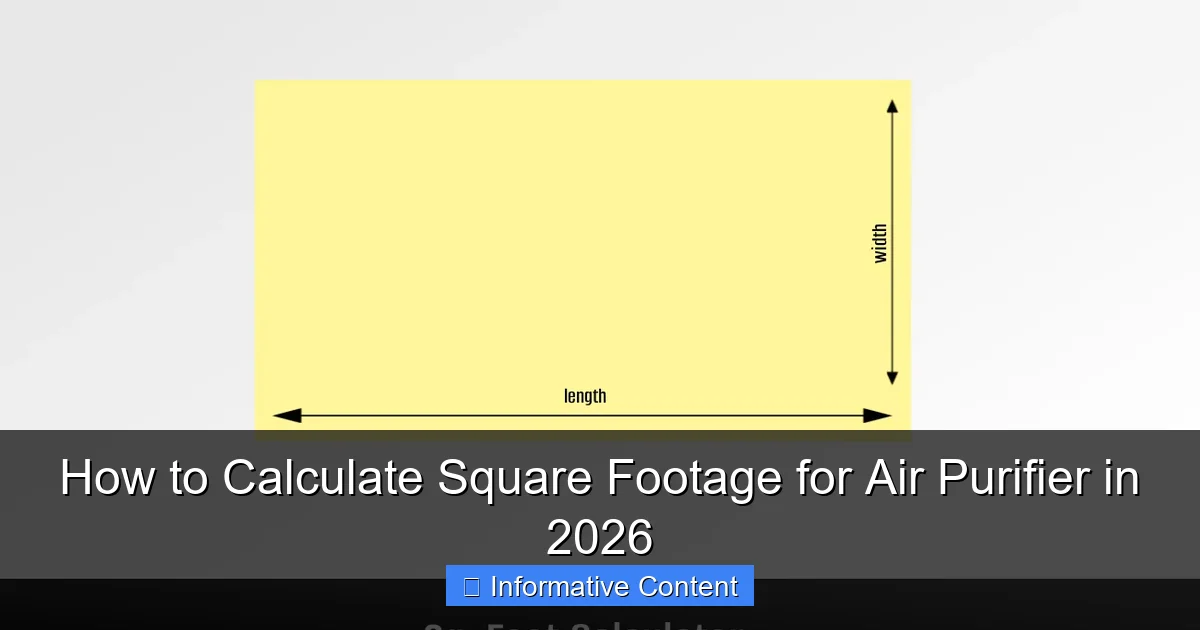
Square footage is just a fancy way of saying “the area of a space measured in feet.” For example, a room that’s 10 feet wide and 12 feet long has 120 square feet (10 × 12 = 120). It’s the same math you used in school, but now it’s actually useful!
Visual guide about how to calculate square footage for air purifier
Image source: cdn.homedit.com
When it comes to air purifiers, square footage tells you how much floor space a unit can effectively clean. But here’s the catch: it’s not just about floor space. You also need to consider ceiling height, because air volume matters more than floor area. A room with 8-foot ceilings holds more air than one with 7-foot ceilings, even if they have the same square footage.
How Air Purifiers Use Square Footage Ratings
Manufacturers test air purifiers in controlled environments and assign a recommended square footage based on how many times the device can exchange the air in a room per hour. This is called Air Changes per Hour (ACH). For most homes, 2–4 ACH is ideal for general air quality. For allergy sufferers or homes with pets, 4–5 ACH is better.
For example, if a purifier is rated for 300 sq. ft. with 4 ACH, it means it can clean all the air in a 300 sq. ft. room (with 8-foot ceilings) four times per hour. If your room is 400 sq. ft., that same purifier might only manage 2–3 ACH—less effective, especially if you have asthma or live in a high-pollution area.
The Real-World Impact of Mismatched Sizing
Let’s say you have a 250 sq. ft. living room. You buy a purifier rated for 200 sq. ft. because it was on sale. Sounds fine, right? But after a week, you’re still sneezing. Why? Because that purifier is working overtime, struggling to keep up. It might run at full speed constantly, making noise and using more electricity, while still failing to clean the air efficiently.
On the flip side, a purifier rated for 500 sq. ft. in a 200 sq. ft. room might be overkill. It could clean the air so fast that it cycles on and off frequently, wearing out the motor faster. Plus, you’re paying for features and power you don’t need.
So, the goal isn’t to get the biggest purifier—it’s to get the right-sized one. And that starts with calculating your room’s square footage correctly.
Step-by-Step: How to Calculate Square Footage for Air Purifier
Step 1: Measure the Room’s Length and Width
Grab a tape measure (or your phone’s measuring app if it has one). Measure the room from wall to wall in two directions: length and width. Write down the numbers in feet. If your room isn’t a perfect rectangle—say, it has a bay window or a closet—break it into smaller rectangles and measure each one separately.
Pro tip: If you’re measuring carpet or flooring, you might already have the square footage from the installation receipt. But double-check—sometimes those numbers are rounded up.
Step 2: Multiply Length × Width
Simple math time: multiply the length by the width. For example:
- Living room: 14 ft × 16 ft = 224 sq. ft.
- Bedroom: 10 ft × 12 ft = 120 sq. ft.
- Kitchen (L-shaped): 12 ft × 10 ft (main area) + 6 ft × 5 ft (nook) = 120 + 30 = 150 sq. ft.
For oddly shaped rooms, sketch a quick floor plan and label each section. It helps avoid mistakes.
Step 3: Adjust for Ceiling Height (Optional but Recommended)
Most air purifier ratings assume 8-foot ceilings. If your ceilings are higher (common in older homes or vaulted spaces), you’re dealing with more air volume.
Here’s how to adjust: Multiply your square footage by the ceiling height, then divide by 8.
Example: A 200 sq. ft. room with 10-foot ceilings:
200 × 10 = 2,000 cubic feet
2,000 ÷ 8 = 250 sq. ft. equivalent
So, even though the room is 200 sq. ft., you should treat it like a 250 sq. ft. space when choosing an air purifier.
Note: If your ceilings are 7 feet or lower, you might get away with a purifier rated for slightly less square footage—but don’t go below 80% of the adjusted number.
Step 4: Consider Room Use and Air Quality Needs
Not all rooms are created equal. A bedroom with a heavy sleeper might need cleaner air than a guest room. Here’s how to adjust based on use:
- Bedrooms (especially for allergy/asthma sufferers): Add 10–20% to your calculated square footage. You’re breathing this air for 6–8 hours a night.
- Living rooms (high traffic, pets, cooking): Add 10–15%. These rooms often have more dust, dander, and VOCs.
- Basements or garages (damp, musty, chemical smells): Add 20–25%. Mold spores and off-gassing materials need more air changes.
- Home offices (with electronics, printers): Add 10%. Printers release ultrafine particles and ozone.
Example: Your 150 sq. ft. bedroom has a cat. You calculate 150 sq. ft., then add 20%: 150 × 1.20 = 180 sq. ft. Look for a purifier rated for at least 180 sq. ft.
Step 5: Check the Air Purifier’s ACH Rating
Now, look at the product specs. You’ll see something like “Recommended for rooms up to 300 sq. ft. (4 ACH).” The “4 ACH” is crucial. It means the purifier can clean the air in a 300 sq. ft. room four times per hour.
If your adjusted square footage is 200 sq. ft., a purifier rated for 300 sq. ft. at 4 ACH will give you more than 4 ACH—great for allergy relief. But if your room is 400 sq. ft., that same purifier might only manage 2–3 ACH—less effective.
Rule of thumb: Match your adjusted square footage to the purifier’s rated coverage at 4 ACH. If you can’t find the ACH info, look for “CADR” (Clean Air Delivery Rate) and compare it to room size (more on that below).
Understanding CADR and ACH: The Science Behind the Numbers
What Is CADR and Why It Matters
CADR stands for Clean Air Delivery Rate. It’s a number (in cubic feet per minute, or CFM) that tells you how much clean air an air purifier delivers. The higher the CADR, the faster it removes pollutants.
CADR is tested for three types of particles:
- Dust (small particles): CADR 100–200 = low, 200–300 = good, 300+ = excellent
- Pollen (medium particles): CADR 100–180 = low, 180–250 = good, 250+ = excellent
- Smoke (tiny particles): CADR 50–150 = low, 150–220 = good, 220+ = excellent
To convert CADR to effective square footage, use this formula:
Effective Square Footage = (CADR × 60) ÷ (ACH × 8)
Example: A purifier with a CADR of 200 for dust, running at 4 ACH:
(200 × 60) ÷ (4 × 8) = 12,000 ÷ 32 = 375 sq. ft.
This means it can effectively clean a 375 sq. ft. room with 8-foot ceilings four times per hour. If your room is 400 sq. ft., you’re slightly under-covered.
ACH: How Many Air Changes Do You Need?
Air Changes per Hour (ACH) is the number of times the purifier replaces the room’s air. Here’s a quick guide:
- 2 ACH: Basic cleaning (dust, odors). Good for guest rooms or low-traffic areas.
- 3–4 ACH: Standard for most homes. Balances performance and energy use.
- 4–5 ACH: Ideal for allergy/asthma sufferers, homes with pets, or high-pollution areas.
- 5+ ACH: Medical-grade (e.g., for immunocompromised individuals). Requires powerful (and often expensive) purifiers.
Real-world example: Sarah has a 200 sq. ft. bedroom with two cats. She wants to reduce pet dander. She buys a purifier with CADR 250 for dust (which includes dander) and runs it at 4 ACH. Using the formula: (250 × 60) ÷ (4 × 8) = 468 sq. ft. effective coverage. That’s more than enough for her room—and gives her a buffer for high-pet-activity days.
CADR vs. Manufacturer’s Square Footage Claims
Some brands list square footage without mentioning CADR or ACH. This is a red flag. A purifier might say “for rooms up to 500 sq. ft.” but only deliver 2 ACH—meaning it’s not cleaning the air as thoroughly as a 300 sq. ft. purifier at 4 ACH.
Always check for CADR numbers, ideally certified by the AHAM (Association of Home Appliance Manufacturers). AHAM-verified CADR is tested in standardized labs, so it’s more reliable than unverified claims.
Practical Examples: Matching Air Purifiers to Real Homes
Example 1: Small Apartment (600 sq. ft. Total)
Maria lives in a 600 sq. ft. studio apartment. She wants one air purifier for the whole space. Here’s her plan:
- Living area: 12 ft × 15 ft = 180 sq. ft.
- Bed area: 10 ft × 12 ft = 120 sq. ft. (overlaps with living area)
- Kitchen: 8 ft × 6 ft = 48 sq. ft.
- Total unique space: ~400 sq. ft. (after removing overlaps)
Adjustments: She has a dog and cooks often. Add 15% for pets and cooking: 400 × 1.15 = 460 sq. ft.
She buys a purifier rated for 500 sq. ft. at 4 ACH (AHAM-verified CADR 280 for dust). It runs at medium speed, keeping noise low and energy use reasonable. Result: cleaner air, fewer dog hair tumbleweeds, and less cooking smoke.
Example 2: Two-Story Home with Allergies
David and his wife have a 2,000 sq. ft. home. Their 12-year-old has severe pollen allergies. They decide to use multiple purifiers.
- Upstairs (bedrooms): 800 sq. ft. total. Adjust for allergies: 800 × 1.20 = 960 sq. ft. They use two purifiers, each rated for 500 sq. ft. at 4 ACH (CADR 300). This gives 4–5 ACH in each bedroom.
- Downstairs (living room, kitchen): 1,000 sq. ft. Adjust for pets and cooking: 1,000 × 1.20 = 1,200 sq. ft. They use one purifier rated for 600 sq. ft. at 4 ACH (CADR 350) and a second for 500 sq. ft. at 4 ACH. Together, they cover 1,100 sq. ft.—close enough with slight overlap.
Result: The child’s allergy symptoms drop significantly. David notices fewer dust bunnies and fresher air in the kitchen.
Example 3: Basement Workshop with Chemical Odors
Carlos uses his 400 sq. ft. basement for woodworking. Sawdust and varnish fumes are a problem. He calculates:
- 400 sq. ft. × 25% (for chemicals/mold risk) = 500 sq. ft.
- Ceiling height: 7.5 ft → 400 × 7.5 ÷ 8 = 375 sq. ft. equivalent
- Combined: ~450 sq. ft. effective coverage needed
He buys a purifier with activated carbon + HEPA filter, rated for 500 sq. ft. at 4 ACH (CADR 250 for dust, 180 for smoke). It runs 24/7 on low speed. Result: Sawdust is trapped, and varnish smells fade within hours.
Common Mistakes and How to Avoid Them
Ignoring Ceiling Height
We’ve all been there: “It’s a 10×10 room, so 100 sq. ft. is fine.” But if your ceiling is 9 feet, you’re dealing with 112.5 sq. ft. of air volume. Always adjust for ceiling height, especially in older homes.
Overlooking Room Use
A 200 sq. ft. bedroom isn’t the same as a 200 sq. ft. storage room. If you’re spending 8 hours a night there, or have pets, cooking, or hobbies, factor that in. A purifier that’s “just big enough” for the floor space might not be enough for your lifestyle.
Trusting Unverified Claims
“Cleans 1,000 sq. ft. in 1 hour!” Sounds impressive, but what’s the ACH? If it’s only 1–2 ACH, it’s not doing much. Look for AHAM-certified CADR or detailed ACH specs. If the brand doesn’t provide them, be skeptical.
Forgetting About Open Floor Plans
If your living room opens to the kitchen or dining area, you can’t treat them as separate rooms. Measure the total connected space. For example, a 200 sq. ft. living room + 150 sq. ft. kitchen = 350 sq. ft. total. Adjust accordingly.
Buying One Purifier for the Whole House
Air doesn’t magically circulate evenly. A purifier in the living room won’t clean the master bedroom effectively. Use multiple units in large or multi-level homes. It’s more effective and often cheaper than one oversized purifier.
Data Table: Air Purifier Sizing Guide (2026)
| Room Type | Base Square Footage | Adjustment Factor | Effective Coverage Needed | Recommended ACH | Notes |
|---|---|---|---|---|---|
| Bedroom (no pets) | 150 sq. ft. | +10% | 165 sq. ft. | 4 | Ideal for general air quality |
| Bedroom (with pet) | 150 sq. ft. | +20% | 180 sq. ft. | 4–5 | Use HEPA + carbon for dander/odors |
| Living Room (high traffic) | 250 sq. ft. | +15% | 288 sq. ft. | 4 | Place near seating area |
| Kitchen (gas stove) | 120 sq. ft. | +20% | 144 sq. ft. | 4–5 | Carbon filter helps with odors |
| Basement (damp) | 300 sq. ft. | +25% | 375 sq. ft. | 4 | Use purifier with mold/mildew resistance |
| Home Office (printer) | 100 sq. ft. | +10% | 110 sq. ft. | 4 | Look for low ozone emission |
Note: Always verify ACH and CADR ratings before buying. Ceiling height adjustments apply to all rooms.
Final Thoughts: Breathe Easy with the Right-Sized Air Purifier
Calculating square footage for air purifier isn’t just about math—it’s about health, comfort, and peace of mind. Whether you’re fighting allergies, dealing with pet hair, or just want fresher air, getting the size right makes all the difference.
Remember: measure carefully, adjust for ceiling height and room use, and always check for CADR and ACH ratings. Don’t fall for flashy marketing claims. A purifier that’s “rated for 1,000 sq. ft.” might not be the best choice if it only delivers 2 ACH.
In 2026, air quality is more important than ever. With wildfires, urban pollution, and indoor allergens on the rise, your air purifier is a silent guardian. But it can only protect you if it’s the right size for the job.
So grab that tape measure, sketch a quick floor plan, and do the math. Your lungs will thank you. And who knows? You might finally get that deep, restful sleep—or stop sneezing every time you pet the cat.
Clean air starts with one simple calculation. Make it count.
Frequently Asked Questions
How do I calculate square footage for an air purifier in 2026?
To calculate square footage for an air purifier, measure the room’s length and width (in feet), then multiply them. For oddly shaped rooms, break the space into rectangles and add their areas together. Always round up to ensure full coverage.
Why is square footage important when choosing an air purifier?
Matching your air purifier’s coverage area to your room’s square footage ensures optimal performance. An undersized unit will struggle to clean the air, while an oversized one may waste energy and money.
Can I use the same air purifier for multiple rooms?
It depends on the total square footage and whether the rooms are connected with open doorways. For best results, calculate the combined area and choose a purifier rated for that size or use separate units.
How does ceiling height affect square footage for air purifier sizing?
Standard square footage calculations assume 8-foot ceilings. For taller ceilings, multiply the floor area by (ceiling height ÷ 8) to adjust for air volume. This ensures the purifier handles the extra space effectively.
What’s the best way to measure large or irregular rooms for an air purifier?
Divide the room into smaller rectangular sections, calculate each area, and sum them. For round spaces, use the formula πr² (radius squared). Always add 10% extra coverage as a safety margin.
Do air purifier manufacturers’ square footage ratings account for real-world use?
Manufacturer ratings often assume ideal conditions (low ceilings, no air leaks). In 2026, look for units with AHAM Verified CADR ratings, which test performance in real-world scenarios, ensuring accurate square footage recommendations.