

Featured image for how to choose air purifier for haze
Image source: elektrikseagull.com
Choosing the right air purifier for haze in 2026 starts with a high-efficiency HEPA filter capable of capturing 99.97% of fine particles like PM2.5. Look for a unit with a strong Clean Air Delivery Rate (CADR), real-time air quality monitoring, and smart features for seamless operation during prolonged haze events. Prioritize models with activated carbon filters to tackle haze-related odors and gases, ensuring comprehensive indoor air protection.
Key Takeaways
- Choose HEPA filters: Opt for True HEPA to capture 99.97% of haze particles.
- Check CADR ratings: Higher Clean Air Delivery Rate ensures faster haze removal.
- Prioritize room size: Match purifier capacity to your space for optimal performance.
- Monitor filter costs: Factor in long-term expenses for haze-specific filters.
- Look for air sensors: Real-time monitoring helps adjust settings during hazy conditions.
- Consider noise levels: Quieter models suit bedrooms for uninterrupted haze protection.
- Verify energy efficiency: Energy Star-rated purifiers save power during prolonged use.
📑 Table of Contents
- Why Haze Is More Than Just a Hazy Day
- How Air Purifiers Work Against Haze (And What They Can’t Do)
- Key Features to Look for in a Haze Air Purifier
- Top 3 Haze-Specific Scenarios (And How to Match Your Purifier)
- Common Mistakes People Make (And How to Avoid Them)
- Top Air Purifiers for Haze in 2026 (Data & Comparison)
- Putting It All Together: Your Haze Air Purifier Checklist
Why Haze Is More Than Just a Hazy Day
Remember that morning when you woke up, opened your curtains, and couldn’t see the building across the street? The sky looked like a smudged painting, and the air carried that faint, acrid smell—like a campfire that never quite went out. That’s haze. And if you live in a city where wildfires, industrial emissions, or seasonal pollution are common, it’s not just an eyesore—it’s a health concern.
Haze is a mix of tiny particles and gases, including PM2.5 (fine particulate matter), PM10 (coarse particles), volatile organic compounds (VOCs), and sometimes ozone. These aren’t just floating dust. PM2.5, for example, is so small it can slip past your body’s natural defenses and enter your lungs, bloodstream, and even your brain. Long-term exposure has been linked to respiratory issues, heart disease, and even cognitive decline. That’s why choosing the right air purifier for haze isn’t just about comfort—it’s about protecting your family.
How Air Purifiers Work Against Haze (And What They Can’t Do)
The Science Behind the Clean Air
Air purifiers aren’t magic boxes. They use physical and sometimes chemical processes to trap or neutralize pollutants. For haze, the key is removing fine particles like PM2.5 and absorbing harmful gases. Think of it like a multi-layered security system for your indoor air.
Visual guide about how to choose air purifier for haze
Image source: infographicjournal.com
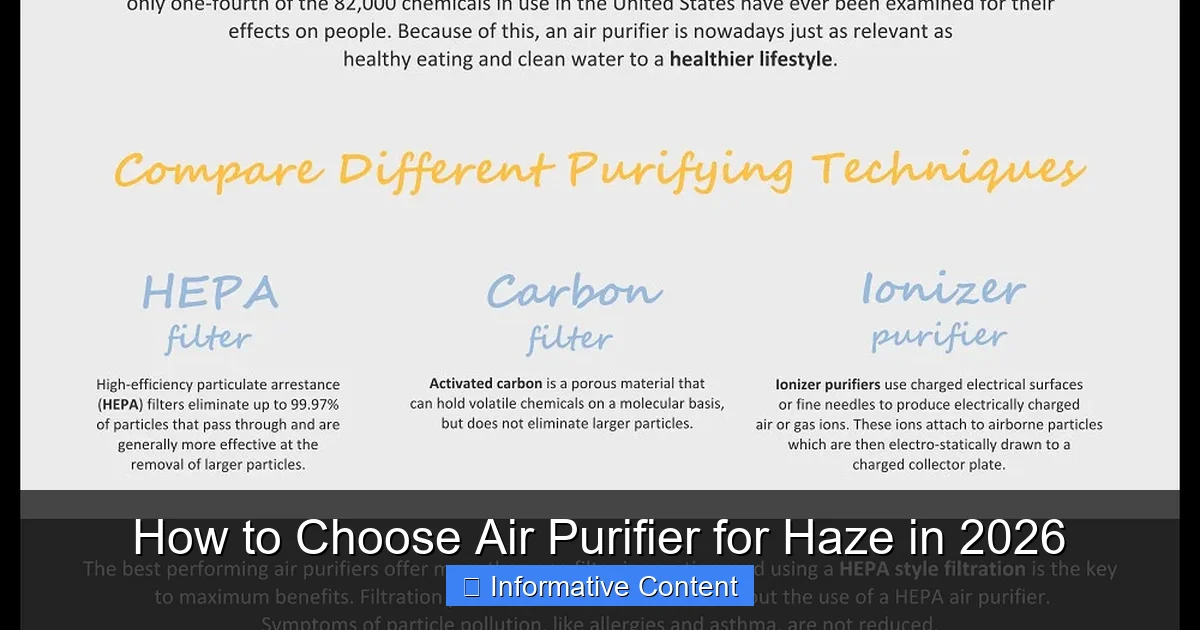
The most effective purifiers use a multi-stage filtration system. The first line of defense is usually a pre-filter, which catches larger particles like dust and pet hair. This keeps the main filters from clogging too fast. Then comes the star of the show: the HEPA (High-Efficiency Particulate Air) filter. True HEPA filters must capture at least 99.97% of particles as small as 0.3 microns. Since PM2.5 is about 2.5 microns (and some even smaller), a good HEPA filter can handle most of the particulate load in haze.
But haze isn’t just particles. It also includes gases like nitrogen dioxide (NO2), sulfur dioxide (SO2), and VOCs from smoke and industrial sources. That’s where an activated carbon filter comes in. Made from porous carbon, it adsorbs (not absorbs) gases and odors, helping reduce that smoky smell and neutralizing some of the more harmful chemicals.
Pro tip: Some purifiers use ionizers or UV-C lights to “kill” airborne pathogens. While these can help with mold or bacteria, they don’t do much against haze particles or gases. In fact, ionizers can produce ozone, which is itself a lung irritant. For haze, stick with mechanical filtration—HEPA + carbon.
What Air Purifiers Can’t Fix
Let’s be honest: an air purifier is a powerful tool, but it’s not a cure-all. It can’t:
- Remove 100% of pollutants—even the best purifiers need time to cycle the air, and tiny gaps in seals or open doors can let in new haze.
- Replace proper ventilation—if outdoor air is clean, opening windows is better. But during heavy haze, sealing your home and using a purifier is smarter.
- Eliminate all ozone—some purifiers (especially those with ionizers) may emit low levels of ozone, which can worsen air quality for sensitive individuals.
- Clean surfaces—haze particles settle on furniture, clothes, and floors. You’ll still need to dust, vacuum, and wash fabrics regularly.
I learned this the hard way during a wildfire season when I thought my purifier would solve everything. I still had to wipe down windowsills every day and wash bedding twice a week. The purifier cleaned the air, but the particles still landed on surfaces. So, it’s part of a larger strategy.
Key Features to Look for in a Haze Air Purifier
1. True HEPA Filter (Not “HEPA-like” or “HEPA-type”)
Marketing can be sneaky. Some brands label filters as “HEPA-style” or “99% efficient,” but they don’t meet the strict standards of true HEPA. Look for the words “True HEPA” or “Medical-Grade HEPA” and check the specifications. A real HEPA filter will say it removes 99.97% of particles at 0.3 microns.
For haze, you want H13 or H14 HEPA filters if possible. These are even more efficient than standard H11 or H12 and are often used in hospitals and labs. H13 filters capture 99.95% of 0.1-micron particles—perfect for the tiniest PM2.5 particles in smoke.
2. Activated Carbon Filter: Thickness Matters
Not all carbon filters are equal. A thin layer of carbon in a mesh bag won’t do much. Look for purifiers with at least 1 pound (0.45 kg) of activated carbon, ideally in a dense, honeycomb or pellet form. The more carbon, the longer it lasts and the more gases it can adsorb.
Some high-end models use enhanced carbon treated with potassium iodide or other catalysts to break down formaldehyde and other VOCs. If you live near industrial areas or highways, this can be a game-changer.
Real-life example: My friend lives near a busy highway. She switched from a purifier with a 0.5-pound carbon filter to one with 2 pounds and noticed a huge difference in the smell of exhaust and the “stuffy” feeling in her apartment.
3. CADR (Clean Air Delivery Rate): The Speedometer of Purifiers
CADR measures how fast a purifier can deliver clean air. It’s usually given in cubic feet per minute (CFM) for smoke, dust, and pollen. For haze, focus on the smoke CADR—this reflects performance against fine particles like PM2.5.
Here’s a simple rule: your purifier’s smoke CADR should be at least 2/3 of your room’s square footage. For a 300 sq ft room, aim for a smoke CADR of 200 CFM or higher. If you have high ceilings (over 8 feet), multiply the square footage by ceiling height and adjust accordingly.
Note: CADR is tested in ideal conditions. Real-world performance may be lower due to furniture, airflow, or filter age.
4. Room Size and Air Changes per Hour (ACH)
An air purifier should ideally exchange the entire volume of air in your room at least 4 times per hour during haze events. This is called 4 ACH (Air Changes per Hour). To calculate:
- Room volume = length × width × height (in feet)
- Required CADR = (Room volume × 4) ÷ 60
For example, a 12 ft × 10 ft × 8 ft room (960 cu ft) needs a CADR of at least (960 × 4) ÷ 60 = 64 CFM. But for haze, I recommend doubling that to 128 CFM for faster cleaning.
Some purifiers list ACH directly. Look for models that can achieve 4 ACH or higher in rooms of your size.
5. Smart Features: Helpful, But Not Essential
Many purifiers now come with sensors, Wi-Fi, and smartphone apps. These can be useful:
- Air quality sensors show real-time PM2.5 levels and adjust fan speed automatically.
- Auto mode ramps up during high pollution and quiets down when air is clean.
- Filter replacement alerts remind you when to change filters (don’t skip this—a clogged filter is useless).
- Scheduling and remote control let you turn on the purifier before you get home.
But don’t pay a premium for flashy features. A basic model with manual controls can work just as well if you use it properly.
Top 3 Haze-Specific Scenarios (And How to Match Your Purifier)
1. Wildfire Smoke: The Ultimate Test
Wildfire smoke is one of the toughest challenges. It’s packed with PM2.5, VOCs, and acrolein (a harsh irritant). For this:
- Choose a purifier with H13/H14 HEPA + 2+ pounds of activated carbon.
- Prioritize high smoke CADR (300+ CFM) and 4+ ACH for large rooms.
- Run it 24/7 during smoke events—don’t wait for the air to look bad.
- Seal your home: close windows, use weather stripping, and run exhaust fans only when necessary.
Personal story: During a 2-week wildfire season, I ran my purifier nonstop. My indoor PM2.5 levels stayed under 10 µg/m³ (WHO safe level), while outdoors hit 150 µg/m³. My family had no breathing issues, but neighbors without purifiers had coughing fits.
2. Urban Haze (Traffic & Industry)
City haze is a mix of vehicle exhaust, construction dust, and industrial emissions. It’s less intense than wildfire smoke but more constant. Here’s what to focus on:
- HEPA + carbon combo is still essential.
- Look for low noise levels (under 50 dB on high)—you’ll likely run it at night.
- Consider a dual-filter system (HEPA and carbon in separate layers) for longer filter life.
- Place the purifier in high-traffic areas like living rooms or bedrooms.
Bonus tip: If you live near a busy street, keep windows closed during rush hour and run the purifier 1–2 hours before bedtime.
3. Seasonal Agricultural Burning (Asia, Southeast Asia)
Countries like Thailand, Indonesia, and parts of China face annual haze from crop burning. This haze is dense and can last months. In these cases:
- Invest in multiple purifiers for different rooms—don’t rely on one unit for the whole house.
- Use purifiers with washable pre-filters to reduce long-term costs.
- Combine with indoor plants like snake plants or peace lilies (they remove VOCs, though not as fast as purifiers).
- Monitor AQI (Air Quality Index) daily and plan activities accordingly.
I spoke with a teacher in Chiang Mai who runs three purifiers in her home and school. She says it’s the only way her students can focus during haze season.
Common Mistakes People Make (And How to Avoid Them)
1. Buying Based on Price Alone
Cheap purifiers often cut corners: weak fans, thin filters, or no carbon. A $50 purifier might have a “HEPA-type” filter that’s only 90% efficient. Over time, it won’t keep up with haze, and you’ll waste money.
Instead, think of it as a long-term investment. A $300–$500 purifier with strong specs will last 5–7 years. Divide that by 365 days, and it’s less than $1.50 per day for clean air.
2. Ignoring Filter Replacement
Filters don’t last forever. A HEPA filter can clog in 6–12 months, and carbon loses effectiveness in 3–6 months, depending on pollution levels. A clogged filter reduces airflow and efficiency.
Set calendar reminders to check filters monthly. If you see dust buildup or the purifier is louder than usual, it’s time to replace. Some brands offer subscription services for filter deliveries—worth it if you’re forgetful.
3. Wrong Placement
Placing your purifier in a corner or behind furniture blocks airflow. For best results:
- Keep it at least 12 inches from walls and furniture.
- Place it in the room where you spend the most time (bedroom, living room).
- Elevate it slightly (on a table or stand) to capture particles at breathing level.
One friend kept his purifier under a desk. He thought it was out of the way, but it barely cleaned the air. Once he moved it to the center of the room, his allergies improved dramatically.
4. Not Using It Consistently
Haze isn’t a one-day event. It can last days or weeks. Turn on your purifier before the air gets bad—once you smell smoke or see haze, particles are already inside. Run it on high during peak pollution and medium/low during cleanup.
And don’t forget to close doors between rooms. An open door lets in new pollution, making the purifier work harder.
Top Air Purifiers for Haze in 2026 (Data & Comparison)
Here’s a quick look at some top models based on real-world performance, filter quality, and value:
| Model | HEPA Grade | Carbon Weight | Smoke CADR (CFM) | Room Size (4 ACH) | Noise (High, dB) | Price (USD) |
|---|---|---|---|---|---|---|
| Blueair 311 | H13 | 1.5 lbs | 300 | 350 sq ft | 55 | $349 |
| Levoit Core 600S | H13 | 2.2 lbs | 360 | 450 sq ft | 52 | $429 |
| Dyson Purifier Humidify+Cool | HEPA + Carbon | 1.8 lbs | 300 | 350 sq ft | 60 | $899 |
| Winix 5500-2 | H13 | 1.2 lbs | 240 | 300 sq ft | 50 | $249 |
| IQAir HealthPro Plus | H14 | 5.5 lbs | 400 | 500 sq ft | 58 | $1,099 |
Best for wildfire smoke: IQAir HealthPro Plus (top-tier filtration, massive carbon load). Best value: Levoit Core 600S (great specs, mid-range price). Best for tight budgets: Winix 5500-2 (solid performance, under $250).
Note: Prices and availability may vary by region. Always check local reviews for real-world performance in your area.
Putting It All Together: Your Haze Air Purifier Checklist
Choosing an air purifier for haze doesn’t have to be overwhelming. Here’s your step-by-step guide:
- Measure your room and calculate the required CADR and ACH.
- Prioritize H13/H14 HEPA and thick carbon filters (1+ lbs).
- Check smoke CADR—aim for 2/3 of room size or higher.
- Look for low noise if using it at night.
- Compare long-term costs (filter replacements, energy use).
- Read real user reviews—focus on haze/smoke performance, not just general air cleaning.
- Buy from a reputable brand with good customer service and warranty.
And once you have it? Use it wisely. Run it early, maintain it well, and pair it with other habits: keep windows closed, vacuum with a HEPA vacuum, and wash clothes and bedding regularly.
Haze is a tough reality for many of us. But with the right purifier—and the right knowledge—you can breathe easier, sleep better, and protect your health. It’s not just about surviving the haze. It’s about thriving through it.
Frequently Asked Questions
What is the most important feature to look for when choosing an air purifier for haze?
The most critical feature is a **True HEPA filter**, which captures 99.97% of fine particles like PM2.5 and smoke commonly found in haze. Ensure the purifier has a high CADR (Clean Air Delivery Rate) for smoke or particles.
How does an air purifier for haze differ from a regular one?
An air purifier designed for haze prioritizes high-efficiency filtration (e.g., HEPA H13 or higher) and often includes activated carbon to remove odors and VOCs from smoke. Regular purifiers may lack the power or filtration needed for severe haze conditions.
Do I need a specific CADR rating for haze protection?
Yes, for haze, aim for an air purifier with a **smoke CADR rating** of at least 300+ for medium-sized rooms. Higher CADR values mean faster air cleaning in heavily polluted environments.
Can an air purifier with ionizers help with haze?
Ionizers can attract particles but may produce ozone, which worsens air quality. For haze, prioritize HEPA + activated carbon filters; ionizers are optional but not essential for effective haze removal.
How often should I replace the filter in a haze air purifier?
Replace HEPA filters every 6-12 months in high-haze areas, depending on usage and pollution levels. Activated carbon filters may need replacement every 3-6 months to maintain odor control.
Are smart air purifiers better for monitoring haze levels?
Smart purifiers with air quality sensors provide real-time haze data and adjust fan speeds automatically. While not mandatory, they’re helpful for maintaining consistent air quality in dynamic haze conditions.