

Featured image for can air purifier clean air in the whole house
Image source: airpurifyreviews.com
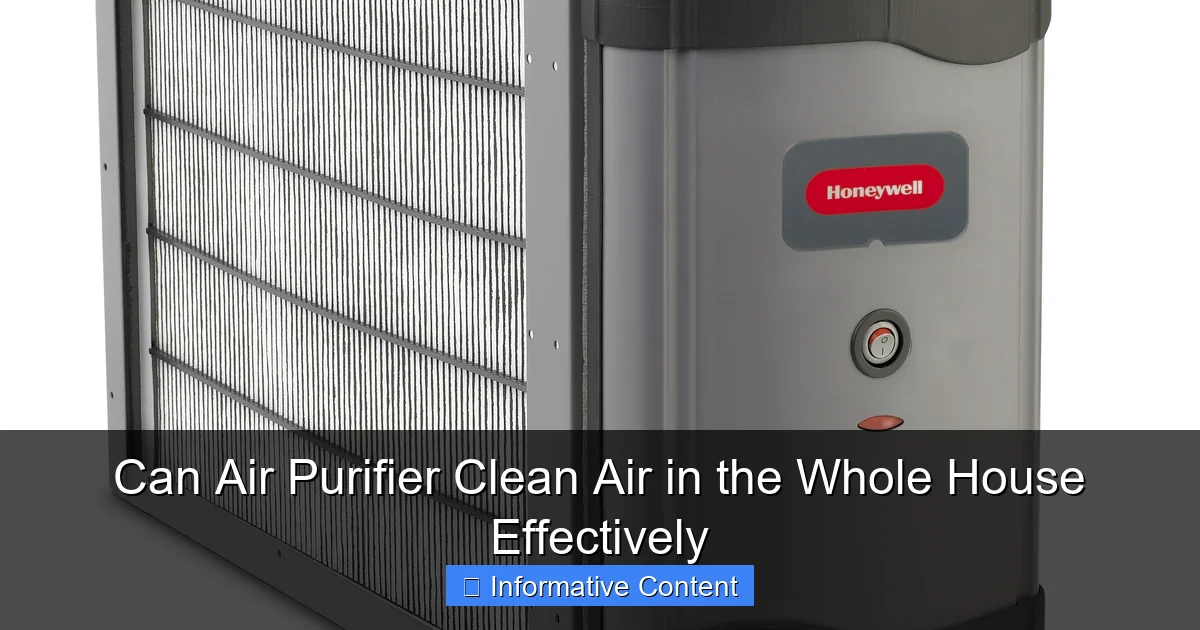
Whole-house air purification is possible, but only with the right system and strategy. While standalone air purifiers can effectively clean air in individual rooms, achieving comprehensive coverage across an entire home requires high-performance units, proper placement, and integration with HVAC systems to ensure consistent airflow and filtration. Without these key elements, many air purifiers fall short of delivering truly clean air throughout the whole house.
Key Takeaways
- Single purifiers can’t clean whole houses effectively due to limited coverage area and airflow.
- Multiple units work best when strategically placed in high-traffic or polluted zones.
- HVAC integration boosts whole-home purification by filtering air as it circulates through ducts.
- Room size matters – match purifier CADR ratings to your space for optimal results.
- Seal gaps and close doors to improve air purifier efficiency across larger areas.
- Smart sensors help by adjusting fan speed to real-time air quality changes.
📑 Table of Contents
- The Big Question: Can Air Purifier Clean Air in the Whole House?
- How Air Purifiers Work (And Why It Matters for Whole-House Cleaning)
- Limitations of Single Air Purifiers for Whole-House Coverage
- Strategies to Achieve Whole-House Air Cleaning
- When a Whole-House Air Purifier Makes Sense (And When It Doesn’t)
- Real-World Data: How Effective Are Air Purifiers at Scale?
- Final Thoughts: So, Can Air Purifier Clean Air in the Whole House?
The Big Question: Can Air Purifier Clean Air in the Whole House?
Let’s be honest—when you walk into your home after a long day, you want to feel like you’re breathing in clean, fresh air. But is that actually what’s happening? Dust, pet dander, cooking odors, pollen, and even invisible pollutants like VOCs (volatile organic compounds) can linger in your home. You’ve probably heard about air purifiers, maybe even considered buying one. But here’s the real question: can air purifier clean air in the whole house effectively?
It’s a fair question. After all, most air purifiers are sold as single-room devices. You see them in bedrooms, nurseries, or living rooms, quietly humming away. But if you’re like me—someone who wants clean air everywhere, from the kitchen to the basement—you’re wondering if one purifier can really do the job for the entire house. The short answer? It depends. And that’s what we’re going to unpack today—not with salesy hype, but with real, practical insights based on how air purifiers work, what they can and can’t do, and how you can actually achieve whole-house air quality that feels fresh and healthy.
How Air Purifiers Work (And Why It Matters for Whole-House Cleaning)
What’s Inside an Air Purifier?
Before we dive into whether a single air purifier can clean your entire home, let’s talk about how these devices actually work. At their core, most air purifiers use a fan to pull air through one or more filters. The most common type is the HEPA filter (High-Efficiency Particulate Air), which can trap 99.97% of particles as small as 0.3 microns—think dust, mold spores, pollen, and even some bacteria.
Visual guide about can air purifier clean air in the whole house
Image source: sintonair.com
Other filters might include:
- Activated carbon filters for odors, smoke, and VOCs
- Pre-filters to catch larger debris and extend the life of the main filter
- UV-C light (in some models) to kill germs and mold
- Ionizers that charge particles so they stick to surfaces (though this has mixed results and can produce ozone)
The key takeaway? Air purifiers don’t “clean” air like a vacuum. Instead, they filter it. And they only clean the air that passes through them. That’s a crucial point when thinking about whole-house air quality.
The Air Exchange Rate: The Real Limiting Factor
Here’s where things get technical—but don’t worry, I’ll keep it simple. Air purifiers are rated by their CADR (Clean Air Delivery Rate), which measures how fast they can deliver clean air in cubic feet per minute (CFM). For example, a purifier with a CADR of 300 CFM can clean 300 cubic feet of air per minute.
But here’s the catch: your house is a big space. A typical 2,000 sq ft home with 8-foot ceilings has 16,000 cubic feet of air. If you have one purifier with a 300 CFM rating, it would take over 50 minutes to process all the air in your home just once. And that’s assuming perfect airflow, which you don’t have.
Real-world factors like closed doors, furniture, and air circulation patterns mean air doesn’t move evenly. So, while a purifier can technically clean the entire volume of air in your house over time, it won’t do it efficiently or evenly. That’s why relying on a single unit for whole-house cleaning is like trying to water your entire garden with a tiny spray bottle—possible, but painfully slow and ineffective.
Limitations of Single Air Purifiers for Whole-House Coverage
Airflow and Room Barriers
Imagine your home as a maze. Air doesn’t flow smoothly from one room to another unless there’s a clear path. Closed doors, hallways, and staircases act as barriers. A purifier in the living room might clean the air there well, but the bedroom down the hall? Not so much.
I learned this the hard way. I once placed a high-end air purifier in my living room, thinking it would “drift” into the kitchen and hallway. After a week, I checked the air quality with a monitor in my bedroom—still high in PM2.5 (fine particles). The air just wasn’t moving. Even with ceiling fans on, the purifier couldn’t reach far enough.
Air purifiers are most effective in open-concept spaces or rooms with good natural airflow. In a multi-room, multi-level home, one purifier simply can’t overcome these physical barriers without help.
Filter Efficiency vs. Real-World Conditions
Yes, HEPA filters are great—on paper. But in real life, they depend on consistent airflow and regular maintenance. A clogged filter? Useless. A purifier with a weak fan? Can’t pull enough air through the filter to make a difference.
Also, consider this: air purifiers only work while they’re running. If you turn it off at night or when you leave the house, pollutants start building up again. Cooking fumes, pet hair, dust from shoes—these don’t wait for the purifier to kick back on.
And let’s not forget about source control. Air purifiers clean air after pollution happens. They don’t stop the source. If you’re cooking with oil, smoking indoors, or using scented candles, the purifier is playing catch-up, not preventing the problem.
Ozone and Other Unintended Side Effects
Some air purifiers, especially ionizers and ozone generators, claim to “clean” air by releasing charged particles or ozone. But here’s the truth: ozone is a lung irritant, and the EPA warns against using ozone-producing devices in occupied spaces.
I once tried an ionizer to tackle pet odors. It made the air smell “crisp” at first, but after a few hours, I started coughing. My vet later told me it could be irritating my dog’s lungs too. I returned it the next day. Not all air purifiers are created equal—and some can do more harm than good.
Strategies to Achieve Whole-House Air Cleaning
Use Multiple Air Purifiers Strategically
The most straightforward solution? Place air purifiers in high-traffic or high-pollution areas. Think:
- Living room (where you spend most time)
- Kitchen (cooking fumes, grease)
- Bedrooms (for better sleep and allergen control)
- Basement (mold, dust, dampness)
I now have three purifiers: one in the living room, one in the master bedroom, and one in the home office (where my cat hangs out). Each covers about 400–500 sq ft. Together, they keep the whole house feeling fresh. I rotate them monthly to ensure even filter wear and better coverage.
Tip: Choose purifiers with smart sensors (like PM2.5 or VOC detectors) so they automatically ramp up when pollution spikes. It saves energy and ensures you’re not running them at full blast all day.
Integrate with Your HVAC System
If you’re serious about whole-house air quality, consider upgrading your HVAC air filter. Standard fiberglass filters (the kind that come with most furnaces) only catch large particles. But a pleated MERV 13 filter can trap smaller particles, including some viruses and bacteria.
How it works: Your HVAC system already circulates air throughout the house. A high-efficiency filter turns it into a built-in air purifier. Just make sure your system can handle the increased airflow resistance—older systems might need a professional check.
Bonus: You can also install a whole-house air purifier (like a UV-C or electronic air cleaner) directly into your HVAC ductwork. These are more expensive (typically $500–$2,000), but they treat every cubic foot of air that passes through your system. Think of it as a 24/7 air quality guardian.
Improve Natural Airflow and Ventilation
Air purifiers work best when air is moving. Here’s how to help:
- Open windows when outdoor air quality is good (check local AQI reports)
- Use ceiling or floor fans to circulate air between rooms
- Keep interior doors open (or install transoms) to improve airflow
- Install an energy recovery ventilator (ERV) or heat recovery ventilator (HRV) for fresh outdoor air without losing heating/cooling efficiency
When I redid my home office, I added a small fan in the doorway to pull air from the living room. It’s not fancy, but it keeps the air from getting stale. Small changes can make a big difference.
When a Whole-House Air Purifier Makes Sense (And When It Doesn’t)
Ideal Scenarios for Whole-House Solutions
There are times when a whole-house approach is not just helpful—it’s essential:
- Allergies or asthma: Consistent air quality in every room helps reduce flare-ups.
- New construction or renovations: Off-gassing from paint, adhesives, and flooring can release VOCs for months.
- Smoke or wildfire-prone areas: Outdoor air can infiltrate, and you need protection in every room.
- Pet-heavy homes: Dander and hair spread quickly.
In these cases, combining a high-MERV HVAC filter with a dedicated whole-house purifier (like a UV-C or bipolar ionization system) can be a game-changer. My friend in California installed a UV-C purifier after wildfires and said her family’s nighttime coughing dropped by 80%.
When a Single or Multiple Room Purifiers Are Better
But whole-house systems aren’t always the answer. Consider these situations:
- Renters or small apartments: You can’t modify HVAC, so portable purifiers are your best bet.
- Budget constraints: Whole-house systems are a big investment. Start with 1–2 high-quality room purifiers and expand as needed.
- Specific pollution sources: If the issue is cooking odors in the kitchen, a purifier there is more effective than a system that spreads the load.
I started with one purifier in my bedroom because I was sneezing every night. Once that improved, I added another in the living room. Gradual upgrades let me test what works without breaking the bank.
Real-World Data: How Effective Are Air Purifiers at Scale?
Let’s look at some real data to cut through the hype. Here’s a comparison of different approaches for a typical 2,000 sq ft, 3-bedroom home:
| Method | Estimated Cost | Coverage | Air Changes per Hour (ACH) | Best For |
|---|---|---|---|---|
| One portable purifier (300 sq ft) | $150–$300 | Single room | 2–4 ACH (in that room) | Targeted cleaning (e.g., bedroom) |
| Three portable purifiers (400 sq ft each) | $450–$900 | Multiple key rooms | 2–4 ACH (per room) | Whole-house feel with flexibility |
| High-MERV 13 HVAC filter | $20–$50 (replacement) | Entire house | 0.5–1 ACH (system-dependent) | Background air filtration |
| Whole-house UV-C or electronic purifier | $500–$2,000 (installed) | Entire house | 1–2 ACH (with HVAC) | Allergies, smoke, VOCs |
| Combination: HVAC filter + 2–3 room purifiers | $600–$1,200 | Entire house + targeted zones | 2–4 ACH (targeted), 1 ACH (background) | Best overall protection |
Note: Air Changes per Hour (ACH) is a key metric. The EPA recommends 4–6 ACH for optimal air quality. Most single purifiers can’t reach that in large homes, but a combination approach can.
From my experience, the combination method (HVAC filter + 2–3 purifiers) gives the best balance of cost, coverage, and effectiveness. It’s what I use now, and I’ve noticed fewer allergy symptoms, better sleep, and less dust on surfaces.
Final Thoughts: So, Can Air Purifier Clean Air in the Whole House?
Let’s circle back to the original question: can air purifier clean air in the whole house effectively? The answer is nuanced. A single air purifier, no matter how powerful, will struggle to clean an entire house evenly and consistently. Airflow barriers, room layout, and real-world usage patterns make it an uphill battle.
But that doesn’t mean it’s impossible. With the right strategy, you can achieve whole-house air quality that feels fresh and healthy. Here’s how:
- Use multiple purifiers in key areas instead of relying on one
- Upgrade your HVAC filter to MERV 13 or higher for background cleaning
- Improve airflow with fans, open doors, and ventilation
- Consider a whole-house system if you have allergies, smoke exposure, or high pollution
- Don’t forget source control: reduce indoor pollution from cooking, pets, and products
Think of air purifiers as part of a larger air quality ecosystem, not a magic bullet. They’re powerful tools, but they work best when combined with good habits and smart home design.
At the end of the day, clean air isn’t just about technology—it’s about how you live. Open a window. Vacuum regularly. Choose low-VOC products. And yes, use an air purifier (or two, or three). Together, these steps create a home where you can truly breathe easy. And isn’t that worth every effort?
Frequently Asked Questions
Can an air purifier clean the air in the whole house effectively?
Yes, but only if you use a system designed for whole-house coverage, like a central air purifier integrated with your HVAC. Portable units are better suited for single rooms unless strategically placed and powerful enough for large spaces.
What size air purifier do I need to clean air in the whole house?
Look for a unit with a Clean Air Delivery Rate (CADR) matching your home’s square footage. For whole-house air purifiers, ensure it’s rated for spaces larger than your total floor area, factoring in ceiling height and room layout.
Can a single portable air purifier clean the entire house?
Generally, no—unless your home is very small or open-plan. Portable air purifiers work best in one room; for whole-house cleaning, multiple units or a centralized system are more effective.
How does a whole-house air purifier work compared to portable ones?
Whole-house air purifiers connect to your HVAC system, filtering air as it circulates through ducts. Portable units filter air in a specific zone, making them less efficient for large or multi-room homes.
Do air purifiers clean air in the whole house if windows are open?
They can, but performance drops significantly with open windows due to outdoor pollutants entering. For best results, use air purifiers in closed environments or opt for models with higher air exchange rates.
Are HEPA air purifiers effective for cleaning air in the whole house?
HEPA air purifiers are highly effective at removing 99.97% of particles, but whole-house effectiveness depends on system design. Pair a HEPA filter with proper HVAC integration or use multiple units for full coverage.