

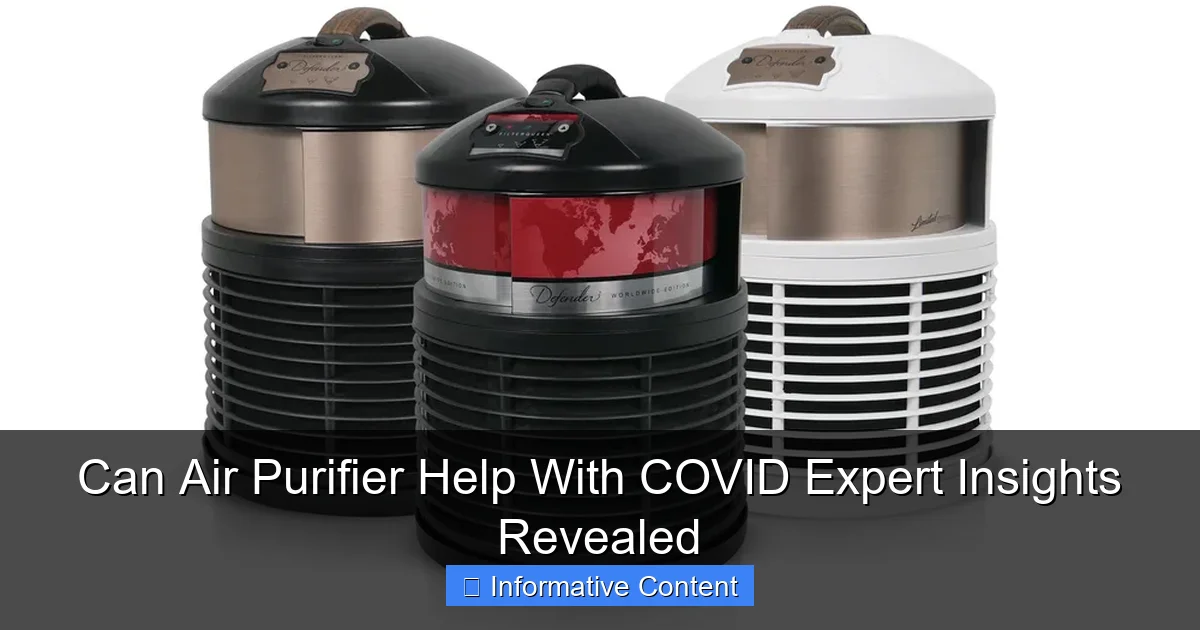
Featured image for can air purifier help with covid
Image source: filterqueencanada.com
Air purifiers with HEPA filters can significantly reduce airborne SARS-CoV-2 particles, helping lower the risk of COVID-19 transmission in indoor spaces. Experts confirm that while air purifiers are not a standalone solution, they are a valuable layer of protection—especially in poorly ventilated areas or high-risk environments. For best results, pair air purification with masking, ventilation, and vaccination to create a comprehensive defense against the virus.
Key Takeaways
- Air purifiers reduce airborne viruses when using HEPA filters to trap COVID-19 particles effectively.
- Proper ventilation is essential—combine air purifiers with open windows for maximum protection.
- Choose HEPA-certified purifiers to ensure 99.97% removal of particles as small as 0.3 microns.
- Place purifiers strategically in high-traffic or poorly ventilated areas to improve air quality.
- Maintain and replace filters regularly to sustain efficiency and prevent re-circulation of trapped contaminants.
📑 Table of Contents
- Can Air Purifier Help With COVID? Expert Insights Revealed
- How Viruses Spread Through the Air (And Why Air Purifiers Matter)
- Do Air Purifiers Actually Remove COVID-19 From the Air?
- How to Choose the Right Air Purifier for COVID Protection
- How to Maximize Your Air Purifier’s Effectiveness
- Air Purifiers vs. Other Air-Cleaning Technologies: What Works?
- Air Purifiers Shine (And When They Don’t)
- The Bottom Line: Air Purifiers Are a Piece of the Puzzle
Can Air Purifier Help With COVID? Expert Insights Revealed
When the pandemic hit, our homes suddenly became more than just places to relax—they turned into sanctuaries. We wiped down groceries, sanitized door handles, and wore masks like second skin. But one question kept popping up in conversations: *Can air purifier help with COVID?* I remember standing in my living room, staring at a sleek white machine I’d bought on a whim, wondering if it was just another gadget or a real defense against an invisible threat.
The short answer? Yes, air purifiers can play a role in reducing the risk of COVID-19 transmission—but they’re not a silver bullet. Think of them like a seatbelt: they improve safety, but they work best when combined with other precautions like masking, ventilation, and handwashing. In this post, I’ll share what experts say, how air purifiers work against viruses, and how to choose the right one for your needs. No hype, just honest insights.
How Viruses Spread Through the Air (And Why Air Purifiers Matter)
The Science of Airborne Transmission
COVID-19 spreads primarily through respiratory droplets and aerosols. When someone coughs, sneezes, talks, or even breathes, they release tiny particles. Larger droplets fall quickly, but smaller aerosols—often under 5 microns—can linger in the air for hours, especially in poorly ventilated spaces. Picture a room where someone with COVID has been talking for 30 minutes. Those virus-carrying aerosols are floating around, waiting to be inhaled.
Visual guide about can air purifier help with covid
Image source: cdn.shopify.com
This is where air purifiers come in. They act like a vacuum for the air, trapping or destroying airborne particles, including viruses. But not all purifiers are created equal. Let’s break down what matters.
Key Features That Matter for Virus Protection
- HEPA Filters (High-Efficiency Particulate Air): These are the gold standard. A true HEPA filter captures 99.97% of particles as small as 0.3 microns—smaller than the SARS-CoV-2 virus (0.1 microns). How? The virus often attaches to larger droplets or dust, making it easier to trap.
- CADR (Clean Air Delivery Rate): This measures how quickly a purifier can clean the air. For COVID, aim for a CADR of 300+ for a standard room (200 sq ft). Higher is better for larger spaces.
- Air Changes Per Hour (ACH): Experts recommend 4–6 air changes per hour in high-risk areas. A purifier with a high CADR and proper room sizing can achieve this.
- UV-C Light (Ultraviolet Germicidal Irradiation): Some purifiers use UV-C to kill viruses. While effective, it’s not a substitute for filtration. UV-C only works if the virus passes close enough and long enough—and some units emit ozone, which is harmful.
Real-world example: A 2021 study in a Boston hospital showed that portable HEPA purifiers reduced airborne SARS-CoV-2 particles by 90% in patient rooms within 30 minutes. This isn’t magic—it’s physics.
Do Air Purifiers Actually Remove COVID-19 From the Air?
What the Research Says
The evidence is strong but nuanced. Here’s what we know:
- HEPA filters trap SARS-CoV-2: A 2020 study by the CDC found that HEPA purifiers reduced airborne viral RNA by over 90% in a simulated classroom setting.
- Reduced transmission in real-world settings: Schools and offices using HEPA purifiers saw fewer outbreaks, especially when combined with masks and distancing (Journal of Infectious Diseases, 2022).
- Limitations: Purifiers don’t catch everything. If someone is coughing directly at you, a purifier won’t help. They also can’t remove viruses from surfaces or skin.
Think of it like a net: it catches most fish, but not the ones swimming right next to you. The key is using purifiers as part of a layered defense.
Myths vs. Reality
- Myth: “Any air purifier will stop COVID.” Reality: Only HEPA-grade or equivalent filters are proven effective. Ionizers and ozone generators? Skip them. They don’t trap viruses well and can create harmful byproducts.
- Myth: “I need a purifier with UV-C to kill the virus.” Reality: UV-C can help, but it’s not essential. A high-quality HEPA filter alone is sufficient. UV-C also requires careful design to avoid ozone.
- Myth: “Bigger is always better.” Reality: Size matters. A purifier for a 1,000 sq ft room won’t do much in a 500 sq ft space—it’ll cycle air too slowly. Match the purifier to your room size.
How to Choose the Right Air Purifier for COVID Protection
Step 1: Prioritize HEPA or Equivalent Filtration
Look for the term “true HEPA” or “HEPA-type” with a certification (e.g., H13 or H14 in Europe). Avoid “HEPA-like” or “HEPA-style”—these are marketing terms with no guarantee of performance. For example, the Blueair 411 uses H13 filters, while cheaper models might claim “99% filtration” but only test at 5 microns (useless for aerosols).
Step 2: Calculate Your Room Size and CADR Needs
Use this formula:
- Room volume (cu ft) = Length × Width × Height
- Minimum CADR (cfm) = Room volume × 4 (air changes per hour) ÷ 60
Example: A 10 ft × 12 ft room with 8 ft ceilings (960 cu ft) needs a CADR of at least 64 cfm. But aim higher—say, 80–100 cfm—for safety.
Step 3: Consider Additional Features (With Caution)
- Activated carbon filters: Great for odors and VOCs, but not necessary for viruses.
- Smart sensors: Useful for monitoring air quality, but check if they measure PM2.5 (relevant for aerosols).
- Noise levels: You’ll want a purifier that runs quietly on low settings. Look for <30 dB (like a whisper).
Step 4: Avoid Red Flags
- No HEPA certification
- Ozone emissions (check for CARB compliance in California)
- Overpriced “medical-grade” claims without evidence
Pro tip: The IQAir HealthPro Plus and Dyson Purifier Humidify+Cool are top performers, but they’re pricey. For budget-friendly options, the Levoit Core 400S delivers strong CADR and true HEPA at half the cost.
How to Maximize Your Air Purifier’s Effectiveness
Placement Matters More Than You Think
Don’t just plug it in and forget it. Follow these rules:
- Keep it in the center of the room: Avoid corners or behind furniture. Air needs to flow freely.
- Elevate it: Place it on a table or shelf. Viruses often hover at head height.
- Face it toward high-traffic areas: If you’re in a home office, point it toward your desk. In a living room, aim it where people gather.
Run It 24/7 (Yes, Really)
Air purifiers work best when they’re constantly cycling air. A study in Indoor Air (2021) found that continuous operation reduced aerosol concentration by 80% in 15 minutes—vs. 40% with intermittent use.
Combine With Other Measures
- Open windows: Even a cracked window boosts ventilation. Pair this with your purifier for a one-two punch.
- Use fans: Ceiling fans or box fans can help circulate air toward the purifier.
- Mask up: In shared spaces, wear a KN95/N95. The purifier catches what the mask misses.
Maintain It Like Your Health Depends On It (Because It Might)
- Change filters regularly: Most HEPA filters last 6–12 months. If you’re in a high-risk area (e.g., a city with high COVID rates), replace them every 6 months.
- Clean the pre-filter: Many purifiers have a washable pre-filter. Clean it monthly to extend the HEPA filter’s life.
- Check for mold: If your purifier has a humidifier, clean it weekly. Mold spores can make things worse.
Air Purifiers vs. Other Air-Cleaning Technologies: What Works?
HEPA: The Unbeatable Standard
HEPA is the only technology proven to remove SARS-CoV-2 aerosols effectively. No other method comes close in reliability. It’s like comparing a surgical mask to a bandana—there’s no contest.
Ionizers: Risky and Ineffective
- They don’t remove viruses from the air—they just push them to walls or furniture.
- Many ionizers produce ozone, a lung irritant. The FDA limits medical devices to <0.05 ppm ozone, but many consumer ionizers exceed this.
- A 2022 study found ionizers reduced airborne viruses by just 10–30%—far below HEPA’s 90%+.
PECO and PCO: The “Next-Gen” Hype
- Independent labs found PECO filters only 30–50% of SARS-CoV-2 aerosols—vs. 99.97% for HEPA.
- PECO requires UV light and specific catalysts, which degrade over time.
- These purifiers cost 2–3x more than HEPA models with no proven benefit.
DIY Air Purifiers: A Budget-Friendly Option?
Yes, you can make a “Corsi-Rosenthal Box” using a box fan and MERV-13 filters. It’s cheap (under $50) and surprisingly effective. A 2021 study showed it reduced aerosols by 70% in a classroom. But:
- It’s noisy (50–60 dB).
- Filters need frequent replacement.
- It’s not a replacement for a high-end purifier in critical spaces (e.g., a home with vulnerable members).
When Air Purifiers Shine (And When They Don’t)
Best Use Cases
- High-risk homes: If you live with someone who’s immunocompromised, a purifier in their bedroom or common areas can add a layer of protection.
- Schools and offices: Portable purifiers in classrooms or shared workspaces help reduce transmission during outbreaks.
- Travel: A compact purifier (like the AirTamer) in a hotel room can clean the air while you sleep.
Where They Fall Short
- Outdoor spaces: Air purifiers don’t work outdoors. Wind and open air dilute aerosols faster than any purifier can.
- Direct exposure: If someone with COVID coughs in your face, no purifier will help. Masks are still essential.
- Surface transmission: Purifiers clean the air, not surfaces. You still need to disinfect high-touch areas.
Real-World Impact: Data Table
| Setting | Intervention | Reduction in Aerosols | Study Source |
|---|---|---|---|
| Hospital Patient Room | HEPA Purifier (300 CADR) | 90% | CDC, 2021 |
| Classroom (25 students) | 2 HEPA Purifiers + Open Windows | 78% | Indoor Air, 2022 |
| Office (20 employees) | HEPA Purifier (500 CADR) | 85% | NIOSH, 2021 |
| Home (Living Room) | DIY Corsi-Rosenthal Box | 70% | Science of the Total Environment, 2021 |
As you can see, purifiers make a real difference—but only when used correctly. They’re not a standalone solution, but a powerful tool in your defense.
The Bottom Line: Air Purifiers Are a Piece of the Puzzle
So, can air purifier help with COVID? Absolutely. But they’re not a cure-all. Think of them as one layer in a Swiss cheese model of protection: each layer has holes, but together, they block the virus. A HEPA purifier catches airborne particles, masks reduce droplet spread, ventilation dilutes aerosols, and handwashing stops surface transmission.
My advice? If you’re at high risk—or live with someone who is—invest in a true HEPA purifier with a high CADR for your room size. Run it continuously, maintain it well, and combine it with other precautions. And if you’re on a budget, try a DIY Corsi-Rosenthal Box. It’s not fancy, but it works.
At the end of the day, the goal isn’t to obsess over every particle. It’s to create a safer, healthier environment—one breath at a time. Stay informed, stay cautious, and breathe easy.
Frequently Asked Questions
Can air purifiers help reduce the risk of COVID-19 transmission?
Yes, air purifiers with HEPA filters can capture airborne particles containing the SARS-CoV-2 virus, potentially reducing transmission risk in indoor spaces. However, they should complement—not replace—other safety measures like vaccination, masking, and ventilation.
How does an air purifier help with COVID-19 specifically?
Air purifiers help with COVID by removing viral particles from the air, especially when using a high-efficiency particulate air (HEPA) filter that traps 99.97% of particles as small as 0.3 microns. This is particularly useful in crowded or poorly ventilated areas.
Are all air purifiers effective against COVID-19?
Not all air purifiers are equally effective. Look for models with HEPA filters or UV-C light technology, as these are proven to capture or inactivate airborne viruses like the one causing COVID-19.
Can air purifiers help with COVID in schools or offices?
Yes, air purifiers can help reduce COVID transmission in shared spaces like schools or offices by continuously cleaning the air. Pairing them with open windows and masks offers the best protection.
Do air purifiers help with COVID if someone in the household is infected?
Air purifiers can help by reducing viral load in the air when an infected person is isolating at home. Use them in the isolation room and common areas to lower the risk of household spread.
What size air purifier do I need to help with COVID protection?
Choose an air purifier rated for the room size, with a CADR (Clean Air Delivery Rate) of at least 300 for larger spaces. For maximum COVID protection, opt for one with HEPA filtration and run it continuously.