
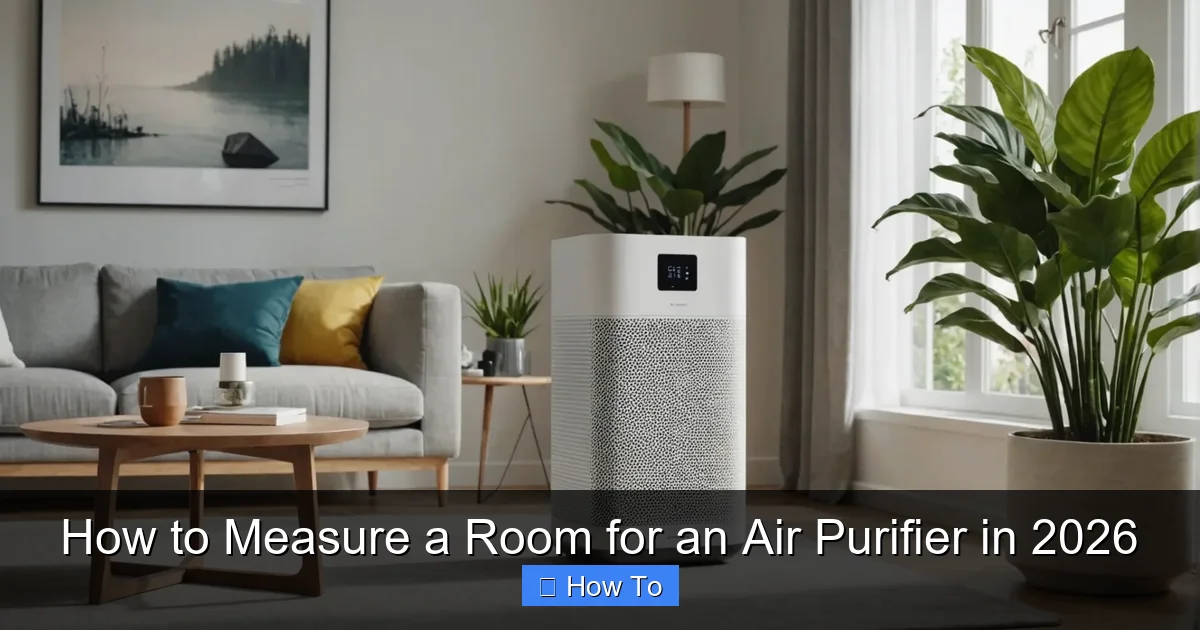
Featured image for how to measure a room for an air purifier
Image source: hisoair.com
Accurately measuring your room’s square footage is the first step to choosing the right air purifier for optimal performance. Use a tape measure to determine the length and width, multiply for total square feet, and always account for ceiling height and air changes per hour (ACH) requirements—especially in high-pollution or allergy-prone spaces—to ensure your purifier can handle the full air volume efficiently.
“`html
How to Measure a Room for an Air Purifier in 2026
Key Takeaways
- Measure room dimensions: Calculate length × width × height for accurate cubic footage.
- Check ACH requirements: Match air purifier to room size for 4–6 air changes hourly.
- Prioritize placement: Keep 3+ feet from walls and furniture for optimal airflow.
- Use CADR ratings: Select a purifier with CADR ≥ 2/3 of your room’s square footage.
- Account for obstacles: Adjust for high ceilings, partitions, or open floor plans.
- Test airflow paths: Ensure unobstructed intake and exhaust for peak performance.
Why This Matters / Understanding the Problem
Let’s be real—nobody buys an air purifier just to watch it collect dust in the corner. You want cleaner air, fewer allergies, and peace of mind, especially with wildfire smoke, pollen seasons getting longer, and indoor pollutants on the rise in 2026. But here’s the catch: if your air purifier is too small for your space, it’s basically running in place—working hard but not making a real difference.
I learned this the hard way. A few years back, I bought a sleek, quiet purifier for my living room. It looked great, sounded like a whisper, and promised “whole-room coverage.” But after a week, my allergies were still acting up. Turns out, I’d skipped the most important step: measuring the room properly. The unit was rated for 200 square feet, but my open-concept living area was closer to 450. Oops.
That’s why knowing how to measure a room for an air purifier in 2026 isn’t just helpful—it’s essential. Air purifier technology has advanced, with smarter sensors, HEPA-H13 filters, and real-time air quality monitoring. But even the fanciest model won’t perform well if it’s undersized. Getting the right fit means better air, less noise, and longer filter life. Plus, you’ll avoid wasting money on a unit that can’t keep up.
In this guide, I’ll walk you through the exact steps I use now—no guesswork, no overcomplication. Whether you’re dealing with pet dander, cooking fumes, or seasonal allergies, measuring your space correctly is the first step toward breathing easier.
What You Need
Before we dive in, let’s gather the basics. Don’t worry—this isn’t a high-tech mission. You probably already have everything at home.
- A tape measure (or a laser measure if you’re feeling fancy)
- A notepad or your phone to jot down measurements
- A calculator (your phone works fine)
- A floor plan or sketch (optional, but helpful for irregular rooms)
If your room has sloped ceilings, multiple levels, or open archways, don’t stress. We’ll cover how to handle those quirks in a bit. The goal is to get as accurate a measurement as possible so your air purifier can do its job—without overworking or underperforming.
Pro tip: Measure during the day when you can see clearly, and avoid doing this right after rearranging furniture. You want to measure the space as it normally is, not as you wish it were.
Step-by-Step Guide to How to Measure a Room for an Air Purifier in 2026
Now, let’s get into the nitty-gritty. These steps are simple, repeatable, and designed to give you confidence that your air purifier will actually clean the air—not just look good doing it.
Step 1: Define the Space You Want to Purify
First things first: which room are we talking about? Is it your bedroom, living room, home office, or a basement playroom? Be specific. Air purifiers are designed for enclosed spaces, so if you’re dealing with an open floor plan, you’ll need to define a “zone” rather than the entire area.
For example, my living room flows into the kitchen and dining area. Instead of measuring the whole 800-square-foot space, I focus on the seating area—about 300 square feet—where we spend most of our time. That’s the zone I want to purify.
Ask yourself:
- Where do I spend the most time in this area?
- Are there walls or partial barriers that separate this space?
- Will the air purifier be running while I’m in this zone?
Defining your target zone ensures you’re not overestimating the space. Remember, it’s better to slightly oversize your purifier than to undersize it. But we’ll get to that later.
Step 2: Measure the Length and Width
Grab your tape measure and start with the basics: length and width. Walk along the longest wall and measure from one end to the other. Then do the same for the width (the shorter side, unless it’s a square room).
Write these numbers down. For example:
- Length: 18 feet
- Width: 14 feet
If your room isn’t a perfect rectangle—maybe there’s a bay window or a closet cutout—measure the main rectangular area first. We’ll adjust for odd shapes in the next step.
Pro tip: Measure in feet and inches, then convert to decimal feet for easier math. For instance, 18 feet 6 inches = 18.5 feet.
Step 3: Calculate the Square Footage
Now, multiply length × width to get the square footage.
Using our example:
18.5 ft × 14 ft = 259 square feet
That’s your base measurement. But wait—don’t stop here. Ceiling height matters too, especially in 2026 when air purifiers are rated not just by square footage, but by air changes per hour (ACH) and clean air delivery rate (CADR).
Step 4: Measure Ceiling Height
Most homes have 8- or 9-foot ceilings, but vaulted ceilings, lofts, or basements can vary. Use your tape measure to check from floor to ceiling in a few spots—especially if the ceiling slopes.
Write down the average height. For example:
- Standard ceiling: 8 feet
- Vaulted ceiling: 12 feet (average)
Why does this matter? Air purifiers are tested in standard 8-foot rooms. If your ceiling is higher, the volume of air increases, meaning your purifier has to work harder to clean the same space.
Step 5: Calculate Room Volume (Cubic Feet)
Now, multiply square footage × ceiling height to get cubic feet.
Example:
259 sq ft × 8 ft = 2,072 cubic feet
This number helps you understand the total air volume your purifier needs to handle. Most modern air purifiers list their coverage in square feet, but some high-end models (especially in 2026) include cubic footage or ACH ratings.
Step 6: Adjust for Room Shape and Openings
Not all rooms are boxes. If your space has alcoves, bay windows, or open archways, you’ll need to adjust.
Here’s how:
- For alcoves or closets: Measure them separately and add to your total square footage if they’re part of the main living area.
- For open archways: If the opening is wider than 4 feet, consider it part of the main zone. If it’s narrower, you can treat it as a separate space.
- For sloped ceilings: Use the average height. For example, if one side is 8 feet and the other is 10 feet, use 9 feet.
I once measured a sunroom with a slanted glass roof. I took three height measurements—lowest, middle, highest—and averaged them. It gave me a realistic volume estimate.
Step 7: Factor in Air Changes Per Hour (ACH)
This is where 2026 tech shines. ACH tells you how many times per hour the air purifier can filter the entire room’s air. For allergy sufferers or smokers, 4–6 ACH is ideal.
To calculate required ACH:
- Multiply your room’s cubic feet by your desired ACH (e.g., 4).
- Divide by 60 to get cubic feet per minute (CFM) needed.
Example:
2,072 cubic feet × 4 ACH = 8,288
8,288 ÷ 60 = ~138 CFM
Now, check your air purifier’s specs. Most list CADR (clean air delivery rate) in CFM. Look for a model that meets or exceeds this number.
Step 8: Check the Manufacturer’s Coverage Rating
Here’s the final step: compare your room size to the purifier’s recommended coverage.
Let’s say your room is 259 square feet. A purifier rated for 300 square feet should work—but only if it’s tested at 8-foot ceilings and 2 ACH. If you want 4 ACH, you might need a unit rated for 500+ square feet.
Manufacturers often overstate coverage. I’ve seen units claim “500 sq ft coverage” but only achieve 2 ACH. For true performance, look for models that specify ACH or CADR.
In 2026, many brands now include smart features that adjust fan speed based on real-time air quality. These can help compensate for slightly larger rooms, but they’re not a substitute for proper sizing.
Pro Tips & Common Mistakes to Avoid
After measuring dozens of rooms (and fixing a few purifier mismatches), here’s what I’ve learned the hard way.
Pro Tip: Always round up. If your room is 259 square feet, don’t buy a 250 sq ft purifier. Go for 300 or 350. Air purifiers perform best when they’re not maxed out.
Warning: Don’t rely solely on square footage. A 300 sq ft room with a 12-foot ceiling has 50% more air than one with an 8-foot ceiling. Volume matters.
Common Mistake: Ignoring furniture and obstacles. Bookshelves, couches, and plants block airflow. Leave at least 12–18 inches of clearance around your purifier for optimal performance.
Pro Insight: Use a laser measure for accuracy. I used to eyeball corners and end up 6 inches off. Now I use a $30 laser tool—it’s a game-changer for irregular rooms.
Real Talk: Open windows reduce efficiency. If you’re measuring a room you frequently ventilate, consider a purifier with a higher CADR or use it in conjunction with an HVAC filter.
Also, don’t forget about noise. A purifier that’s too small will run on high constantly, which can be loud. A properly sized unit can run on low or medium, saving your ears and your energy bill.
FAQs About How to Measure a Room for an Air Purifier in 2026
Q: Do I need to measure every room if I have an open floor plan?
Not necessarily. Focus on the zone where you spend the most time. If your living room, kitchen, and dining area are open, measure the combined area but treat it as one large zone. Just make sure your purifier is rated for that total square footage—or consider multiple units.
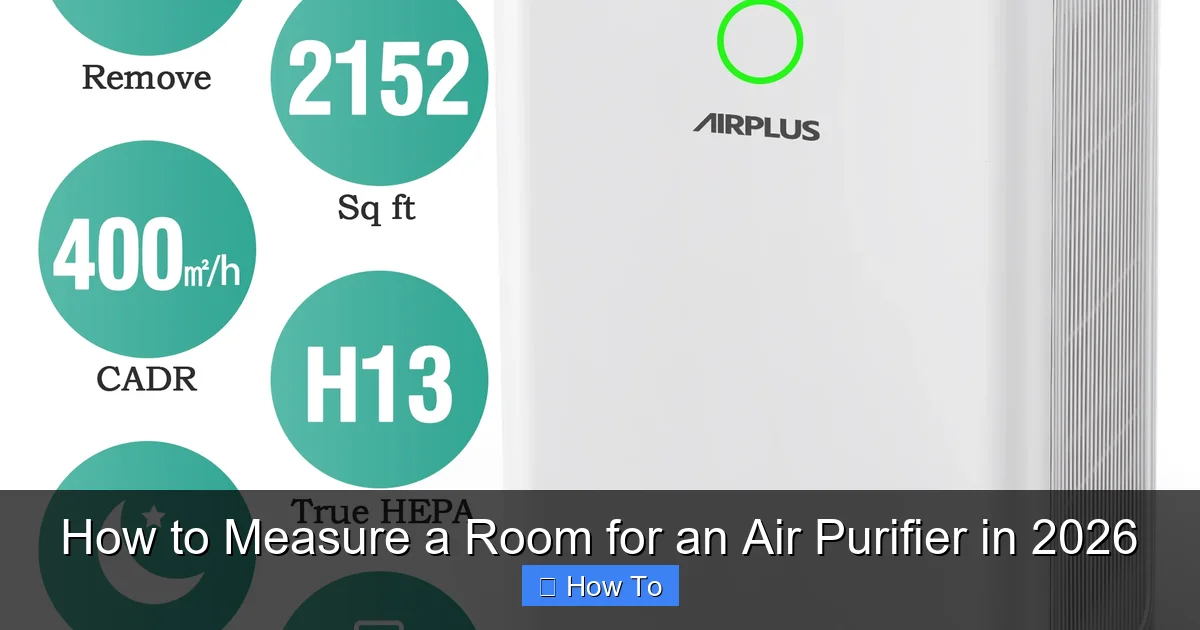
Visual guide about how to measure a room for an air purifier
Image source: i5.walmartimages.com
Visual guide about how to measure a room for an air purifier
Image source: reviewed-com-res.cloudinary.com
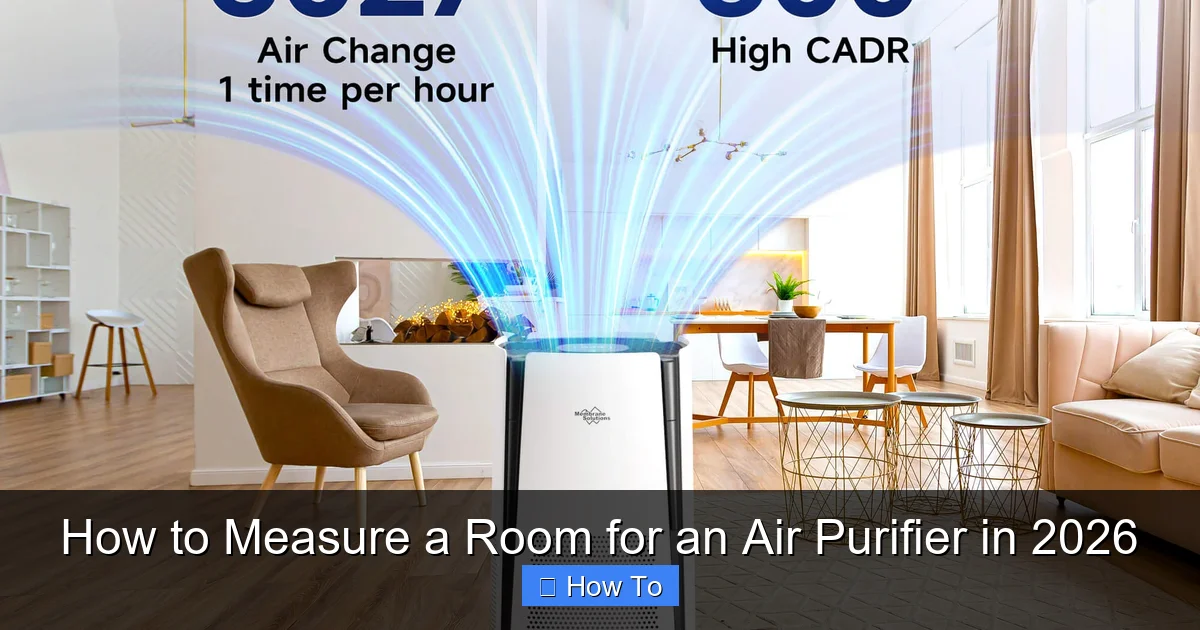
Visual guide about how to measure a room for an air purifier
Image source: simpurelife.com
Q: What if my ceiling is slanted or vaulted?
Use the average height. Measure at the lowest and highest points, add them, and divide by two. For example, 8 ft + 12 ft = 20 ft ÷ 2 = 10 ft average. Then calculate volume using that number.
Q: Can I use one air purifier for multiple small rooms?
Only if they’re connected and you’re willing to move the unit. Air doesn’t flow well through closed doors. For best results, place the purifier in the room where you need it most, or invest in a whole-home system.
Q: How often should I remeasure my room?
Only if you make major changes—like removing a wall, adding a loft, or converting a garage. Otherwise, one accurate measurement is enough. Just keep your notes handy for future purchases.
Q: Does furniture layout affect my measurement?
Not the square footage, but it affects airflow. Avoid placing the purifier behind a couch or in a tight corner. Measure the room as-is, but plan placement for maximum circulation.
Q: Are smart air purifiers better for large rooms?
They can help. Models with auto-mode adjust fan speed based on air quality, which is great for variable conditions. But they still need to be properly sized. A smart purifier too small for your room will run constantly and wear out faster.
Q: What’s the difference between CADR and ACH?
CADR (Clean Air Delivery Rate) measures how fast a purifier removes smoke, dust, and pollen in cubic feet per minute. ACH (Air Changes per Hour) tells you how many times it can filter the entire room’s air per hour. Both matter—look for high CADR and at least 2–4 ACH for effective cleaning.
Final Thoughts
Measuring your room for an air purifier might seem like a small step, but it’s the foundation of clean air. In 2026, with smarter devices and rising air quality concerns, getting this right matters more than ever.
You don’t need to be an engineer or buy expensive tools. Just grab a tape measure, follow the steps, and trust the numbers. Remember: it’s not just about square footage—it’s about volume, airflow, and how often you want the air refreshed.
If you’re still unsure, start with a slightly oversized purifier. It’s better to have a little extra power than to wonder why your allergies aren’t improving. And if you’re investing in a high-end model with sensors and app control, proper sizing ensures you’re getting your money’s worth.
So go ahead—measure that room. Write it down. Compare it to the specs. And breathe easy knowing your air purifier is working as hard as you are.
Because in the end, clean air isn’t a luxury. It’s a necessity. And now, you’ve got the know-how to make it happen.
“`