

Featured image for can a small air purifier clean a large room
Image source: assets.wfcdn.com
Yes, a small air purifier can clean a large room effectively—but only if it has a high CADR rating and is designed for spaces beyond its compact size. Key factors like room layout, airflow, and filter quality determine real-world performance, so choose models with HEPA filters and strong circulation to maximize coverage. Don’t be fooled by size: smart engineering lets small units outperform larger ones in the right conditions.
Key Takeaways
- Room size matters: Match purifier capacity to room square footage for effective cleaning.
- Check CADR rating: Higher Clean Air Delivery Rate means better performance in large spaces.
- Use multiple units: One small purifier may need help; consider strategic placement of two.
- Run continuously: Small purifiers work best when operated nonstop in large rooms.
- Upgrade filters regularly: Clogged filters reduce efficiency, especially in high-pollution areas.
- Supplement with ventilation: Open windows occasionally to boost air exchange and purifier effectiveness.
📑 Table of Contents
- Can a Small Air Purifier Clean a Large Room Effectively
- How Air Purifiers Actually Work
- Size Matters—But Not in the Way You Think
- Factors That Affect Air Purifier Performance in Large Rooms
- When a Small Air Purifier Can Work in a Large Room
- How to Choose the Right Air Purifier for Your Space
- Performance Comparison: Small vs. Large Air Purifiers
- Final Thoughts: Can a Small Air Purifier Clean a Large Room?
Can a Small Air Purifier Clean a Large Room Effectively
Imagine this: you’ve just moved into a new apartment with a spacious living room—maybe 400 square feet or more. It’s bright, airy, and full of potential. But there’s one problem: every time you walk in, you catch a whiff of stale air, dust, or maybe even lingering cooking smells from the previous tenant. You want fresh, clean air, so you head to the store and pick up a compact, affordable air purifier. It’s sleek, quiet, and fits perfectly on your nightstand. But here’s the big question: can a small air purifier actually clean a large room effectively?
It’s a common dilemma. Many of us assume that bigger rooms need bigger machines. After all, logic tells us that a small fan can’t cool a huge space, so why would a small air purifier clean one? But the truth is more nuanced. While size does matter to some extent, it’s not the only factor. The real answer lies in understanding how air purifiers work, what “cleaning” actually means, and how room dynamics affect performance. In this post, we’ll dive deep into whether a small air purifier can truly handle a large room—and if so, under what conditions. Whether you’re dealing with allergies, pet dander, smoke, or just want to breathe easier, this guide will help you make an informed decision.
How Air Purifiers Actually Work
Before we can answer whether a small air purifier can clean a large room, we need to understand what these devices do—and how they do it. At their core, air purifiers are designed to remove airborne contaminants like dust, pollen, mold spores, pet dander, smoke particles, and even some bacteria and viruses. But they don’t “clean” the air in the way a vacuum cleans a floor. Instead, they pull air through a series of filters, trap the pollutants, and release cleaner air back into the room.
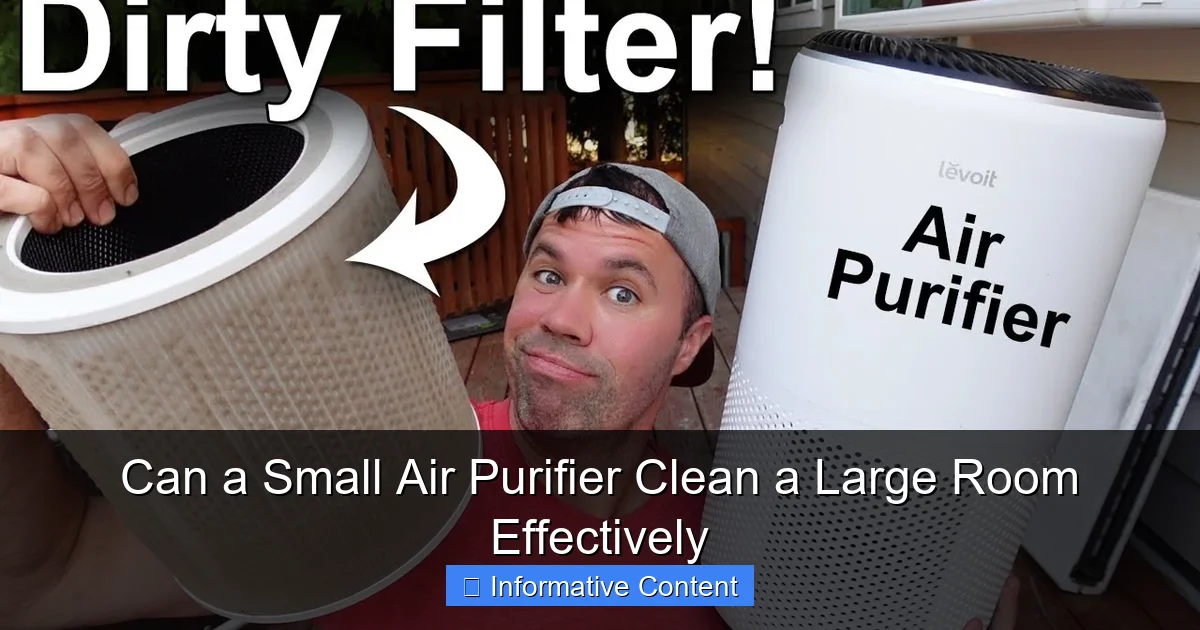
Visual guide about can a small air purifier clean a large room
Image source: i.ytimg.com
The Role of Filters
Most air purifiers rely on a multi-stage filtration system. The most common and effective type is the HEPA (High-Efficiency Particulate Air) filter. True HEPA filters can capture at least 99.97% of particles as small as 0.3 microns—that’s smaller than most bacteria and viruses. Some models also include pre-filters to catch larger particles like hair and lint, activated carbon filters to absorb odors and gases, and even UV-C lights to neutralize microorganisms.
Here’s the key: the effectiveness of an air purifier depends heavily on the quality and type of filters it uses, not just its physical size. A small purifier with a true HEPA filter can be far more effective than a larger model with a low-quality filter. So while size plays a role, it’s not the whole story.
Air Changes Per Hour (ACH)
Another critical concept is Air Changes Per Hour (ACH). This measures how many times the purifier can filter the entire volume of air in a room within one hour. For example, an ACH of 4 means the purifier cleans all the air in the room four times per hour. The higher the ACH, the faster and more thoroughly the air is cleaned.
For optimal air quality, experts recommend an ACH of at least 4–6 for allergy sufferers or in rooms with high pollution levels. A small purifier might only achieve an ACH of 2 in a large room, which means it’s working, but not as efficiently as needed. That’s why understanding ACH is crucial when evaluating whether a small unit can handle a big space.
CADR: Clean Air Delivery Rate
You’ve probably seen the term CADR on air purifier packaging. It stands for Clean Air Delivery Rate and measures how quickly a purifier can deliver clean air, rated in cubic feet per minute (CFM). CADR is typically given for three types of pollutants: smoke (smallest particles), dust, and pollen (largest particles).
For example, a purifier with a smoke CADR of 200 CFM can clean smoke particles from a 200-square-foot room more effectively than one with a CADR of 100 CFM. The Association of Home Appliance Manufacturers (AHAM) recommends choosing a purifier with a CADR rating that’s at least two-thirds the size of your room in square feet. So for a 300-square-foot room, you’d want a CADR of at least 200.
This is where small purifiers often fall short. Many compact models have lower CADR ratings, making them better suited for bedrooms or offices than large living areas. But again, it’s not just about size—it’s about matching the purifier’s performance to the room’s needs.
Size Matters—But Not in the Way You Think
Let’s address the elephant in the room: yes, size matters. But not in the way most people assume. A small air purifier isn’t automatically ineffective in a large room—it’s about whether its performance specs match the room’s demands.
Physical Size vs. Performance Capacity
Many people equate a purifier’s physical size with its power. A tall, bulky unit must be stronger, right? Not necessarily. Some compact models are engineered with high-efficiency motors and advanced filtration systems that outperform larger, older models. For instance, the Levoit Core 300 is a small, sleek purifier that fits on a nightstand but has a CADR of 141 CFM and can handle rooms up to 219 square feet. That’s impressive for its size.
On the flip side, some large purifiers are overbuilt for small spaces and waste energy. So instead of focusing on how big the machine looks, pay attention to its performance metrics: CADR, ACH, and room coverage rating.
Room Coverage Ratings
Manufacturers often list a “recommended room size” on the packaging. This is usually based on the purifier’s CADR and assumes standard ceiling heights (8–9 feet). For example, a purifier rated for 200 square feet should effectively clean a room of that size under normal conditions.
But here’s the catch: these ratings are often optimistic. They assume ideal conditions—no open windows, minimal airflow, and consistent pollutant levels. In real life, a large room with high ceilings, open floor plans, or frequent foot traffic will challenge even a well-rated purifier.
So if you’re using a small purifier in a 400-square-foot living room, and it’s only rated for 200 square feet, it’s likely working overtime. It might reduce pollutants over time, but it won’t achieve the rapid, thorough cleaning you’d get with a properly sized unit.
Real-World Example: Small Purifier in a Large Room
Let’s say you have a 350-square-foot open-concept living room with 10-foot ceilings. You buy a small purifier rated for 150 square feet. At first, you notice a slight improvement—maybe the dust settles faster, or the air feels less stuffy. But after a week, you’re still sneezing, and the smell of last night’s dinner lingers.
Why? Because the purifier simply can’t process enough air fast enough. It might take hours to complete one full air change, and new pollutants are constantly being introduced—from cooking, pets, or outdoor air seeping in. In this case, the small purifier is helping, but it’s not sufficient on its own.
Factors That Affect Air Purifier Performance in Large Rooms
Even the best air purifier can underperform if the environment isn’t conducive to air cleaning. Several factors influence how well a small purifier can clean a large room.
Room Layout and Airflow
Open floor plans are beautiful but challenging for air purifiers. Without walls to contain airflow, pollutants can spread quickly, and the purifier’s cleaned air may not reach all corners. Furniture placement also matters. If your sofa or bookshelf blocks the purifier’s intake or outlet, it creates “dead zones” where air isn’t being filtered.
Tip: Place your purifier in a central location, away from walls and large furniture. Elevate it slightly (on a table or stand) to improve airflow. Avoid placing it near doors or windows where outdoor pollutants can easily enter.
Ceiling Height
Most room size ratings assume 8-foot ceilings. If your room has 10- or 12-foot ceilings, the air volume increases significantly. A purifier rated for 200 square feet at 8 feet won’t cover the same space at 10 feet—it would need to handle 250 cubic feet instead of 160.
This is why high-ceilinged rooms often require more powerful purifiers or multiple units. A small purifier might struggle to keep up with the increased air volume.
Source of Pollution
The type and intensity of pollutants matter. If you’re dealing with heavy smoke from cooking, frequent pet shedding, or outdoor pollution (like wildfire smoke), your purifier has to work harder. A small unit might reduce particle counts, but it won’t eliminate strong odors or high concentrations of pollutants quickly.
For example, if you fry fish every night, a small purifier with only a HEPA filter won’t remove the lingering smell. You’d need one with a robust activated carbon filter—and even then, it might need to run continuously to keep up.
Usage Patterns
How you use the purifier also affects performance. Running it on the highest fan speed will clean the air faster but may be noisy. Running it on low is quieter but slower. Some models have auto modes that adjust fan speed based on air quality, which can be a good compromise.
Pro tip: Run your purifier 24/7 on the lowest effective setting. This maintains consistent air quality without overworking the motor. Many modern purifiers are energy-efficient, so the cost is minimal.
When a Small Air Purifier Can Work in a Large Room
So far, we’ve highlighted the challenges. But there are scenarios where a small air purifier can still be effective—even in a large room.
Supplemental Use
A small purifier can be a great supplement to other air-cleaning strategies. For example, if you have a central HVAC system with a high-MERV filter, a small purifier can target specific areas—like your desk or bedside—where you spend the most time. It’s not meant to clean the entire room, but to provide localized relief.
Think of it like a desk fan: it won’t cool the whole house, but it keeps you comfortable where you are.
Low Pollution Levels
If your large room has minimal pollutants—no pets, no smoking, good ventilation—a small purifier might be sufficient. In a clean, well-maintained space, even a modest unit can maintain good air quality with regular use.
For instance, a home office with a door that closes and few pollution sources might only need a small purifier to handle occasional dust or outdoor pollen.
Short-Term or Temporary Use
Small purifiers are ideal for temporary situations. Staying in a hotel room during allergy season? A portable purifier can make a big difference. Hosting a dinner party and want to reduce cooking odors quickly? A small unit placed near the kitchen can help.
They’re also great for travel or small apartments where space is limited. Just don’t expect them to replace a full-sized unit in a large, high-traffic area.
Strategic Placement
Even in a large room, you can maximize a small purifier’s impact with smart placement. Put it near the source of pollution—like next to a pet bed or cooking area. Or place it where you spend the most time, such as your reading chair or workspace.
Some people use multiple small purifiers in different zones of a large room. While this costs more upfront, it can be more effective than one underpowered unit trying to cover the entire space.
How to Choose the Right Air Purifier for Your Space
Now that we’ve explored the possibilities and limitations, here’s how to pick the right purifier—whether small or large—for your needs.
Calculate Your Room’s Air Volume
Start by measuring your room’s square footage and ceiling height. Multiply length × width × height to get the total cubic feet. For example, a 20 ft × 20 ft room with 10 ft ceilings = 4,000 cubic feet.
Then, check the purifier’s CADR and recommended room size. Use the AHAM guideline: choose a purifier with a CADR at least two-thirds of your room’s square footage. For a 300-square-foot room, aim for a CADR of 200 or higher.
Look for True HEPA Filters
Avoid “HEPA-type” or “HEPA-like” filters—they don’t meet the true HEPA standard. Only true HEPA filters guarantee 99.97% efficiency at 0.3 microns. This is especially important if you have allergies or asthma.
Consider Additional Features
- Activated carbon filter: Essential for odors, smoke, and VOCs.
- UV-C light: Can kill bacteria and viruses, but effectiveness varies.
- Auto mode: Adjusts fan speed based on air quality sensors.
- Timer and sleep mode: For convenience and energy savings.
- Filter replacement indicators: Helps maintain performance.
Energy Efficiency and Noise
Check the energy usage (watts) and noise level (decibels). A purifier that uses 50 watts on high is more efficient than one using 100 watts. For bedrooms, look for models under 50 dB on low—about the sound of a quiet conversation.
Read Real User Reviews
Manufacturer specs can be misleading. Look for reviews from users with similar room sizes and pollution levels. Sites like Wirecutter, Consumer Reports, and Amazon reviews often include detailed feedback on real-world performance.
Performance Comparison: Small vs. Large Air Purifiers
To help you visualize the differences, here’s a comparison of three popular air purifiers—two small and one large—based on key performance metrics.
| Model | Size | Room Coverage | CADR (Smoke/Dust/Pollen) | ACH (in 300 sq ft) | Noise Level (Low/High) | Best For |
|---|---|---|---|---|---|---|
| Levoit Core 300 | Small | 219 sq ft | 141 / 140 / 145 CFM | 2.5 | 24 dB / 54 dB | Bedrooms, small offices |
| Winix 5500-2 | Medium | 360 sq ft | 243 / 240 / 246 CFM | 4.5 | 27 dB / 58 dB | Living rooms, large bedrooms |
| Blueair Blue Pure 211+ | Large | 540 sq ft | 350 / 350 / 350 CFM | 6.5 | 31 dB / 62 dB | Open-concept spaces, high pollution |
This table shows that while the Levoit Core 300 is compact and quiet, it’s not ideal for large rooms. The Winix 5500-2 offers a good balance, and the Blueair 211+ is built for serious air cleaning in big spaces. The ACH values highlight the difference: the small purifier changes the air 2.5 times per hour in a 300-square-foot room, while the large one does it 6.5 times.
Final Thoughts: Can a Small Air Purifier Clean a Large Room?
So, can a small air purifier clean a large room effectively? The short answer is: sometimes, but not always. It depends on the room’s size, layout, pollution levels, and the purifier’s actual performance—not just its physical size.
A small purifier can help reduce airborne particles and improve air quality in a large room, especially if used strategically or in low-pollution environments. But for consistent, thorough cleaning—especially in open, high-traffic, or high-pollution spaces—it’s usually better to choose a unit designed for larger areas.
Think of it like this: a small purifier is like a sprinter—fast and efficient in short bursts. A large purifier is like a marathon runner—built for endurance and sustained performance. If your goal is long-term, reliable air cleaning in a big space, go for the marathon runner.
That said, don’t dismiss small purifiers entirely. They’re perfect for targeted use, supplemental cleaning, or smaller zones within a large room. And with advancements in technology, many compact models now pack serious performance into tiny frames.
Ultimately, the best air purifier is the one that matches your room’s needs and your lifestyle. Read the specs, understand the metrics, and don’t be swayed by size alone. Clean air is worth the investment—and with the right purifier, even a large room can feel fresh, healthy, and breathable.
Frequently Asked Questions
Can a small air purifier clean a large room effectively?
A small air purifier may struggle to clean a large room effectively due to limited coverage area and lower Clean Air Delivery Rate (CADR). For optimal performance, choose a model rated for your room’s square footage.
What size air purifier do I need for a large room?
For a large room, look for an air purifier with a high CADR and coverage area that matches or exceeds your room size. Small units are typically designed for spaces under 300 square feet and may not suffice.
How does room size affect air purifier performance?
Room size directly impacts how well an air purifier can circulate and filter air. In large rooms, a small purifier may run continuously without achieving consistent air quality improvements.
Can I use multiple small air purifiers in a large room?
Yes, using multiple small air purifiers can help improve air quality in a large room by increasing overall filtration coverage. This setup mimics the performance of a single, larger unit when strategically placed.
What features should I look for in an air purifier for a large room?
Prioritize high CADR ratings, HEPA filtration, and a coverage area that matches your room size. Some models also include air quality sensors and auto modes for better efficiency in large spaces.
Will a small air purifier help with allergies in a big room?
A small air purifier may offer limited relief for allergies in a large room due to reduced air exchange rates. For better results, choose a unit specifically designed for large-room allergen removal.