
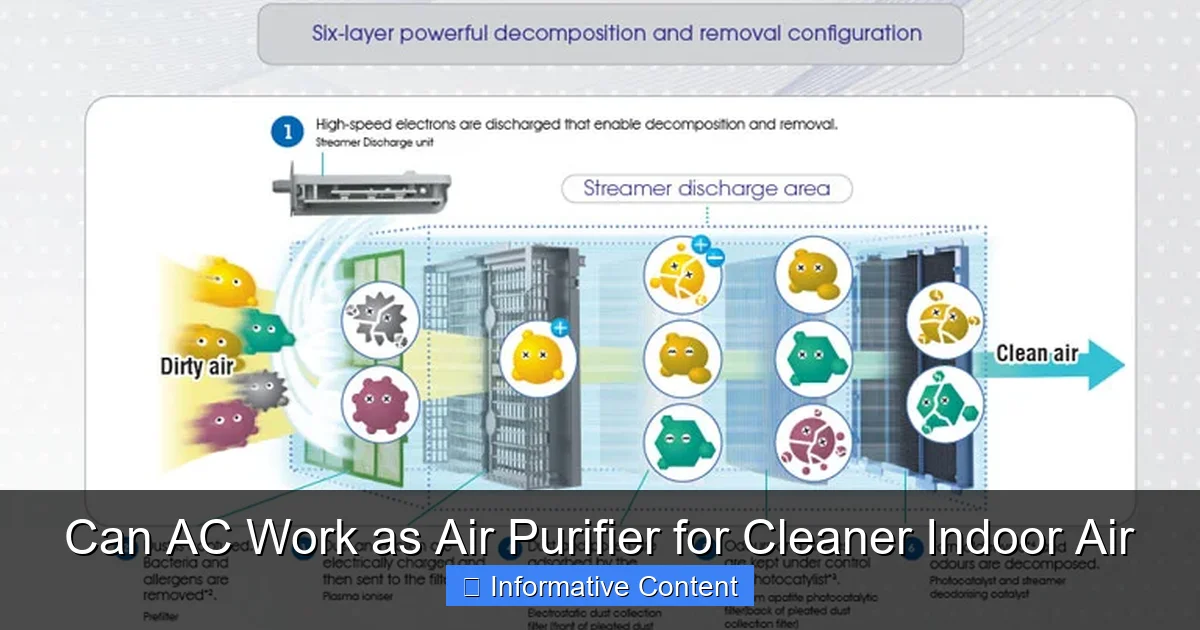
Featured image for can ac work as air purifier
Image source: daikinindia.com
An air conditioner cannot effectively replace a dedicated air purifier, as its primary function is temperature control, not air filtration. While some AC units include basic filters that trap dust and allergens, they lack the advanced technology (like HEPA or activated carbon) needed to remove microscopic pollutants, odors, or volatile organic compounds (VOCs)—key features of true air purifiers. For cleaner indoor air, pairing an AC with a standalone air purifier delivers the best results.
Key Takeaways
- ACs filter dust and allergens but aren’t true air purifiers without advanced filters.
- Upgrade to MERV 13+ filters to boost AC air-cleaning performance effectively.
- ACs lack HEPA filtration unless specifically designed with HEPA-grade components.
- Run AC continuously to maintain cleaner air but monitor humidity levels.
- Pair AC with air purifier for optimal indoor air quality and health benefits.
📑 Table of Contents
- Can AC Work as Air Purifier for Cleaner Indoor Air
- How Air Conditioners Actually Work
- What Your AC Can (and Can’t) Filter
- Air Purifiers vs. Air Conditioners: Key Differences
- Can You Upgrade Your AC for Better Air Cleaning?
- When an Air Purifier Is the Better Choice
- Conclusion: Should You Rely on Your AC for Clean Air?
Can AC Work as Air Purifier for Cleaner Indoor Air
It’s a hot summer afternoon, and you’ve just cranked up the AC to escape the sweltering heat. As the cool air begins to circulate, you take a deep breath—only to notice a faint musty smell or a tickle in your throat. You start wondering: Is the air my AC is blowing actually clean? Or is it just cold air carrying dust, pollen, and other invisible pollutants?
Many of us assume that turning on the air conditioner automatically means we’re breathing cleaner air. After all, it’s filtering the air, right? But here’s the truth: while your AC does play a role in improving indoor air quality, it’s not the same as a dedicated air purifier. The idea that “can AC work as air purifier” is a common misconception—one that deserves a closer look. In this post, we’ll explore how air conditioners actually function, what they filter (and what they don’t), and whether they can truly deliver the clean, fresh air we all want in our homes.
Whether you’re dealing with allergies, pet dander, or just want to breathe easier, understanding the difference between cooling and purifying is key. Let’s dive in and find out if your AC is doing more than just keeping you cool—or if it’s time to bring in some extra help.
How Air Conditioners Actually Work
Before we can answer whether an AC can double as an air purifier, we need to understand what it’s designed to do. At its core, an air conditioner’s primary job is to cool and dehumidify the air in your home. It doesn’t create cold air—instead, it removes heat from indoor air and transfers it outside, leaving you with a cooler, more comfortable environment.

Visual guide about can ac work as air purifier
Image source: housefresh.com
The Cooling Process Explained
Here’s how it works: Your AC unit pulls warm air from inside your home through return air vents. This air passes over cold evaporator coils filled with refrigerant. As the refrigerant absorbs heat from the air, the air cools down and is then blown back into your living space by a fan. Meanwhile, the heat absorbed by the refrigerant is pumped outside through the condenser unit.
During this process, the air also loses moisture. That’s why ACs help reduce humidity—especially important in humid climates where sticky air can make you feel even hotter. But while this process cools and dries the air, it doesn’t necessarily clean it.
Air Filtration: A Secondary Feature
Most modern air conditioners come with a basic air filter—usually a mesh or fiberglass panel located near the return air vent. This filter is designed to catch larger particles like dust, lint, and pet hair before they enter the AC system. Think of it as a protective barrier for your unit, not a health-focused air cleaner.
For example, if you’ve ever pulled out your AC filter and seen a gray, dusty layer, that’s the filter doing its job—keeping debris from clogging the internal components. But here’s the catch: this filter isn’t fine enough to capture smaller pollutants like mold spores, bacteria, or smoke particles. So while your AC is helping maintain system efficiency, it’s not actively purifying the air you breathe.
Air Circulation vs. Air Cleaning
Another important distinction is between air circulation and air cleaning. Your AC constantly moves air around your home—this is called circulation. It pulls air in, cools it, and pushes it back out. But circulation alone doesn’t remove contaminants. In fact, without proper filtration, an AC can actually spread pollutants throughout your home.
Imagine this: if someone sneezes in the living room, and your AC is running, the system can pull that air—along with airborne germs—into the ducts and redistribute it to other rooms. Without a high-quality filter or additional purification, you’re just moving dirty air around, not cleaning it.
So, while your AC plays a role in air movement and basic particle capture, it’s not designed to be a comprehensive air cleaning solution. That leads us to the next big question: what exactly can your AC filter out?
What Your AC Can (and Can’t) Filter
Now that we know how air conditioners work, let’s break down what they’re actually capable of filtering. The answer depends largely on the type of filter your AC uses and how well it’s maintained.
Types of AC Filters and Their Effectiveness
Most residential AC systems use one of several common filter types:
- Fiberglass filters: These are the most basic and inexpensive options. They’re designed to protect the AC unit from large debris but capture less than 20% of airborne particles. They’re not effective for allergy or asthma sufferers.
- Pleated filters: Made from polyester or cotton folds, these offer better filtration. They can capture dust, pollen, and mold spores with an efficiency of 40–60%, depending on the MERV rating.
- High-efficiency pleated filters (MERV 13+): These are the best option for AC systems that can handle them. They can trap smaller particles like smoke, bacteria, and even some viruses.
- Electrostatic filters: These use static electricity to attract particles. They’re reusable and can be effective, but their performance depends on regular cleaning.
The MERV rating (Minimum Efficiency Reporting Value) is a key factor here. It ranges from 1 to 20 and indicates how well a filter captures particles of different sizes. Most standard AC filters are rated between MERV 4 and MERV 8. While that’s fine for protecting your unit, it’s not enough for true air purification.
Particles Your AC Can Capture
With a decent filter (MERV 8 or higher), your AC can effectively remove:
- Dust and lint
- Pet dander
- Pollen
- Some mold spores
- Large bacteria
These are all common indoor allergens, so a well-maintained AC with a good filter can help reduce allergy symptoms—especially during high-pollen seasons or if you have pets.
Particles Your AC Can’t Capture
Here’s where the limitations become clear. Your standard AC filter cannot effectively remove:
- Fine particulate matter (PM2.5)—like smoke, smog, and combustion byproducts
- Volatile organic compounds (VOCs)—found in cleaning products, paints, and furniture
- Small bacteria and viruses
- Odors (cooking smells, pet odors, cigarette smoke)
- Radon byproducts and other gaseous pollutants
For example, if you live in a city with high air pollution or someone in your home smokes, your AC alone won’t make the air safe to breathe. Similarly, if you’ve recently painted a room or used strong cleaning chemicals, those VOCs will linger unless you have a system designed to neutralize them.
Real-World Example: The Allergy Test
Let’s say you have seasonal allergies and rely on your AC to keep pollen out. You change the filter regularly and keep the system running. You might notice some relief—especially compared to opening windows during high-pollen days. But on days when pollen counts are extremely high, you may still experience sneezing, itchy eyes, or congestion.
Why? Because even with a good filter, your AC isn’t removing all the fine particles. Plus, pollen can settle on surfaces and get stirred up again when the AC kicks on. Without additional air cleaning, you’re only getting partial protection.
The bottom line: your AC can help with larger airborne particles, but it’s not a complete solution for indoor air quality. For that, you need something more advanced.
Air Purifiers vs. Air Conditioners: Key Differences
Now that we’ve covered what ACs can and can’t do, let’s compare them directly to air purifiers. Understanding the differences will help you decide whether you need one, the other, or both.
Design and Purpose
Air conditioners are built for climate control—cooling and dehumidifying your space. Air purifiers, on the other hand, are designed specifically for air cleaning. They don’t cool the air; instead, they focus entirely on removing contaminants.
Think of it like this: an AC is like a fan with a cooling system. An air purifier is like a vacuum cleaner for the air—constantly pulling in pollutants and trapping them.
Filtration Technology
Most air purifiers use advanced filtration systems that go far beyond what a standard AC filter can do. Here are the most common types:
- HEPA filters: High-Efficiency Particulate Air filters can capture 99.97% of particles as small as 0.3 microns—including dust, pollen, mold, bacteria, and even some viruses. This is the gold standard for air purification.
- Activated carbon filters: These absorb odors, smoke, and VOCs. They’re especially useful in homes with pets, smokers, or strong cooking smells.
- UV-C light: Some purifiers use ultraviolet light to kill bacteria, viruses, and mold spores as air passes through.
- Ionic or electrostatic purifiers: These release charged ions that attach to particles, causing them to fall out of the air or stick to surfaces. However, they can produce ozone, which is a lung irritant, so they’re not recommended for everyone.
In contrast, even the best AC filters (MERV 13+) don’t match the performance of a true HEPA filter. And most ACs don’t include carbon filters or UV lights unless they’re part of a specialized HVAC system.
Coverage and Air Changes
Another key difference is how often the air is cleaned. Air purifiers are rated by their Clean Air Delivery Rate (CADR), which tells you how quickly they can clean the air in a given room size. A good purifier can cycle the air in a room 3–5 times per hour.
Air conditioners, while they move a lot of air, don’t necessarily clean it with each pass. And because they’re designed to cool the entire house, they may not focus enough airflow on a single room to be effective at purification.
Energy Use and Maintenance
Air purifiers are generally energy-efficient, especially modern models with auto modes and sleep settings. They use about as much electricity as a light bulb—typically 50–200 watts depending on the size and settings.
AC units, by contrast, are power-hungry. A central AC can use 3,000–5,000 watts or more. While they do filter air as a side effect, the energy cost isn’t justified if your main goal is air cleaning.
Maintenance is also different. AC filters need to be changed every 1–3 months, depending on usage and filter type. Air purifier filters (especially HEPA and carbon) also need regular replacement—usually every 6–12 months—but the process is often simpler and more targeted.
When to Use Each
So, when should you rely on your AC, and when do you need an air purifier?
- Use your AC when: You need to cool your home, reduce humidity, or filter out large particles like dust and pet hair.
- Use an air purifier when: You want to remove allergens, smoke, odors, bacteria, or fine particles. Ideal for bedrooms, nurseries, or homes with asthma/allergy sufferers.
The best approach? Use both. Run your AC to keep cool and circulate air, and use an air purifier in key rooms for targeted cleaning. They complement each other—like sunscreen and a hat on a sunny day.
Can You Upgrade Your AC for Better Air Cleaning?
If you love your current AC system but want better air quality, you might be wondering: Can I make my AC work more like an air purifier? The short answer is yes—with some upgrades and smart choices.
Upgrade to a Higher-MERV Filter
The easiest and most cost-effective improvement is switching to a higher-efficiency filter. If your current filter is MERV 6 or lower, upgrading to a MERV 11 or MERV 13 filter can significantly improve particle capture.
For example, a MERV 13 filter can trap:
- 90% of particles between 1.0 and 3.0 microns (like mold spores and fine dust)
- 85% of particles between 0.3 and 1.0 microns (like bacteria and smoke)
Just make sure your HVAC system can handle the increased resistance. Some older systems may struggle with high-MERV filters, leading to reduced airflow or higher energy bills. Check your owner’s manual or consult an HVAC technician.
Install a Whole-House Air Purifier
For a more advanced solution, consider a whole-house air purifier that integrates with your existing HVAC system. These units are installed in your ductwork and work alongside your AC to clean the air as it circulates.
Popular types include:
- UV air purifiers: Use ultraviolet light to kill germs and mold in the ducts.
- Electrostatic precipitators: Charge particles and collect them on plates, similar to some portable purifiers.
- Photocatalytic oxidation (PCO) systems: Break down pollutants at a molecular level using UV light and a catalyst.
These systems can be highly effective—especially for homes with chronic air quality issues. However, they require professional installation and regular maintenance, so they’re a bigger investment than a simple filter upgrade.
Use Portable Air Purifiers in Key Rooms
If a whole-house system isn’t in the budget, portable air purifiers are a great alternative. Place them in bedrooms, living rooms, or home offices—anywhere you spend the most time.
Look for models with:
- True HEPA filters
- Activated carbon filters
- CADR ratings appropriate for the room size
- Low noise levels (especially for bedrooms)
For example, a purifier with a CADR of 200 for smoke is suitable for a room up to 200 square feet. Run it continuously or on auto mode for the best results.
Maintain Your System Regularly
No upgrade will help if your system isn’t well-maintained. Here are some tips:
- Change your AC filter every 1–3 months, or as recommended.
- Clean vents and ducts every 3–5 years to prevent mold and dust buildup.
- Keep indoor humidity between 30–50% to discourage mold and dust mites.
- Vacuum and dust regularly to reduce the load on your air filters.
Even small efforts—like wiping down vents or using a vacuum with a HEPA filter—can make a big difference in indoor air quality.
When an Air Purifier Is the Better Choice
Despite the improvements you can make to your AC, there are situations where a dedicated air purifier is clearly the better option. Let’s look at when and why.
Health Conditions and Allergies
If you or a family member has asthma, allergies, or a respiratory condition like COPD, air quality is critical. In these cases, a HEPA air purifier can provide relief that an AC simply can’t match.
Studies show that using HEPA purifiers can reduce airborne allergens by up to 90% and improve symptoms like wheezing, coughing, and nasal congestion. For example, a 2020 study published in the Journal of Allergy and Clinical Immunology found that children with asthma who used air purifiers at home had fewer emergency room visits and better sleep quality.
Smoke and Odor Control
Whether it’s wildfire smoke, cigarette smoke, or strong cooking odors, ACs aren’t designed to handle gaseous pollutants. Only activated carbon filters can effectively absorb these compounds.
If you live in an area prone to wildfires, a portable air purifier with a carbon filter can be a lifesaver during smoke events. Similarly, if someone in your home smokes indoors, a purifier can help reduce secondhand smoke exposure.
Pet Owners and Pet Dander
Pets bring joy—but also dander, fur, and odors. While your AC can catch some of this, it won’t eliminate it. A HEPA purifier can capture microscopic dander particles that float in the air and settle on furniture.
Place a purifier in the room where your pet spends the most time, and run it daily. You’ll notice less dust on surfaces and fewer allergy symptoms.
New Homes and Renovations
After moving into a new home or completing renovations, indoor air can be filled with VOCs from paint, adhesives, and new furniture. These chemicals can off-gas for weeks or even months.
An air purifier with a carbon filter can help neutralize these odors and reduce exposure. Run it continuously during the first few weeks after moving in or finishing a project.
Data Table: AC vs. Air Purifier Performance
| Feature | Standard AC | AC with MERV 13 Filter | HEPA Air Purifier |
|---|---|---|---|
| Primary Purpose | Cooling & dehumidifying | Cooling + improved filtration | Air cleaning |
| Particle Removal (0.3 microns) | <20% | ~85% | 99.97% |
| Removes Odors/VOCs? | No | No | Yes (with carbon filter) |
| Removes Bacteria/Viruses? | Rarely | Partially | Yes (with HEPA + UV) |
| Energy Use | High (3,000–5,000W) | High | Low (50–200W) |
| Best For | General cooling | Improved air quality + cooling | Allergies, asthma, smoke, odors |
Conclusion: Should You Rely on Your AC for Clean Air?
So, can AC work as air purifier? The answer is: partially, but not completely. Your air conditioner does help improve indoor air quality by filtering out larger particles and circulating air. With a high-MERV filter, it can even capture some allergens and bacteria. But it’s not designed to remove fine particles, odors, or gaseous pollutants—the things that truly impact your health and comfort.
Think of your AC as the first line of defense. It keeps you cool and handles the big stuff. But for truly clean, fresh air—especially if you have allergies, pets, or live in a polluted area—you need a dedicated air purifier. Together, they form a powerful team: one cools, the other cleans.
The best approach is to use both. Upgrade your AC filter, maintain your system, and add a HEPA air purifier in key rooms. You’ll breathe easier, sleep better, and enjoy a healthier home environment. After all, clean air isn’t just a luxury—it’s a necessity.
So the next time you turn on the AC and take a deep breath, ask yourself: Is this air really clean? Now you know how to find out—and how to make it better.
Frequently Asked Questions
Can an AC work as an air purifier to improve indoor air quality?
Standard air conditioners are not designed to purify air, but they can help reduce large particles like dust and pet dander through their filters. However, they lack advanced filtration (e.g., HEPA) to trap ultrafine pollutants or pathogens like true air purifiers do.
Do air conditioners remove allergens and mold spores like an air purifier?
While ACs may capture some allergens via basic mesh filters, they cannot fully replace an air purifier with HEPA or activated carbon filters. Mold spores often pass through AC filters unless the unit includes specialized antimicrobial technology.
Can AC units with built-in air purifier features work as standalone purifiers?
Some modern ACs include ionizers or advanced filtration (e.g., HEPA, UV-C) to supplement cooling with air purification. These hybrid systems can work as air purifiers but may require frequent filter maintenance to remain effective.
Why doesn’t my AC filter out smoke or odors like an air purifier?
AC filters focus on large particulates, not gaseous pollutants like smoke or VOCs. Air purifiers with activated carbon filters are better suited to absorb odors and chemical contaminants that standard ACs miss.
Is it safe to run my AC all day as an air purifier alternative?
Running an AC continuously can circulate air but won’t purify it without proper filtration. Overuse may also increase energy costs and strain the system, especially if filters are clogged or inefficient.
Can a portable AC work as an air purifier in small rooms?
Portable ACs with washable filters offer minimal air cleaning, mainly trapping dust and hair. For true air purification, pair it with a dedicated air purifier to tackle finer pollutants and microbes effectively.