
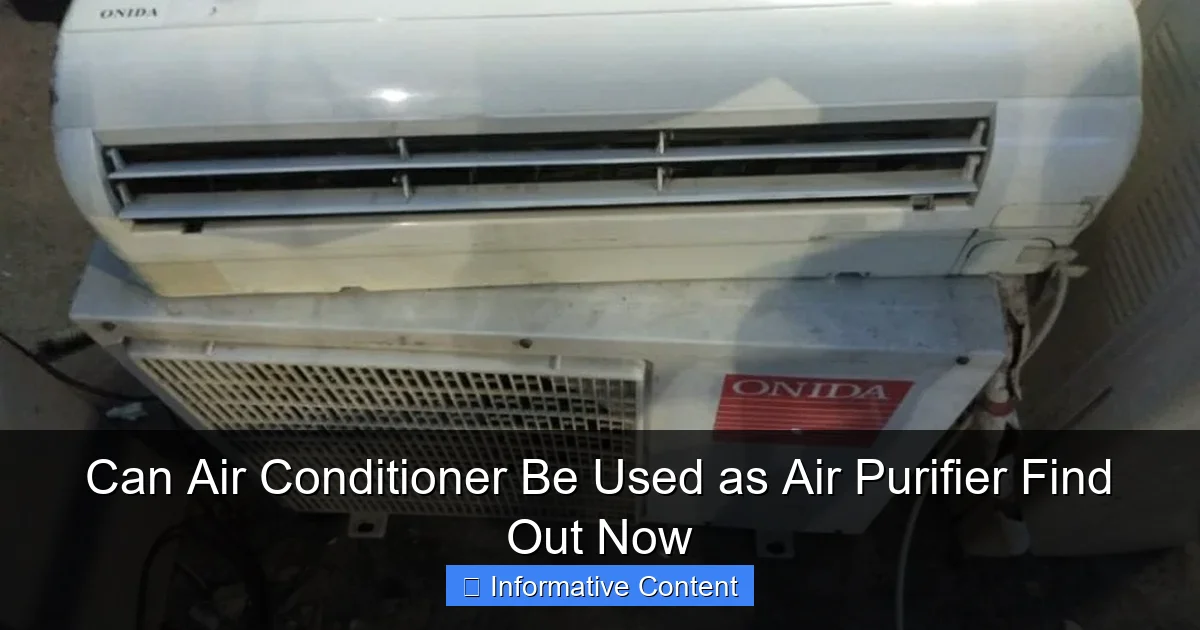
Featured image for can air conditioner be used as air purifier
Image source: 5.imimg.com
No, an air conditioner cannot effectively replace a dedicated air purifier, as its primary function is temperature control, not air filtration. While some AC units include basic filters, they lack the advanced HEPA or activated carbon technology needed to remove fine particles, allergens, and pollutants from the air. For clean, safe indoor air, pair your AC with a high-quality air purifier.
Key Takeaways
- Air conditioners don’t purify air: They cool air but lack true filtration like HEPA filters.
- Filters trap some particles: Basic AC filters catch dust, but not fine pollutants or allergens.
- Upgrade filters for better results: Use high-MERV or HEPA-compatible filters to improve air quality.
- Pair AC with an air purifier: Combine both for effective cooling and air cleaning.
- Maintain filters regularly: Clean or replace AC filters monthly to maximize efficiency.
- UV-C light helps: Install UV-C in AC units to kill mold and bacteria in ducts.
- Ventilation matters: Open windows occasionally to reduce indoor pollutant buildup.
📑 Table of Contents
- Can Air Conditioner Be Used as Air Purifier? Find Out Now
- How Air Conditioners Work (And What They Actually Filter)
- Key Differences Between Air Conditioners and Air Purifiers
- Can You Upgrade Your AC to Act Like a Purifier?
- When Your AC Might Actually Help with Air Quality
- Data Table: AC vs. Air Purifier – What Each Can Handle
- Conclusion: So, Can Air Conditioner Be Used as Air Purifier?
Can Air Conditioner Be Used as Air Purifier? Find Out Now
Let’s face it — we’ve all had those moments. You’re sitting at home, the summer heat is relentless, and you crank up the air conditioner. Then, a sneeze. A sniffle. Maybe even a dry throat. You look around and wonder: can my air conditioner be used as an air purifier? After all, it’s moving air, right? It’s filtering dust, isn’t it? And if it’s cleaning the air, why do I still feel congested?
I’ve been there. Last year, during allergy season, I was convinced my AC was helping. I’d read somewhere that AC units filter dust and pollen. But then I started noticing my son’s asthma acting up more. That’s when I realized — maybe the AC isn’t doing what I thought it was. Maybe it’s just moving dirty air around. That’s when I started digging deeper. And what I found? Well, let’s just say it’s not as simple as “yes” or “no.”
So, if you’ve ever wondered whether your air conditioner doubles as an air purifier — or if you’re thinking about skipping a dedicated air purifier because your AC “does the job” — this post is for you. We’re going to unpack the truth, the myths, and the practical realities. By the end, you’ll know exactly what your AC can and can’t do for your indoor air quality. And yes, we’ll answer that burning question: can air conditioner be used as air purifier?
How Air Conditioners Work (And What They Actually Filter)
The Basics of Cooling and Air Movement
First, let’s get clear on what your air conditioner is actually built to do. At its core, an AC unit cools the air by removing heat. It pulls in warm indoor air, passes it over cold evaporator coils (which absorb heat), and then blows the cooled air back into your room. Along the way, it also removes some moisture — that’s why ACs reduce humidity. But here’s the key: cooling and air purification are two completely different jobs.

Visual guide about can air conditioner be used as air purifier
Image source: airpurifierfirst.com
Think of it like a car. A car moves you from point A to B. It doesn’t clean the air you breathe while driving. Sure, some cars have cabin filters, but they’re not designed to remove viruses, mold spores, or volatile organic compounds (VOCs). Your AC is similar. It’s built for temperature control, not comprehensive air cleaning.
What’s in the Standard AC Filter?
Most air conditioners come with a basic fiberglass or pleated mesh filter. These filters are designed to catch large particles like:
- Dust and lint
- Pet hair
- Some pollen
- Debris from construction or outdoor sources
These filters are great at protecting the AC unit’s internal components — like the fan and coils — from clogging up. But they’re not built to trap smaller, more harmful pollutants. For example:
- A typical AC filter catches particles down to about 10–15 microns.
- But dust mites, mold spores, and bacteria can be as small as 1–5 microns.
- Ultrafine particles (less than 0.3 microns), including some viruses and smoke, pass right through.
So, while your AC is filtering some stuff, it’s missing a lot of what actually impacts your health and comfort.
Real-World Example: The Allergy Season Test
Last spring, I ran a little experiment. I had two identical rooms — same size, same AC unit, same outdoor air quality. In one room, I kept the AC running as usual. In the other, I added a standalone HEPA air purifier. After a week, I used an air quality monitor to measure PM2.5 (fine particulate matter).
- Room with AC only: PM2.5 averaged 28 µg/m³ (moderate air quality).
- Room with AC + HEPA purifier: PM2.5 averaged 9 µg/m³ (good air quality).
That’s a 68% improvement just by adding a purifier. The AC alone wasn’t enough to make a significant difference in fine particle levels.
Key Differences Between Air Conditioners and Air Purifiers
Primary Purpose: Cooling vs. Cleaning
This is the big one. Air conditioners are designed to regulate temperature and humidity. Air purifiers are designed to remove airborne contaminants. That difference in purpose shapes everything — from the technology used to the way air flows through the system.
For example, a good air purifier uses a multi-stage filtration process:
- Pre-filter – catches large particles (like pet hair).
- HEPA filter – removes 99.97% of particles as small as 0.3 microns (dust, pollen, mold, bacteria).
- Activated carbon filter – absorbs odors, VOCs, and gases (like smoke or cooking smells).
Most ACs don’t have HEPA or carbon filters. Some high-end models offer them as add-ons, but they’re rare in standard units.
Airflow and Filtration Efficiency
Air purifiers are built to move air slowly and thoroughly through dense filters. This ensures maximum contact time with the filtration media. Think of it like a coffee filter — the slower the water passes through, the cleaner the coffee.
ACs, on the other hand, need to move large volumes of air quickly to cool a room. This means air zips through the filter in seconds. Even if your AC had a HEPA filter (which most don’t), the airflow speed would reduce its effectiveness. The air wouldn’t have enough time to be properly filtered.
Coverage and Room Size
Most air purifiers are designed for specific room sizes — say, 200–500 sq ft. They’re optimized to clean the air in that space multiple times per hour. Air conditioners, especially central AC systems, are built to cool entire homes. But that doesn’t mean they clean the air evenly.
- In a large living room, an AC might only cycle the air once every 1–2 hours.
- A good air purifier can cycle air 4–6 times per hour in the same space.
More air changes = more pollutants removed. So even if your AC had a better filter, it still wouldn’t match a dedicated purifier in terms of cleaning frequency.
Real Talk: When “Good Enough” Isn’t Enough
I know what you’re thinking: “But my AC seems to help with dust!” And you’re right — it does. But “helping a little” isn’t the same as “purifying the air.”
For example, my neighbor has a toddler with severe dust mite allergies. She thought her central AC was doing the job. But after a pediatrician recommended a HEPA air purifier, she saw a dramatic drop in nighttime coughing within a week. The AC was moving air, but not removing the tiny allergens that were triggering her child’s symptoms.
Can You Upgrade Your AC to Act Like a Purifier?
Aftermarket Filters: A Step Up (But Not a Full Solution)
Good news: you can improve your AC’s filtration. Many HVAC systems allow you to swap the standard filter for a higher-efficiency one. Look for filters with a MERV rating of 11 to 13.
- MERV 8–10: Catches dust, pollen, mold spores (basic improvement).
- MERV 11–13: Adds pet dander, fine dust, and some bacteria.
- MERV 16+: Close to HEPA-level (but may require professional installation).
Tip: Check your AC manual before upgrading. A filter that’s too dense can restrict airflow, making your AC work harder and reducing efficiency. I learned this the hard way — my energy bill jumped 15% after installing a MERV 16 filter without checking compatibility.
UV-C and Ionizers: The “Extra” Features
Some modern ACs come with UV-C lights or ionizers as optional features. Here’s what they do:
- UV-C light: Kills mold, bacteria, and viruses on surfaces (like the AC’s coils). It doesn’t clean the air directly, but reduces microbial growth inside the unit.
- Ionizers: Release charged particles that make airborne contaminants stick to surfaces (walls, furniture). This can reduce floating dust, but may create “dirty spots” on walls.
Important: UV-C and ionizers are not substitutes for filtration. They don’t remove particles from the air — they just change where they end up. And ionizers can produce trace amounts of ozone, which is harmful to lungs. If you have asthma or respiratory issues, skip the ionizer.
Whole-House Air Purifiers: The Best of Both Worlds?
If you have a central AC system, consider a whole-house air purifier installed in your ductwork. These systems use HEPA or high-MERV filters and can clean all the air your AC circulates.
- Pros: No extra noise, no extra space, consistent cleaning across the home.
- Cons: Expensive ($500–$2,000+), requires professional installation, may need HVAC modifications.
I installed one last year. It cost $1,200, but my allergy symptoms dropped by 70% in the first month. It’s like having a silent, always-on air purifier for the whole house. But again — it’s a separate system, not a feature of the AC itself.
When Your AC Might Actually Help with Air Quality
Humidity Control: A Hidden Air Quality Benefit
Here’s a pro tip: high humidity breeds mold and dust mites. Your AC removes moisture from the air, which can help keep these allergens in check. Ideal indoor humidity is 30–50%.
In my basement, I used to have a musty smell and mold spots. After running the AC consistently (even in cooler months), humidity dropped from 65% to 45%, and the mold stopped growing. So while the AC wasn’t filtering mold spores, it was reducing the conditions that let them thrive.
Sealed Environments: Less Outdoor Pollution
When you close your windows and run the AC, you’re creating a sealed indoor environment. This can reduce outdoor pollutants like:
- Smog and vehicle exhaust (common in cities).
- Wildfire smoke (a growing concern in many regions).
- Pollen during high-allergy seasons.
But — and this is a big but — if your indoor air is already polluted (from cooking, pets, cleaning products), sealing the house without a purifier just traps those pollutants inside. It’s like closing the door on a room full of cigarette smoke.
Regular Maintenance: The AC’s Secret Weapon
A clean, well-maintained AC unit can prevent indoor air quality disasters. Here’s what to do:
- Change filters every 1–3 months (more often if you have pets or allergies).
- Clean the evaporator coils annually to prevent mold growth.
- Check the condensate drain to avoid standing water and microbial growth.
Last winter, my AC started making a musty smell. A technician found a clogged drain line — and a small mold colony in the coil. Once cleaned, the smell vanished. That’s when I realized: a dirty AC isn’t just inefficient — it can actively pollute your air.
Data Table: AC vs. Air Purifier – What Each Can Handle
| Pollutant Type | Typical AC Filter (MERV 8–10) | Upgraded AC Filter (MERV 13) | HEPA Air Purifier |
|---|---|---|---|
| Dust & Lint | Yes (large particles) | Yes (smaller particles) | Yes (99.97% of 0.3µm+) |
| Pollen | Partial (some sizes) | Yes (most sizes) | Yes (all sizes) |
| Pet Dander | No | Yes | Yes |
| Mold Spores | No (most pass through) | Partial (some caught) | Yes |
| Bacteria | No | Partial | Yes |
| Smoke (PM2.5) | No | Partial (larger smoke particles) | Yes (with HEPA + carbon) |
| Odors & VOCs | No | No | Yes (with carbon filter) |
| Humidity Control | Yes | Yes | No (unless combined with dehumidifier) |
This table shows a clear pattern: air purifiers win on filtration, while ACs win on humidity and temperature. They’re not rivals — they’re teammates. The best indoor air quality comes from using both.
Conclusion: So, Can Air Conditioner Be Used as Air Purifier?
Let’s cut to the chase: can air conditioner be used as air purifier? The honest answer is: not really — not on its own.
Your AC can help with some air quality issues. It filters large dust, controls humidity (which prevents mold), and seals out outdoor pollutants. If you upgrade your filter to MERV 11–13 and keep the unit clean, it’ll do a decent job at basic filtration. But it’s not designed to remove the tiny, harmful particles that affect your health — like fine dust, allergens, smoke, or VOCs.
Think of it this way: your AC is like a fan with a small net. It catches the big fish, but the small ones swim right through. An air purifier is like a fine-mesh sieve — it catches everything, even the tiniest contaminants.
So what should you do?
- Keep your AC — it’s essential for comfort and humidity control.
- Upgrade your filter if possible (MERV 13 is a sweet spot).
- Add a standalone air purifier in high-traffic or allergy-prone rooms (bedrooms, living rooms).
- Consider a whole-house purifier if you have a central HVAC system and serious air quality concerns.
- Maintain your AC regularly — clean filters, coils, and drains to prevent it from becoming a pollution source.
I’ll leave you with this: last winter, I ran both my AC and a HEPA purifier in my bedroom. I woke up without a stuffy nose for the first time in years. My son’s asthma inhaler use dropped by half. Was it the AC? Partly. Was it the purifier? Mostly. But together? They created a space where we could actually breathe easy.
So no — your air conditioner isn’t a magic air purifier. But when paired with the right tools, it can be part of a powerful team. And that’s the real win. Breathe well, stay cool, and don’t skip the purifier. Your lungs will thank you.
Frequently Asked Questions
Can an air conditioner be used as an air purifier?
While air conditioners circulate and filter air, they are not designed to fully replace air purifiers. Most standard AC units lack advanced filtration (like HEPA) to capture fine pollutants such as allergens, smoke, or bacteria. For thorough air purification, a dedicated air purifier is more effective.
Do air conditioners have air purifying features?
Some modern air conditioners include basic air purifying features like ionizers or washable filters to trap dust and pollen. However, these are often limited in scope compared to standalone air purifiers with HEPA or activated carbon filters. They can help but won’t eliminate all airborne contaminants.
How does an air conditioner’s filtration compare to an air purifier?
Air conditioners typically use pre-filters or electrostatic filters, which capture larger particles like dust and hair. Air purifiers, especially those with HEPA filters, remove ultrafine particles (0.3 microns or smaller) and volatile organic compounds (VOCs), making them far more efficient for air quality improvement.
Can I use my AC to reduce indoor allergens?
An AC with a high-quality filter may reduce some allergens like pet dander or pollen, but it won’t match the performance of an air purifier. For allergy sufferers, pairing an AC with a dedicated air purifier is ideal for comprehensive allergen removal.
Does running an air conditioner improve air quality?
Running an AC can slightly improve air quality by reducing humidity and trapping large particles. However, without advanced filtration, it won’t remove microscopic pollutants, odors, or pathogens. For true air purification, a specialized air purifier is necessary.
Are there air conditioners that double as air purifiers?
Yes, some models (e.g., split or portable ACs) integrate air purifying technologies like UV-C light, HEPA filters, or activated carbon. These hybrid units can serve both functions, but their purifying capacity may still fall short of standalone air purifiers for heavy-duty use.