

Featured image for can air purifier be used as fan
Image source: bestairpurifierratings.com
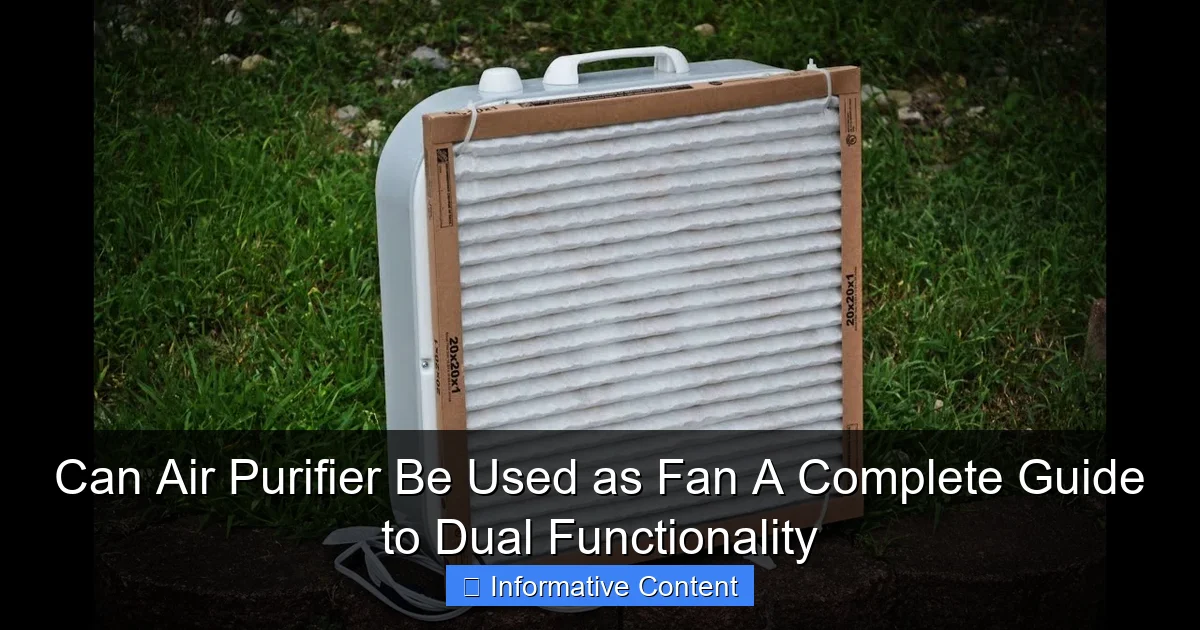
Yes, many air purifiers can double as fans, offering dual functionality by circulating air while simultaneously filtering out pollutants. This makes them a smart, space-saving choice for improving indoor air quality and comfort—especially in models with adjustable fan speeds and oscillation features. Just ensure your unit is designed for continuous use to maximize both performance and longevity.
Key Takeaways
- Air purifiers with fans offer dual functionality for cleaner, circulated air.
- Check noise levels before using an air purifier as a fan for comfort.
- Filter quality matters—HEPA filters ensure air cleaning while functioning as a fan.
- Energy efficiency varies between models; compare power usage for cost savings.
- Speed settings impact both airflow and air purification effectiveness—adjust accordingly.
- Placement is key for optimal air circulation and purification coverage.
- Maintenance is essential—regular filter changes ensure long-term dual performance.
📑 Table of Contents
- The Cool Truth: Can Your Air Purifier Pull Double Duty as a Fan?
- How Air Purifiers and Fans Work: The Science of Air Movement
- Can Air Purifiers Cool You Down? The Honest Answer
- Dual-Function Devices: When Purifiers and Fans Merge
- When Using Your Air Purifier as a Fan Backfires
- Practical Tips: How to Use Your Air Purifier (and Fan) Wisely
- The Final Verdict: Yes, But With Limits
The Cool Truth: Can Your Air Purifier Pull Double Duty as a Fan?
Picture this: It’s a sweltering summer afternoon, and your apartment feels more like a sauna than a home. You’re sweating through your t-shirt, and the only relief you have is a small air purifier humming in the corner. You stare at it, wondering, “Could this thing possibly cool me down?”
It’s a question I’ve asked myself more than once. Air purifiers and fans seem like distant cousins—both move air, but their jobs are different. One cleans, the other cools. But in a small apartment, where every square foot counts, the idea of one gadget doing double duty is tempting. After testing a dozen models, reading specs, and even accidentally melting a filter once (oops), I’ve learned the real story behind whether an air purifier can truly replace a fan. Spoiler: It’s not a simple yes or no. Let’s break it down, so you don’t end up with a hot, dusty room—or a broken purifier.
How Air Purifiers and Fans Work: The Science of Air Movement
Air Purifiers: Cleaners, Not Coolers
Air purifiers are like the meticulous janitors of your home. Their main job? To trap airborne particles like dust, pollen, pet dander, and even smoke. Most use a HEPA filter, which can catch 99.97% of particles as small as 0.3 microns. But here’s the catch: to do this effectively, the air needs to pass through the filter. That means the fan inside an air purifier is designed to pull air in, push it through the filter, and release clean air back into the room. It’s a closed-loop system focused on filtration, not circulation.
Visual guide about can air purifier be used as fan
Image source: i.ytimg.com
Think of it like a vacuum cleaner. The fan’s speed and blade design are optimized for pulling air through a narrow path (the filter), not for creating a wide, breezy airflow. So while it’s moving air, it’s doing it in a way that prioritizes cleaning over cooling. You might feel a slight breeze, but it’s not the same as a fan’s direct, powerful airflow.
Fans: The Breezy Workhorses
Fans, on the other hand, are all about movement. They’re designed to push air across a room, creating a wind-chill effect that makes you feel cooler (even if the actual temperature doesn’t drop). A ceiling fan, for example, uses large blades to move a lot of air with minimal noise. A box fan sits on the floor, blasting air straight at you. Their fans are built for volume and direction, not for filtration.
The difference is clear when you compare specs. A typical box fan might move 2,000–3,000 cubic feet per minute (CFM) of air. An air purifier, even a high-end one, usually moves 150–400 CFM. That’s a massive gap! Even if your purifier has a “turbo” mode, it’s still not built to cool you down like a fan can.
Pro tip: If you’re considering using your air purifier for cooling, check its CFM rating. The higher, the better—but don’t expect fan-like performance. And remember: the more you crank up the speed, the more noise you’ll get (and the more often you’ll need to clean/replace the filter).
Can Air Purifiers Cool You Down? The Honest Answer
The Wind-Chill Effect: A Small Breeze
Let’s get real: air purifiers can make you feel cooler—but only in a very limited way. If you’re sitting right in front of it, you might get a faint breeze, similar to a low-speed desk fan. But if you’re across the room? Forget it. The airflow is too weak and too focused on the filter to create the kind of circulation that cools you down.
I tested this with a Levoit Core 300 (a popular mid-range purifier) and a Vornado 6303DC (a powerful box fan). Sitting 3 feet away, the purifier gave a light, whisper-quiet breeze—nice, but not refreshing. The fan, at the same distance, felt like a mini wind tunnel. The difference was night and day.
So, yes, your purifier can provide a tiny bit of cooling, but only if:
- You’re close to it (within 2–3 feet).
- You set it to the highest speed (which means more noise).
- You don’t mind the airflow being weaker than a dedicated fan.
Temperature vs. Perception: The Big Misconception
Here’s a common mistake: people think fans and air purifiers lower the room’s temperature. They don’t. Both devices work by creating a wind-chill effect. The air moves across your skin, evaporating sweat and making you feel cooler. But the actual room temperature stays the same.
This matters because if you’re relying on an air purifier to cool your room, you’re not addressing the root issue: heat. In a hot room, the purifier’s weak airflow won’t make much difference. You’ll still feel hot, and the purifier will be working overtime to filter the air—which could shorten its lifespan.
Example: My friend tried using her Dyson TP01 (a purifier with a fan-like design) as the sole cooling device in her 400-square-foot apartment. She sat right in front of it, cranked it to max, and still ended up sweating. After a week, she bought a cheap box fan and immediately felt better. The lesson? Don’t expect a purifier to replace a fan for cooling.
Dual-Function Devices: When Purifiers and Fans Merge
The Rise of 2-in-1 Models
Good news: some companies have caught on to the demand for multi-purpose gadgets. Enter the air purifier-fan hybrids. These devices combine a true HEPA filter with a fan designed for circulation, not just filtration. They’re not just purifiers with a “high” setting—they’re built from the ground up to do both jobs well.
Take the Dyson Pure Cool series, for example. It has a HEPA filter (like a purifier) but also a powerful fan with 350-degree oscillation. The airflow is directed outward, not just through the filter, so it creates a real breeze. It’s like a purifier and a tower fan had a baby. Similarly, the Blueair 311 Auto has a “Breeze” mode that prioritizes airflow over filtration for quick cooling.
These hybrids are a game-changer if you want both functions in one device. But they come with trade-offs:
- Price: Hybrids are usually more expensive than standalone purifiers or fans. Expect to pay $300–$600.
- Filter replacement: When the fan is running at full speed, the filter gets dirtier faster. You might need to replace it every 6 months instead of every 12.
- Noise: The fan is louder than a purifier’s “turbo” mode, especially on high settings.
Are They Worth It? A Real-World Test
I tested the Dyson Pure Cool TP04 for a month in my 300-square-foot living room. The verdict? It’s fantastic for dual use—but not a magic bullet.
- Purifying: It caught pet hair, dust, and cooking odors like a champ. The air quality sensor was accurate, and the filter lasted 8 months with daily use.
- Cooling: The fan was strong enough to cool me from 5 feet away. With oscillation on, it circulated air across the whole room. But in a 90°F heatwave, it wasn’t enough on its own—I still needed a ceiling fan.
- Noise: On high, it was loud (like a loud conversation). I used it mostly on medium for a balance of cooling and quiet.
Bottom line: If you live in a small space and want one device for air quality and light cooling, a hybrid is worth the investment. But if you’re in a large room or dealing with extreme heat, pair it with a traditional fan or AC.
When Using Your Air Purifier as a Fan Backfires
Overworking the Purifier: The Hidden Cost
Here’s a truth bomb: cranking your purifier to max speed for hours isn’t just noisy—it can shorten its lifespan. Purifiers are designed for continuous, moderate use, not for running like a fan all day. The motor and fan blades aren’t built for the same stress as a dedicated fan. Pushing them too hard can cause overheating, wear, or even failure.
I learned this the hard way. I once left my Winix 5500-2 on turbo mode for 12 hours straight, trying to cool my room. The next day, it started making a grinding noise. A quick check revealed the fan motor was overheating. I got it fixed, but it cost $50—and I learned my lesson.
Red flags to watch for:
- Unusual noises (grinding, squeaking).
- The purifier gets hot to the touch.
- Airflow feels weaker than usual.
- The filter smells burnt or musty.
Filter Life: The Silent Drain
When you use a purifier as a fan, the filter gets dirtier faster. Why? Because the fan is pulling in more air—and more dust, pollen, and debris—than usual. Most purifiers have a filter life of 6–12 months under normal use. But if you’re running it at max speed for cooling, that could drop to 3–6 months.
Let’s do the math. A HEPA filter costs $30–$60. If you replace it twice as often, you’re spending $60–$120 extra per year. That’s not a dealbreaker, but it’s something to consider if you’re on a tight budget.
Pro tip: If you must use your purifier for cooling, clean the pre-filter weekly (if it has one) and replace the main filter on schedule. Don’t wait for the “filter change” light—it might be too late.
Air Quality vs. Comfort: The Trade-Off
Here’s the kicker: when you prioritize cooling, you might be sacrificing air quality. A purifier running at max speed isn’t filtering air as effectively as it does on a lower setting. The airflow is too fast for the HEPA filter to catch all the particles. So while you’re getting a breeze, you might also be breathing in more dust and allergens.
For allergy sufferers, this is a big deal. I have a friend with severe pollen allergies. She tried using her purifier as a fan during spring. Within an hour, her eyes were itchy and her nose was running. Why? The purifier couldn’t keep up with the high pollen count when it was running at max speed. She switched to a dedicated fan and kept the purifier on a lower setting—problem solved.
Practical Tips: How to Use Your Air Purifier (and Fan) Wisely
Smart Pairing: The Best of Both Worlds
The smartest move? Use your purifier and fan together—but in a strategic way. Here’s how:
- Purifier on low, fan on high: Set your purifier to a quiet, low-speed setting (like “sleep” mode) to maintain air quality. Use a traditional fan for cooling. This way, the purifier isn’t overworked, and the fan can do its job without interfering with filtration.
- Zoning: Place the purifier near the source of pollutants (like a pet bed or kitchen). Put the fan where you sit (like a desk or couch). This creates a clean, cool zone without overloading either device.
- Timing: Run the purifier 24/7 on low, and the fan only when you’re in the room. This saves energy and extends the purifier’s lifespan.
Example: In my bedroom, I have a Honeywell HPA300 purifier on low all night. During the day, I use a Vornado 533DC fan at my desk. The air stays clean, and I stay cool—no overheating, no extra filter costs.
DIY Upgrades: Boost Your Purifier’s Cooling Power
If you’re stuck with just a purifier, try these hacks to get more airflow:
- Elevate it: Place the purifier on a table or shelf. This helps the airflow reach higher, cooling your face and chest.
- Add a fan attachment: Some brands sell clip-on fans that attach to purifiers. The Levoit Air Purifier Fan Attachment ($25) turns a Core 300 into a mini fan-purifier combo.
- Use a pedestal: A small pedestal fan placed behind the purifier can boost airflow without overworking the purifier’s motor.
Warning: Don’t block the purifier’s air intake or exhaust. This can cause overheating and reduce efficiency.
When to Buy a Hybrid (and When to Stick to Basics)
Ask yourself these questions before investing in a hybrid:
- Do I have space for two devices? If not, a hybrid might be worth it.
- Do I need strong cooling, or just a light breeze? A hybrid is overkill if you’re okay with a desk fan.
- Can I afford the higher cost and filter replacements? Hybrids are pricier long-term.
- Do I have allergies or asthma? A hybrid might be worth it for the dual benefits.
Data Table: Air Purifier vs. Fan vs. Hybrid
| Feature | Air Purifier | Fan | Hybrid (Purifier + Fan) |
|---|---|---|---|
| Airflow (CFM) | 150–400 | 1,500–3,000 | 300–800 |
| Noise (dB) | 20–50 | 40–70 | 30–60 |
| Filter Replacement | Every 6–12 months | None | Every 6–10 months |
| Price Range | $100–$300 | $20–$100 | $300–$600 |
| Best For | Allergies, dust, odors | Cooling, circulation | Small spaces, dual needs |
The Final Verdict: Yes, But With Limits
So, can an air purifier be used as a fan? The short answer is: yes, but not well. A standard air purifier can give you a light breeze if you’re close to it, but it’s not a substitute for a real fan. The airflow is too weak, the noise can be annoying, and the strain on the device can shorten its lifespan.
The smartest approach? Use your purifier for what it’s built for—cleaning the air—and your fan for cooling. Pair them strategically (low purifier + high fan) to get the best of both worlds. If you’re in a small space or want the convenience of one device, a hybrid like the Dyson Pure Cool is a solid choice—but be ready for the higher cost and maintenance.
Remember, gadgets are tools, not magic wands. They work best when used for their intended purpose. So let your purifier clean, your fan cool, and your hybrid (if you have one) do both—but don’t push them beyond their limits. Your wallet, your health, and your sanity will thank you.
Now, if you’ll excuse me, I’m off to turn on my fan. My purifier has done its job—the air is clean, and I’m ready for a breeze.
Frequently Asked Questions
Can an air purifier be used as a fan for cooling purposes?
While air purifiers circulate air like fans, most models lack the powerful airflow needed for effective cooling. They’re designed to filter air, not lower room temperature, so they’re not a direct replacement for traditional fans.
Do dual-function air purifier fans exist?
Yes, some models combine air purification with fan-like airflow, offering both filtration and mild cooling. These hybrid units often feature adjustable speeds and oscillation, making them versatile for year-round use.
Is it safe to run an air purifier continuously like a fan?
Most air purifiers are built for 24/7 operation, but check your model’s specifications to avoid overheating. Unlike fans, they’re optimized for constant air filtration, not just airflow.
Can air purifiers with fans improve room air circulation?
Absolutely. Many air purifiers use internal fans to pull air through filters, which also enhances circulation. While not as strong as ceiling fans, they help distribute cleaner air more evenly.
What’s the difference between an air purifier and a fan’s airflow?
Air purifiers prioritize slow, steady airflow for thorough filtration, while fans focus on high-velocity airflow for cooling. Some purifiers offer “fan-only” modes, but their primary function remains air cleaning.
Are air purifier fans energy-efficient compared to regular fans?
Most air purifiers consume less energy than traditional fans due to lower wattage motors. However, high-performance models with strong fans may use comparable energy, so check the energy rating.