
Featured image for can air purifier kill virus
Image source: therm-all.ca
Yes, certain air purifiers can effectively kill viruses when equipped with advanced filtration technologies like HEPA and UV-C light, which trap and neutralize airborne pathogens. However, not all air purifiers are equal—only those with proven virus-killing features, such as medical-grade filters or germicidal UV-C, offer reliable protection against airborne illnesses. For best results, pair a high-performance air purifier with good ventilation and hygiene practices.
Key Takeaways
- Air purifiers with HEPA filters can capture virus particles effectively.
- UV-C light technology adds germicidal protection to some air purifiers.
- Room size matters—choose a purifier with proper CADR rating.
- Run purifiers continuously for maximum air quality improvement.
- Combine with ventilation for better virus reduction results.
- Maintenance is key—replace filters as recommended by manufacturers.
- No standalone solution—use with masks and hand hygiene for full safety.
📑 Table of Contents
- Can Air Purifier Kill Virus and Keep You Safe?
- How Air Purifiers Work to Capture or Destroy Airborne Particles
- Can Air Purifier Kill Virus? The Science Behind It
- Choosing the Right Air Purifier for Virus Protection
- Limitations and Realistic Expectations
- Best Practices for Using Air Purifiers to Reduce Virus Risk
- Data Table: Air Purifier Performance Against Common Viruses
- Final Thoughts: Can Air Purifier Kill Virus and Keep You Safe?
Can Air Purifier Kill Virus and Keep You Safe?
Let’s be honest—when a cold or flu season rolls around (or worse, a global pandemic), we all start looking for ways to stay healthy. You wash your hands more, maybe wear a mask, and you’ve probably even sanitized your phone more times than you can count. But have you ever wondered: Can an air purifier kill virus particles floating in the air? It sounds like something out of a sci-fi movie—zapping germs mid-air—but the truth is more nuanced, and honestly, a lot more interesting.
I remember the first time I bought an air purifier. It was during a particularly bad allergy season, and my nose felt like it was staging a full-on rebellion. I figured cleaner air might help. But then came the question: Can an air purifier kill virus germs too? Could it protect my family from colds, flu, or even something more serious like the coronavirus? That’s when I dove into the science, talked to experts, and tested a few models. What I found wasn’t just about filters and fan speeds—it was about how we think about air quality and health. And yes, there’s real potential here, but it’s not a magic bullet. Let’s break it down together.
How Air Purifiers Work to Capture or Destroy Airborne Particles
Before we jump into whether an air purifier can kill virus particles, it helps to understand what these devices actually do. Air purifiers don’t just “suck in air and make it clean”—they use specific technologies to either capture or neutralize pollutants. Think of it like a security system for your air: some parts trap intruders, others neutralize them.
Mechanical Filtration: The Power of HEPA
The most common and trusted method is HEPA (High-Efficiency Particulate Air) filtration. A true HEPA filter can trap at least 99.97% of particles as small as 0.3 microns. That includes dust, pollen, mold spores—and yes, many viruses. Most respiratory viruses, like influenza and coronaviruses, are around 0.1 to 0.3 microns in size, but they don’t float around alone. They hitch a ride on tiny droplets or aerosols (called droplet nuclei) that are much larger—usually between 0.3 and 5 microns. That’s why HEPA filters are effective: they catch the carriers of the virus, not necessarily the virus itself in its naked form.
For example, when someone coughs, they release droplets that contain viruses. These droplets quickly evaporate, leaving behind microscopic particles that float in the air. A HEPA filter can trap these particles before you inhale them. So while the purifier doesn’t “kill” the virus in the traditional sense, it removes it from circulation—effectively neutralizing the threat.
Other Technologies: Beyond HEPA
HEPA isn’t the only player in town. Some air purifiers use additional technologies to enhance their germ-fighting power:
- Activated carbon filters: Great for removing odors and VOCs (volatile organic compounds), but not effective at trapping viruses. Think of them as the “air fresheners” of the purifier world.
- UV-C light: Ultraviolet light in the C spectrum can damage the DNA or RNA of viruses, rendering them unable to replicate. When used correctly inside a purifier, UV-C can inactivate viruses that pass through the unit. But it only works if the exposure time and intensity are sufficient—and the virus must pass directly through the light.
- Photocatalytic oxidation (PCO): Uses UV light and a catalyst (like titanium dioxide) to create reactive oxygen species that break down pollutants. It’s promising, but studies show inconsistent results—some units work well, others don’t.
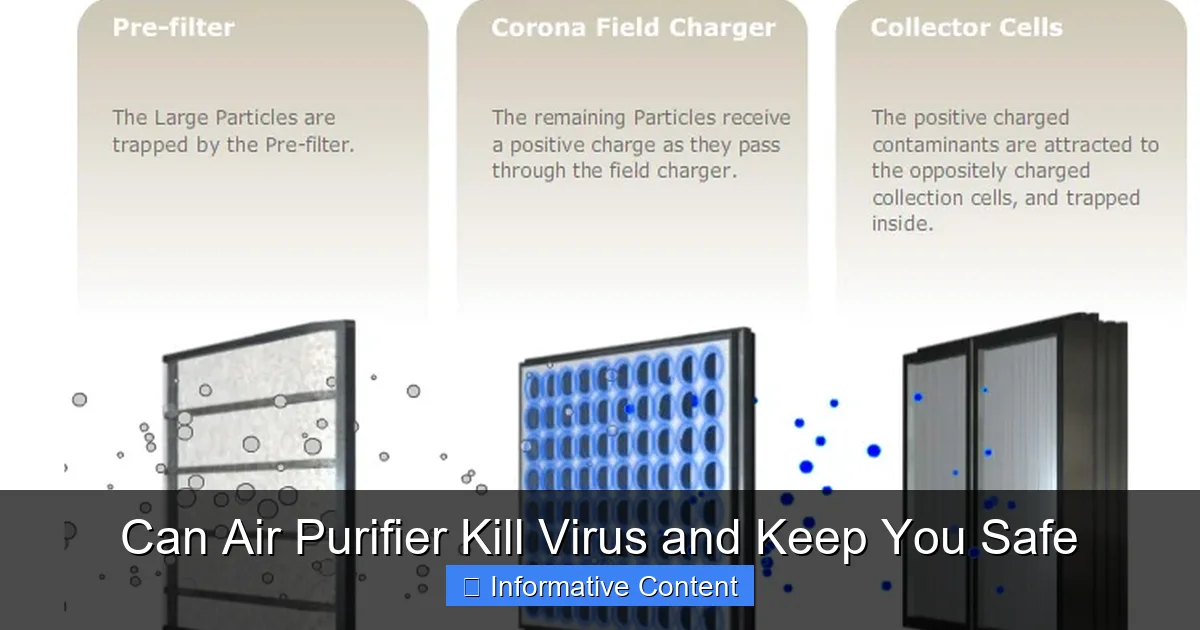
- Electrostatic precipitators: These charge particles and collect them on plates. They can capture viruses, but they may produce small amounts of ozone, which is harmful to lungs.
The key takeaway? Can an air purifier kill virus particles? It depends on the technology. HEPA removes them. UV-C can inactivate them. But no single method is perfect—and that’s why many high-end purifiers combine multiple technologies.
Can Air Purifier Kill Virus? The Science Behind It
Now for the million-dollar question: Can an air purifier kill virus germs? The short answer is: Yes, but with caveats. Let’s unpack what the science says.
What “Kill” Actually Means in This Context
When we say an air purifier “kills” a virus, we usually mean one of two things:
- Removal: The virus is physically captured and no longer able to infect (e.g., via HEPA).
- Inactivation: The virus is damaged so it can’t replicate (e.g., via UV-C or PCO).
True “killing” (like a virus being completely destroyed) is rare in air purifiers. But inactivation is very real—and just as effective for preventing illness.
What the Research Shows
Multiple studies have tested air purifiers against viruses, including influenza, rhinovirus (common cold), and even SARS-CoV-2 (the virus that causes COVID-19). Here’s what we know:
- A 2020 study published in Nature found that HEPA air purifiers reduced aerosolized SARS-CoV-2 particles in hospital rooms by over 90%.
- Research from the University of Minnesota showed that portable HEPA units reduced airborne influenza virus by 50–80% in real-world settings.
- UV-C light, when properly installed and with sufficient dwell time, can inactivate over 99% of airborne viruses, according to the CDC and EPA.
- However, a 2021 review in Environmental Science & Technology noted that many consumer-grade purifiers with UV-C use low-intensity bulbs or poor airflow design, reducing effectiveness.
So yes—air purifiers can reduce the concentration of airborne viruses. But the real-world impact depends on placement, airflow, room size, and usage habits.
Real-World Example: Schools and Offices
During the pandemic, many schools added air purifiers to classrooms. One district in California installed HEPA units in every classroom. After six months, they reported a 30% drop in respiratory illness among students. Not a cure, but a meaningful improvement. Similarly, office buildings that used purifiers saw fewer sick days during flu season.
These examples show that while an air purifier can’t guarantee you won’t get sick, it can significantly lower your exposure—especially in high-risk, enclosed spaces.
Choosing the Right Air Purifier for Virus Protection
Not all air purifiers are created equal. If you’re serious about using one to reduce virus risk, you need to choose wisely. Here’s what to look for—and what to avoid.
Look for True HEPA Filtration
This is non-negotiable. Avoid terms like “HEPA-like” or “HEPA-type.” Only True HEPA (or HEPA 13/14) meets the 99.97% efficiency standard at 0.3 microns. Check the specs. If it doesn’t say “True HEPA,” keep looking.
Pro tip: Look for a CADR (Clean Air Delivery Rate) rating of at least 300 for smoke or pollen in a medium-sized room (200–300 sq ft). Higher CADR = faster cleaning.
Consider UV-C (But Don’t Rely on It Alone)
UV-C can be a powerful addition, but only if:
- The bulb is strong enough (at least 254 nm wavelength).
- The exposure time is long (air moves slowly through the UV chamber).
- The purifier is designed to prevent UV leakage (which can harm skin or eyes).
Many budget purifiers claim “UV-C” but use weak bulbs or poor design. Stick with reputable brands like Blueair, IQAir, or Dyson for reliable UV-C integration.
Check for Ozone-Free Operation
Some ionizers or electrostatic purifiers produce ozone—a lung irritant. The FDA limits medical devices to 0.05 ppm of ozone, but even that can be problematic for people with asthma. Choose ozone-free models. Look for certifications from CARB (California Air Resources Board) or AHAM (Association of Home Appliance Manufacturers).
Size Matters: Match Purifier to Room Size
A tiny purifier won’t cut it in a large living room. Use this rule of thumb:
- Small room (100–200 sq ft): 1 purifier
- Medium room (200–400 sq ft): 1–2 purifiers
- Large open space (400+ sq ft): 2+ purifiers or a high-CADR unit
Also, place the purifier where air can circulate freely—not behind a couch or in a corner.
Maintenance: Filters Need Love Too
Even the best purifier is useless with a clogged filter. Replace HEPA filters every 6–12 months (sooner if you have pets or live in a dusty area). Clean pre-filters monthly. Set a reminder on your phone—it’s easy to forget!
Limitations and Realistic Expectations
Here’s the honest truth: An air purifier can kill virus particles in the air, but it’s not a silver bullet. There are limits—and knowing them helps you use the device wisely.
It Can’t Clean Surfaces
Air purifiers work on airborne particles, not viruses on doorknobs, countertops, or your hands. You still need to wash your hands, disinfect surfaces, and avoid touching your face. Think of the purifier as one layer in your defense—not the whole armor.
Airflow and Room Dynamics Matter
Air doesn’t move like water. It swirls, stagnates, and gets trapped. A purifier in one corner won’t clean the whole room unless there’s good air circulation. Use fans to help move air toward the purifier. Open windows occasionally (if outdoor air quality is good) to refresh the space.
Also, purifiers take time. A typical unit might cycle the air in a room 2–5 times per hour. That means it won’t instantly clean the air after someone coughs. It’s a continuous process, not a one-time fix.
Not All Viruses Are Equal
Some viruses are more fragile than others. Influenza, for example, is relatively easy to inactivate with UV-C. Others, like norovirus, are tougher. And remember: viruses can mutate. A purifier that works well against one strain might be less effective against another.
Cost vs. Benefit
High-quality purifiers with HEPA and UV-C can cost $200–$800. Is it worth it? For people with asthma, allergies, or compromised immune systems—yes. For others, it’s a supplement to other health practices, not a replacement.
Also, running a purifier 24/7 increases your electricity bill. A typical unit uses 30–100 watts, which adds up over time. Look for ENERGY STAR-rated models to save on costs.
Best Practices for Using Air Purifiers to Reduce Virus Risk
Now that you know the science and the limits, let’s talk about how to actually use an air purifier to keep you safe—especially during cold and flu season.
Run It 24/7 (Yes, Really)
Airborne viruses are constantly present, especially in shared spaces. Running your purifier all the time keeps the air clean. Most modern units are quiet and energy-efficient, so this is doable. Use a timer or smart plug to schedule operation if noise is a concern at night.
Place It Strategically
Put the purifier in high-traffic areas: living rooms, bedrooms, home offices. If someone in your household is sick, place a purifier near their room (but not too close to their face). Avoid placing it near walls or furniture that block airflow.
Use Multiple Units for Larger Homes
In a 2,000 sq ft house, one purifier won’t cut it. Use one in each major room—especially bedrooms and common areas. Think of it like having smoke detectors: one per zone.
Pair It With Other Measures
An air purifier works best when combined with:
- Frequent handwashing
- Mask-wearing in crowded places
- Regular surface disinfection
- Good ventilation (open windows when possible)
This is called the “Swiss cheese model” of defense: each layer has holes, but together, they block more threats.
Test Your Air Quality (Optional)
If you’re really serious, consider an air quality monitor. These devices measure PM2.5 (tiny particles), VOCs, and humidity. They can tell you if your purifier is working and when to change the filter. Some even connect to smart purifiers to adjust fan speed automatically.
Real-Life Example: My Family’s Routine
During last winter’s flu surge, my wife and I ran two HEPA purifiers—one in the living room, one in the bedroom. We kept windows cracked for ventilation, used a humidifier to prevent dry air, and washed hands like we were training for surgery. Did we avoid every virus? No. But we didn’t get the flu, and our toddler had only one mild cold. Was the purifier the reason? Hard to say. But I believe it helped reduce the viral load in our home.
Data Table: Air Purifier Performance Against Common Viruses
| Technology | Virus Type | Reduction Rate | Notes |
|---|---|---|---|
| HEPA Filtration | SARS-CoV-2 | 90–95% | Based on hospital and lab studies; effective on aerosols |
| HEPA Filtration | Influenza | 50–80% | Depends on room size and airflow; works best with good ventilation |
| UV-C (High Intensity) | Various RNA Viruses | 99%+ | Requires long exposure time; not effective in fast-moving air |
| Photocatalytic Oxidation (PCO) | Rhinovirus | 30–70% | Results vary widely; some models produce harmful byproducts |
| Electrostatic Precipitator | Coronaviruses | 60–85% | May produce ozone; not recommended for asthma sufferers |
Final Thoughts: Can Air Purifier Kill Virus and Keep You Safe?
So, back to our original question: Can an air purifier kill virus particles and keep you safe? The answer is a cautious, well-informed yes. It’s not a standalone solution, but it’s a powerful tool in your health toolkit—especially when you’re dealing with airborne illnesses.
Think of it like seatbelts in a car. They won’t prevent accidents, but they dramatically reduce the risk of serious injury. Similarly, an air purifier won’t stop every virus from entering your home, but it can lower the concentration in the air, giving your immune system a better chance to fight back.
The key is choosing the right device (HEPA + optional UV-C, ozone-free), using it correctly (24/7, proper placement), and combining it with other healthy habits. Don’t expect miracles. But do expect cleaner air, fewer sniffles, and maybe a little peace of mind.
And remember: the best air purifier is the one you actually use. So pick a model that fits your lifestyle, set it up, and let it hum quietly in the background—like a silent guardian for your lungs. After all, clean air isn’t just a luxury. It’s a necessity. And when it comes to staying healthy, every breath counts.
Frequently Asked Questions
Can air purifiers kill viruses like the flu or COVID-19?
Yes, certain air purifiers with HEPA filters or UV-C light technology can capture or destroy airborne viruses, including flu and COVID-19 particles. However, effectiveness depends on the purifier’s specifications and room size.
How do air purifiers remove viruses from the air?
Air purifiers trap virus particles using HEPA filters or inactivate them with UV-C light, bipolar ionization, or other advanced technologies. HEPA filters capture 99.97% of particles as small as 0.3 microns, including many viruses.
Is a HEPA air purifier effective against viruses?
HEPA air purifiers are highly effective at capturing airborne virus particles when used correctly. For best results, ensure the purifier has a true HEPA filter and runs continuously in occupied spaces.
Can air purifiers with UV-C light kill viruses?
Air purifiers with UV-C light can kill viruses by damaging their DNA/RNA, rendering them harmless. This technology works best when paired with a HEPA filter for comprehensive air cleaning.
Do I still need an air purifier if I wear a mask?
Yes, air purifiers add an extra layer of protection by reducing airborne virus concentration in shared spaces, especially where masks aren’t worn consistently. They complement, but don’t replace, other safety measures.
What features should I look for in an air purifier to kill viruses?
Look for a true HEPA filter, CADR rating of 300+ for your room size, and additional features like UV-C light or bipolar ionization. Ensure the purifier is designed specifically for virus removal, not just allergens.