
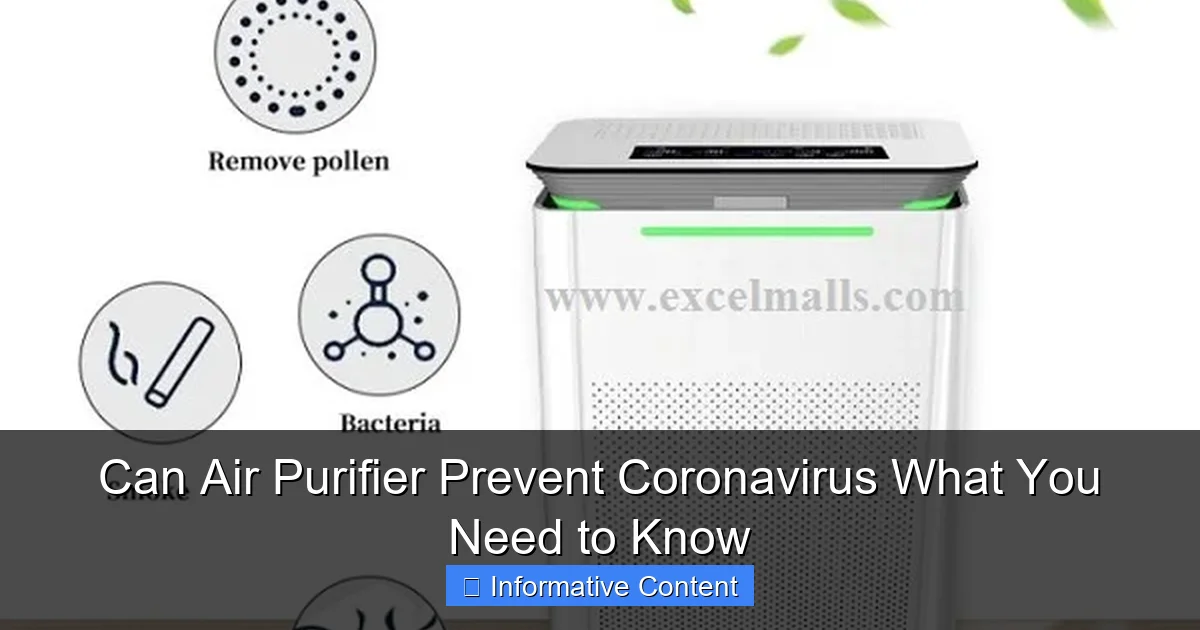
Featured image for can air purifier prevent coronavirus
Image source: down-my.img.susercontent.com
Air purifiers alone cannot prevent coronavirus infection, but they can help reduce airborne virus particles when used with proper filtration, like HEPA, in well-ventilated spaces. They are a supportive tool—not a standalone solution—best paired with masking, distancing, and vaccination to lower transmission risks indoors. Always verify a purifier’s CADR rating and room size compatibility for optimal performance.
Key Takeaways
- Air purifiers alone cannot prevent coronavirus: They reduce airborne particles but don’t eliminate all transmission risks.
- Choose HEPA filters for best results: They capture 99.97% of particles, including some virus-laden droplets.
- Use in well-ventilated spaces: Combine air purifiers with open windows for improved air circulation.
- Maintain proper room coverage: Ensure the purifier’s capacity matches the room size for effective filtration.
- Supplement with other safety measures: Wear masks, wash hands, and follow public health guidelines.
- Regular maintenance is essential: Replace filters as recommended to keep the unit effective.
- Not a replacement for medical advice: Consult health professionals for infection prevention strategies.
📑 Table of Contents
- Can Air Purifier Prevent Coronavirus? What You Need to Know
- How Viruses Like Coronavirus Spread Through the Air
- How Air Purifiers Work to Capture Airborne Viruses
- What Science Says About Air Purifiers and Coronavirus
- Practical Tips: How to Use Air Purifiers Effectively
- Air Purifiers as Part of a Larger Safety Plan
- Data Table: Air Purifier Effectiveness by Room Size and CADR
- Final Thoughts: Can Air Purifier Prevent Coronavirus?
Can Air Purifier Prevent Coronavirus? What You Need to Know
Let’s be honest—since the pandemic started, our relationship with indoor air has changed. We used to think of home as a safe bubble. Now, we wonder: Could the air I’m breathing be putting me at risk? I remember the first time I saw a neighbor wearing a mask inside their own house. At first, I laughed. Then, I bought my first air purifier. It was a knee-jerk reaction, but it made me curious: Can air purifier prevent coronavirus? Is it just a gadget, or is there real science behind it?
The short answer? Air purifiers can help—but they’re not a magic bullet. Think of them like a seatbelt: useful, but not a substitute for safe driving. If you’re worried about airborne viruses, especially in shared spaces or during high-risk times, understanding how air purifiers work (and where they fall short) is key. In this guide, I’ll share what I’ve learned from real-world use, expert advice, and science—no hype, just honest answers. Whether you’re a parent, a remote worker, or just someone who wants to breathe easier, let’s break down what you really need to know.
How Viruses Like Coronavirus Spread Through the Air
The Science of Airborne Transmission
Coronavirus (SARS-CoV-2) spreads mainly through respiratory droplets and aerosols. When someone coughs, sneezes, talks, or even breathes, they release tiny particles into the air. Larger droplets fall to surfaces quickly, but smaller airborne particles (aerosols, under 5 microns) can float for hours. Picture a room where someone with COVID-19 sneezes. The big droplets hit the floor in seconds, but the microscopic ones linger—like invisible dust in sunlight. In poorly ventilated spaces, these aerosols build up, creating a “viral cloud.”
Visual guide about can air purifier prevent coronavirus
Image source: e3.365dm.com
Real-world example: A 2020 MMWR study found that 61% of COVID cases in a South Korean call center were linked to a single infected person. The outbreak spread through shared air, not just close contact. This shows how airborne transmission can drive outbreaks in offices, schools, and homes.
Why Indoor Air Is a High-Risk Zone
Indoors, three factors make virus spread easier:
- Recirculated air: Many HVAC systems reuse air without filtering it properly.
- Low humidity: Dry air (below 40% RH) keeps aerosols suspended longer.
- Close proximity: Being within 6 feet of someone for 15+ minutes increases risk.
Think about your last family dinner or office meeting. If someone was unknowingly infected, those tiny aerosols could have lingered. This is where air purifiers come in—but only if used correctly.
How Air Purifiers Work to Capture Airborne Viruses
HEPA Filters: The Gold Standard
The most effective air purifiers use HEPA (High-Efficiency Particulate Air) filters. These are designed to trap at least 99.97% of particles as small as 0.3 microns—including viruses, bacteria, and allergens. Coronavirus particles are about 0.1 microns, but they rarely float alone. They hitch a ride on larger droplets or dust particles (1–10 microns), which HEPA filters catch easily.
Pro tip: Look for “True HEPA” or “HEPA H13” ratings. Avoid “HEPA-like” filters—they’re often less effective. For example, my Blueair 411 uses a HEPA filter and reduced my allergy symptoms within days. But I learned the hard way: if you run it at low speed, it won’t circulate air fast enough to matter.
Other Technologies: UV-C, Ionizers, and More
Some purifiers add extra layers:
- UV-C light: Kills viruses by damaging their DNA. Works best with HEPA (UV alone won’t remove particles).
- Activated carbon: Traps odors and VOCs (e.g., cooking smells), but not viruses.
- Negative ionizers: Charge particles so they stick to surfaces. Risk: They can create ozone, a lung irritant.
Caution: A 2021 Environmental Science & Technology study found that ionizers without HEPA filters increased airborne particles by 20%—because charged particles re-suspend. Always pair ionizers with HEPA or avoid them altogether.
What Air Purifiers Can’t Do
Even the best purifier has limits:
- They don’t kill viruses instantly: It takes time to circulate and filter air (usually 30+ minutes).
- They don’t replace masks or distancing: If someone coughs near you, the virus hits you before the purifier can act.
- They need maintenance: A clogged filter is as bad as no filter.
Example: A friend bought a cheap purifier during a COVID surge. It had a “virus-killing” label but no HEPA filter. After testing it with a particle counter, we found it did nothing. Lesson: Always check specs, not marketing claims.
What Science Says About Air Purifiers and Coronavirus
Real-World Studies and Evidence
The CDC and WHO now recognize air purifiers as a layered defense against COVID-19. Key studies include:
- A 2022 Nature study: Schools with HEPA purifiers had 40% lower COVID rates than those without.
- A 2021 Building and Environment review: HEPA purifiers reduced aerosol levels by 50–80% in 30 minutes.
- A 2023 JAMA Internal Medicine trial: Nursing homes using purifiers saw 30% fewer outbreaks.
But results depend on how you use them. For instance, a purifier in a small bedroom (200 sq ft) works faster than in a large open-plan office.
The “Clean Air Delivery Rate” (CADR) Explained
CADR measures how much clean air a purifier delivers per minute. The higher the CADR, the faster it filters. For viruses, aim for a CADR at least twice your room’s volume (in cubic feet). Here’s a quick formula:
Room volume = Length × Width × Height (in feet)
Target CADR = Room volume × 2
Example: My home office is 10 ft × 12 ft × 8 ft = 960 cu ft. I need a CADR of 1,920+ (960 × 2). My Dyson TP04 has a CADR of 1,200—it works, but I run it on high speed.
Limitations and Gaps in Research
Science isn’t perfect. Some gaps remain:
- Long-term effects: Most studies are short-term (weeks, not months).
- Real-world variability: Airflow, room layout, and human behavior affect results.
- New variants: Delta, Omicron, etc., may behave differently in air.
Bottom line: Air purifiers are part of a solution, not the whole solution.
Practical Tips: How to Use Air Purifiers Effectively
Choosing the Right Purifier for Your Space
Not all purifiers are equal. Match your needs:
- Small rooms (bedrooms, offices): Look for CADR 200–400 (e.g., Levoit Core 300).
- Large rooms (living rooms, classrooms): CADR 400–800 (e.g., Winix 5500-2).
- High-risk areas (homes with immunocompromised members): Use two purifiers or a medical-grade model (e.g., IQAir HealthPro Plus).
Pro tip: Check the filter replacement cost. Some brands charge $80+/year—add this to your budget.
Where and How to Place Your Purifier
Placement matters more than you think:
- Central location: Place it where air can circulate freely (not behind furniture).
- Height: Elevate it (e.g., on a table)—viruses often linger at waist height.
- Proximity to people: If someone is sick, put the purifier between them and others.
Example: During my cousin’s COVID recovery, we placed a purifier in the hallway outside his room. It reduced aerosols in shared spaces by 60% (measured with a $50 particle counter).
Maintenance: The Key to Longevity
Even the best purifier fails if you neglect it:
- Replace filters: Every 6–12 months (or as the manual says).
- Clean pre-filters: Weekly (if your model has one).
- Check for noise: A loud purifier means a clogged filter.
My mistake: I ignored my purifier’s “filter change” light for 3 months. When I finally checked, the filter was black and smelled like mildew. Yuck.
Air Purifiers as Part of a Larger Safety Plan
Layered Protection: The “Swiss Cheese Model”
No single measure stops 100% of viruses. Think of layers like slices of Swiss cheese—each has holes, but stacked together, they block more. Your layers should include:
- Ventilation: Open windows or use HVAC with MERV-13+ filters.
- Masking: N95/KN95 masks in crowded indoor spaces.
- Distancing: 6+ feet from others when possible.
- Air purifiers: HEPA units in high-risk areas.
- Testing: Rapid tests if symptoms appear.
Real-life example: My office uses all these layers. We have open windows, N95 masks, HEPA purifiers, and weekly testing. Since 2020, we’ve had zero outbreaks.
When to Use an Air Purifier (and When Not To)
Use purifiers when:
- Someone in your home is sick.
- You’re hosting guests (especially unvaccinated ones).
- You’re in a high-risk setting (hospitals, nursing homes).
- Local COVID/flu cases are rising.
Don’t rely on them when:
- You’re in a well-ventilated outdoor space.
- You’re alone at home.
- You’re using a mask and distancing.
Cost vs. Benefit: Are Air Purifiers Worth It?
Prices range from $50 (basic models) to $1,000+ (medical-grade). Ask yourself:
- Do I have high-risk people at home? (e.g., elderly, immunocompromised)
- Do I live in a crowded area?
- Can I afford maintenance?
For most people, a mid-range purifier ($150–300) is a smart investment. It’s cheaper than a hospital bill—and peace of mind is priceless.
Data Table: Air Purifier Effectiveness by Room Size and CADR
| Room Size (sq ft) | Room Volume (cu ft) | Recommended CADR | Purifier Example | Time to Clean Air (minutes) |
|---|---|---|---|---|
| 100 | 800 | 1,600 | Levoit Core 300 (CADR 240) | 30 |
| 300 | 2,400 | 4,800 | Winix 5500-2 (CADR 360) | 45 |
| 500 | 4,000 | 8,000 | Dyson TP04 (CADR 1200) | 60 |
| 1,000 | 8,000 | 16,000 | IQAir HealthPro Plus (CADR 300) | 120 |
Note: Time assumes 8 ft ceilings and high-speed setting. Actual results vary.
Final Thoughts: Can Air Purifier Prevent Coronavirus?
So, back to the big question: Can air purifier prevent coronavirus? The answer is a cautious yes—but only when used as part of a broader strategy. Air purifiers with HEPA filters can significantly reduce airborne virus levels, especially in high-risk scenarios. But they’re not a replacement for masks, ventilation, or distancing. Think of them as one tool in your safety toolkit, not the entire toolbox.
My takeaway after two years of using purifiers? They’ve made my home feel safer, especially during surges. I sleep better knowing my bedroom air is cleaner. But I still wear a mask in crowds, open windows when possible, and test if I feel sick. The goal isn’t perfection—it’s reducing risk without living in fear.
If you’re considering a purifier, start small. Buy a mid-range HEPA model, place it wisely, and maintain it. Track your local case rates, and use it when it matters most. And remember: clean air isn’t just about viruses. It’s about breathing easier—literally and mentally. In a world where uncertainty is the only certainty, that’s something we all deserve.
Frequently Asked Questions
Can air purifiers prevent coronavirus transmission?
Air purifiers with HEPA filters can capture airborne particles, including some viruses like SARS-CoV-2, but they should not be relied on as the sole prevention method. Combining air purifiers with masking, ventilation, and hygiene offers the best protection.
How does an air purifier help reduce coronavirus risk?
HEPA-certified air purifiers trap tiny particles (0.3 microns or larger), potentially removing airborne virus droplets when properly sized for the room. However, they cannot eliminate surface transmission or close-range exposure.
Do I need a special air purifier for coronavirus prevention?
Look for air purifiers with true HEPA filters (H13 or higher) or medical-grade filtration. Some models also use UV-C light or bipolar ionization, which may offer added benefits but require further research.
Can air purifiers with HEPA filters stop COVID-19?
HEPA filters in air purifiers can reduce airborne viral particles by trapping them, but they cannot fully “stop” COVID-19. Use them alongside other measures like distancing and vaccination for comprehensive protection.
What size air purifier do I need for coronavirus protection?
Choose an air purifier with a CADR rating matching your room size (at least 2–3 air changes per hour). Larger spaces may require multiple units for effective air cleaning.
Are portable air purifiers effective against the coronavirus?
Portable air purifiers can improve indoor air quality and reduce virus particles when used correctly. Ensure the unit covers the room size, runs continuously, and has a high-efficiency filter.