
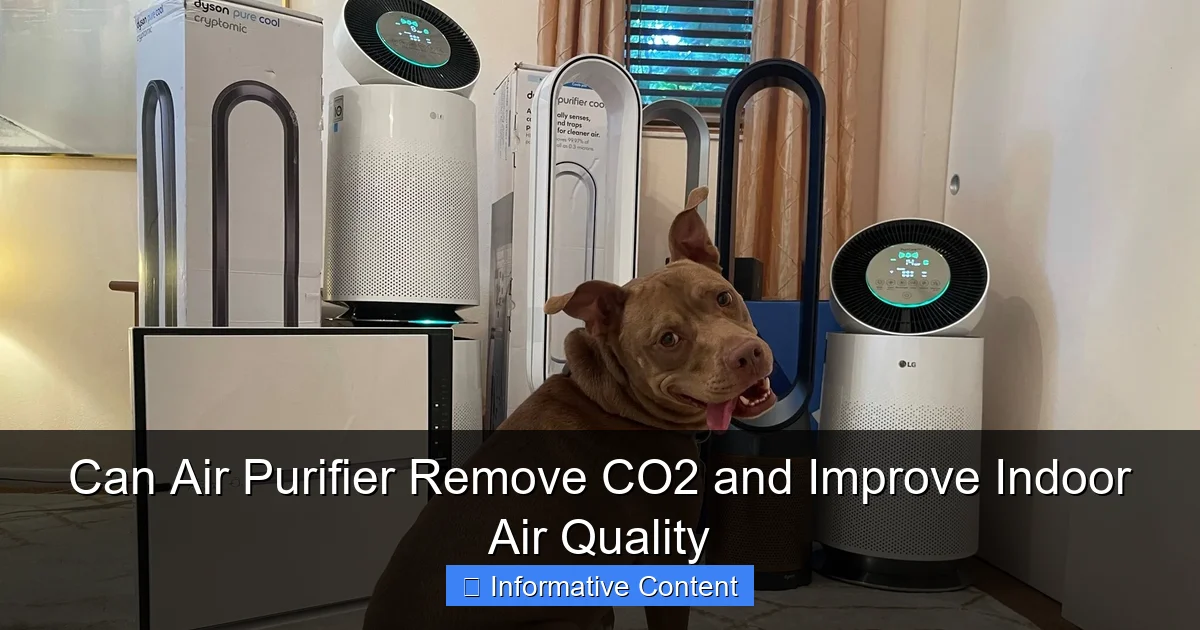
Featured image for can air purifier remove co2
Image source: i.pcmag.com
No, standard air purifiers cannot remove CO2—they target pollutants like dust, allergens, and VOCs, not carbon dioxide. Only specialized systems, such as those with molecular filtration or CO2 scrubbers, can reduce CO2 levels, making them essential for spaces requiring precise air quality control. For most homes, improving ventilation remains the best way to lower CO2 concentrations.
Key Takeaways
- Air purifiers cannot remove CO2: They filter particles, not gaseous CO2.
- Ventilation reduces CO2: Open windows or use HVAC systems for fresh air.
- Plants help lower CO2: Add indoor plants to absorb CO2 naturally.
- CO2 monitors are essential: Track levels to identify poor ventilation areas.
- HEPA filters don’t trap CO2: Use them for allergens, not CO2 reduction.
📑 Table of Contents
- Can Air Purifier Remove CO2 and Improve Indoor Air Quality?
- Understanding CO2: What It Is and Why It Matters Indoors
- How Air Purifiers Work: The Truth About CO2 Removal
- Effective Ways to Reduce Indoor CO2 (Beyond Air Purifiers)
- Myths vs. Facts: What You Need to Know
- Data Snapshot: CO2 Levels and Health Effects
- Conclusion: The Right Tools for the Right Job
Can Air Purifier Remove CO2 and Improve Indoor Air Quality?
Let’s be honest—most of us spend a big chunk of our lives indoors. Whether it’s at home, in the office, or even at school, we’re breathing the same recycled air for hours on end. And while we often worry about dust, pollen, or pet dander, there’s a less visible but equally important concern: carbon dioxide (CO2). You’ve probably heard about CO2 in the context of climate change, but did you know it can also build up in your home and impact your health and focus?
I remember the first time I felt sluggish during a long meeting at work. The room was warm, the windows were sealed, and everyone was yawning. My colleague joked, “We’re running low on oxygen!” But in reality, it wasn’t a lack of oxygen—it was a rise in CO2. That moment got me thinking: Can air purifier remove CO2? And more importantly, can these devices truly improve indoor air quality in a meaningful way? If you’ve ever felt tired in a crowded room or struggled to concentrate at home, you’ve probably wondered the same thing. Let’s dive into the science, the myths, and the real solutions.
Understanding CO2: What It Is and Why It Matters Indoors
What Is Carbon Dioxide (CO2)?
Carbon dioxide is a colorless, odorless gas that’s naturally present in the atmosphere. We all produce it every time we exhale. In outdoor environments, CO2 levels are typically around 400 parts per million (ppm)—a safe and normal concentration. But indoors, especially in poorly ventilated spaces, CO2 can accumulate quickly. Think about a small bedroom with two people sleeping for eight hours, or a packed conference room with 20 people talking for an hour. In these cases, CO2 levels can easily rise above 1,000 ppm—and even exceed 2,500 ppm in extreme situations.
Unlike pollutants like smoke or mold, CO2 isn’t toxic at typical indoor levels. But it does affect how your body and brain function. Higher CO2 concentrations can lead to:
- Reduced concentration and mental clarity
- Increased drowsiness and fatigue
- Headaches and dizziness
- Impaired decision-making
- Even nausea at very high levels (above 5,000 ppm)
Why Indoor CO2 Builds Up
Indoor CO2 builds up due to a few key factors:
- Occupant density: More people = more exhaled CO2. A family of four in a small apartment will generate more CO2 than a single person in a large house.
- Poor ventilation: Sealed windows, lack of HVAC systems, or closed doors trap air and prevent fresh air exchange.
- Energy-efficient building designs: While great for saving energy, modern homes and offices are often built to be airtight, which limits airflow.
- Extended occupancy: Long meetings, overnight stays, or remote work can all contribute to rising CO2 levels.
For example, a 2015 study by the Lawrence Berkeley National Laboratory found that students in classrooms with high CO2 levels (above 1,000 ppm) performed significantly worse on cognitive tests than those in well-ventilated rooms. That’s not just a comfort issue—it’s a performance issue.
How Air Purifiers Work: The Truth About CO2 Removal
Common Air Purifier Technologies
Before we answer can air purifier remove CO2, let’s understand how most air purifiers actually work. The majority use one or more of these technologies:
- HEPA filters: These capture tiny particles like dust, pollen, pet dander, and mold spores. They’re great for allergies and asthma but do not remove gases like CO2.
- Activated carbon filters: These adsorb volatile organic compounds (VOCs), odors, smoke, and some gases (like formaldehyde or benzene). However, CO2 is a stable, non-reactive molecule, so it doesn’t bind well to carbon.
- UV-C light: Used to kill bacteria, viruses, and mold. It has no effect on CO2.
- Ionizers: Release charged particles to make airborne contaminants stick to surfaces. Again, ineffective against CO2.
- Photocatalytic oxidation (PCO): Breaks down pollutants using UV light and a catalyst. Still, CO2 isn’t broken down—it’s a byproduct of the process, not a target.
So, if you’re using a standard HEPA or carbon filter purifier, it’s doing a great job at cleaning particulates and odors—but it’s not removing CO2. In fact, most consumer air purifiers on the market today are completely incapable of reducing CO2 levels.
Why CO2 Isn’t Filtered Like Other Pollutants
CO2 is a small, stable molecule. It doesn’t carry an electrical charge, and it doesn’t easily stick to surfaces or react with most filter materials. Think of it like trying to catch a marble with a fishing net—it just slips through. Even the most advanced activated carbon filters can only adsorb a tiny fraction of CO2, and they quickly become saturated.
Some companies claim their purifiers “reduce CO2” using special filters, but these are often marketing gimmicks. Independent testing by organizations like Consumer Reports and Wirecutter has shown that such filters have negligible impact on CO2 levels. In one test, a purifier with a “CO2-reducing” filter reduced CO2 by less than 50 ppm over several hours in a closed room—while natural ventilation dropped it by 500 ppm in the same time.
The bottom line: No mainstream air purifier can effectively remove CO2 from the air. If you’re buying one for that purpose, you’re likely wasting your money.
Effective Ways to Reduce Indoor CO2 (Beyond Air Purifiers)
Ventilation: The Real Game-Changer
If air purifiers can’t remove CO2, what can? The most effective and scientifically proven method is ventilation—introducing fresh outdoor air into your space. Here are some practical ways to do it:
- Open windows: Even 5–10 minutes every few hours can make a big difference. I do this in my home office during the day, and I notice a huge improvement in focus.
- Use exhaust fans: Bathroom and kitchen fans pull stale air out, allowing fresh air to enter through gaps or windows.
- Install a mechanical ventilation system: Systems like Energy Recovery Ventilators (ERVs) or Heat Recovery Ventilators (HRVs) exchange indoor and outdoor air while retaining heat or cooling. They’re common in energy-efficient homes and are excellent for maintaining CO2 levels.
- Cross-ventilation: Open windows on opposite sides of a room to create a breeze. This is especially helpful in larger spaces.
For example, a small study in a home office showed that opening a window for 10 minutes every hour reduced CO2 from 1,800 ppm to under 800 ppm. That’s a dramatic improvement—and it cost nothing.
CO2 Monitors: Know Your Air
You can’t manage what you can’t measure. A CO2 monitor (also called a CO2 meter or indoor air quality monitor) gives you real-time feedback on your air. I use one in my bedroom, and it’s been eye-opening. I’ve learned that CO2 spikes when the door is closed all night, but drops quickly when I crack the window.
Look for monitors that show CO2 in ppm and include other metrics like temperature and humidity. Some popular models include the Aranet4, Kaiterra, and Airthings Wave Plus. They range from $100 to $200 and are worth every penny if you care about air quality.
Houseplants: A Natural (But Limited) Option
You’ve probably heard that plants “clean the air” and reduce CO2. It’s true—during photosynthesis, plants absorb CO2 and release oxygen. But there’s a catch: they only do this in the presence of light, and their effect is minimal in typical home settings.
A NASA study from the 1980s suggested that certain plants could improve indoor air quality. However, more recent research (like a 2019 study from Drexel University) found that you’d need 10–1,000 plants per square meter to make a meaningful impact on CO2. That’s not practical for most homes.
That said, plants are still great for aesthetics, humidity, and mental well-being. Just don’t rely on them to fix CO2 problems.
When Air Purifiers Can Help (Even Without CO2 Removal)
Improving Overall Air Quality
Even though air purifiers don’t remove CO2, they play a crucial role in improving indoor air quality. In fact, they can make your space feel less stuffy and more comfortable—which indirectly helps with CO2-related fatigue.
For example, if your room has high levels of dust, pet dander, or cooking odors, you might feel more congested or tired. An air purifier with a HEPA filter can reduce these irritants, making the air feel “fresher” and easier to breathe. This can improve your overall well-being, even if CO2 levels are unchanged.
Think of it like this: CO2 is the silent drainer of your energy. But other pollutants are like loud, annoying distractions. Removing the distractions helps you focus better and feel more alert—even if the CO2 is still there.
Combining Purifiers with Ventilation for Best Results
The most effective strategy is a two-pronged approach:
- Use an air purifier to remove particulates, allergens, and odors.
- Use ventilation (or a ventilator system) to reduce CO2 and refresh the air.
I do this in my home: I run a HEPA purifier in the living room during the day to handle dust and pet hair, and I open the windows for 10 minutes every few hours. At night, I use a quieter purifier in the bedroom and crack the window slightly. The result? Cleaner air, better sleep, and no afternoon brain fog.
Some smart purifiers even connect to CO2 monitors and automatically increase fan speed when CO2 rises—though they still can’t remove it. Instead, they alert you to ventilate. It’s a helpful reminder, not a solution.
Myths vs. Facts: What You Need to Know
Myth: “All air purifiers reduce CO2”
Fact: Only a handful of industrial or specialized systems can remove CO2—and they’re not for home use. Most consumer purifiers cannot and do not reduce CO2 levels.
Myth: “A purifier with a ‘CO2 filter’ works”
Fact: These filters are usually just marketing hype. Independent tests show minimal to no CO2 reduction. If a company claims this, ask for third-party lab results.
Myth: “If the air feels fresh, CO2 must be low”
Fact: CO2 is odorless and invisible. You can’t tell its level by how the air “feels.” A room can smell clean but still have high CO2. Only a monitor gives you accurate data.
Myth: “Plants are enough to balance CO2”
Fact: While beautiful and beneficial, houseplants have a negligible impact on CO2 in real-world conditions. Don’t rely on them as your primary air quality solution.
Myth: “Sealed homes are healthier”
Fact: Sealed homes save energy but trap CO2, VOCs, and humidity. The healthiest homes balance energy efficiency with proper ventilation.
Data Snapshot: CO2 Levels and Health Effects
| CO2 Level (ppm) | Effects | Recommended Action |
|---|---|---|
| 400–600 | Normal outdoor levels. No health effects. | Maintain current ventilation. |
| 600–1,000 | Common in well-ventilated homes. Slight drowsiness possible. | Open windows occasionally. |
| 1,000–1,500 | Reduced concentration, mild headaches, fatigue. | Increase ventilation. Use exhaust fans. |
| 1,500–2,500 | Significant drowsiness, poor decision-making, discomfort. | Ventilate immediately. Leave the room if possible. |
| 2,500+ | Nausea, dizziness, shortness of breath. Not safe for prolonged exposure. | Evacuate and ventilate. Check for combustion sources. |
Source: ASHRAE, EPA, and peer-reviewed studies on indoor air quality.
Conclusion: The Right Tools for the Right Job
So, can air purifier remove CO2? The honest answer is: no, not really. Most air purifiers are excellent at removing particles, allergens, and odors—but they can’t tackle the invisible buildup of carbon dioxide in your home or office.
That doesn’t mean air purifiers are useless. On the contrary, they’re a vital tool for improving indoor air quality, especially if you have allergies, pets, or live in a polluted area. But when it comes to CO2, the real solution is ventilation. Open a window, install a ventilator, or use a CO2 monitor to know when it’s time to refresh the air.
Think of it this way: an air purifier is like a vacuum for your air—it cleans up the mess. But ventilation is like opening a window to let in fresh air—it renews the supply. You need both for truly healthy indoor air.
Next time you feel sluggish at home or in a meeting, don’t just reach for the purifier remote. Ask yourself: When was the last time I opened a window? Sometimes, the simplest solutions are the most powerful. And who knows? You might just find yourself thinking clearer, sleeping better, and feeling more energized—all because of a little fresh air.
Your lungs (and your brain) will thank you.
Frequently Asked Questions
Can air purifiers remove CO2 from indoor air?
No, standard air purifiers cannot remove CO2 (carbon dioxide) because they are designed to filter particles, gases, and odors using technologies like HEPA or activated carbon—not to capture CO2. To reduce CO2 levels, proper ventilation or specialized systems like CO2 scrubbers are required.
How does an air purifier improve indoor air quality if it doesn’t remove CO2?
Air purifiers enhance indoor air quality by trapping allergens, dust, mold spores, and volatile organic compounds (VOCs) through filters like HEPA and activated carbon. While they don’t reduce CO2, they address other pollutants that impact health and comfort.
Are there any air purifiers that can remove CO2?
Most consumer-grade air purifiers cannot remove CO2, but industrial or specialized systems (e.g., molecular adsorbents or amine-based scrubbers) can. For homes, increasing ventilation or using plants is more practical for CO2 management.
Does a HEPA air purifier reduce CO2 levels?
No, HEPA filters only capture particulate matter like dust and pollen. CO2 is a gaseous molecule too small for HEPA filtration; it requires ventilation or chemical absorption methods to lower concentrations.
Can an air purifier with activated carbon remove CO2?
While activated carbon filters absorb some gases and odors, they are ineffective at removing CO2 due to its low reactivity and small molecular size. These filters target VOCs and chemicals, not carbon dioxide.
What’s the best way to reduce CO2 indoors if air purifiers don’t work?
The most effective methods are increasing fresh air exchange (via windows, HVAC systems, or energy recovery ventilators) and reducing CO2 sources like overcrowding. Air purifiers complement these strategies by cleaning other pollutants.