

Featured image for can air purifier remove covid
Image source: pub.mdpi-res.com
Yes, certain air purifiers can effectively reduce airborne COVID-19 particles when equipped with HEPA filters or advanced technologies like UV-C light and bipolar ionization. They improve indoor air quality by capturing virus-laden aerosols, especially in poorly ventilated spaces, offering a valuable layer of protection alongside masks and ventilation.
Key Takeaways
- Air purifiers with HEPA filters can capture airborne particles, including viruses like COVID-19.
- Not all air purifiers are effective—choose models with true HEPA or equivalent filtration.
- Air purifiers reduce transmission risk but should complement, not replace, masks and ventilation.
- Proper placement matters—position purifiers in high-traffic or poorly ventilated indoor areas.
- Regular maintenance is essential—replace filters as recommended to maintain performance.
- Combine with other strategies like opening windows and using UV-C for better air quality.
📑 Table of Contents
- Can Air Purifier Remove COVID and Improve Indoor Air Quality?
- How COVID-19 Spreads Through the Air
- How Air Purifiers Work to Capture Airborne Viruses
- Effectiveness of Air Purifiers Against COVID-19: What the Evidence Says
- Choosing the Right Air Purifier for Virus Protection
- Air Purifiers as Part of a Holistic Indoor Air Strategy
- Data Table: Air Purifier Performance Comparison
- Final Thoughts: Air Purifiers, COVID, and Cleaner Air for All
Can Air Purifier Remove COVID and Improve Indoor Air Quality?
Remember that tense moment in early 2020 when grocery stores ran out of hand sanitizer and masks? We all scrambled to protect ourselves and our families from a virus we barely understood. Fast forward to today, and while we’ve learned a lot about COVID-19, one question still lingers in many homes and offices: Can air purifier remove COVID?
You’re not alone if you’ve stood in front of a wall of air purifiers, squinting at technical specs and wondering if any of it really matters. As someone who once bought a $500 “miracle” purifier only to find it was louder than my coffee grinder and less effective than opening a window, I get the confusion. Air quality is personal—literally. It affects how we breathe, sleep, and even how we feel emotionally. And with indoor air quality now a top concern post-pandemic, it’s time to cut through the noise and answer the real question: Do air purifiers help against COVID-19, and if so, how?
How COVID-19 Spreads Through the Air
The Science of Airborne Transmission
Let’s start with the basics. COVID-19 spreads mainly through respiratory droplets and aerosols. When someone infected with the virus talks, coughs, or even breathes, they release tiny particles into the air. Larger droplets fall to the ground quickly, but smaller aerosols (often called “virus-laden particles”) can linger in the air for minutes to hours—especially in poorly ventilated rooms.
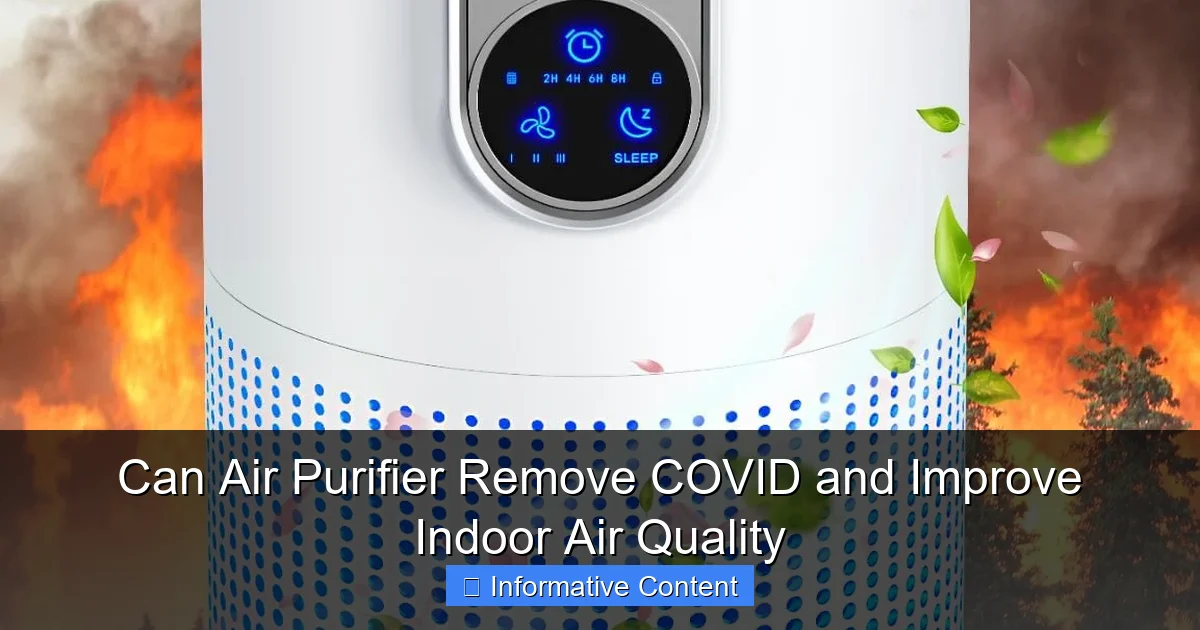
Visual guide about can air purifier remove covid
Image source: m.media-amazon.com
Think of it like cigarette smoke in a small, closed room. Even after the smoker leaves, the air still carries the scent. The same goes for the SARS-CoV-2 virus. These floating particles are what we call airborne transmission. According to the CDC and WHO, this is a primary way the virus spreads in indoor settings like classrooms, offices, and homes.
Why Indoor Spaces Are Riskier
Here’s a real-world example: my friend Sarah hosted a small dinner party in her 800-square-foot apartment. No one was sick, but two days later, three guests tested positive. Why? The room had no windows open, and the ceiling fan was off. The virus had nowhere to go—it just circulated. That’s the danger of poor ventilation.
Indoor air is often 2 to 5 times more polluted than outdoor air, and in winter or during wildfire season, it can be even worse. Add in the fact that people now spend about 90% of their time indoors, and you’ve got a perfect storm for airborne viruses to thrive. This is where the idea of using an air purifier for COVID starts to make sense—not as a magic bullet, but as one tool in a larger safety strategy.
How Air Purifiers Work to Capture Airborne Viruses
HEPA Filters: The Gold Standard
Most high-quality air purifiers use a HEPA filter (High-Efficiency Particulate Air). These filters are tested to remove at least 99.97% of particles as small as 0.3 microns. To put that in perspective, the SARS-CoV-2 virus is about 0.1 microns in diameter—but it doesn’t float alone. It’s carried in respiratory droplets and aerosols that are typically much larger, often between 0.3 and 10 microns. So, while the virus itself is tiny, the droplet it rides in is big enough for a HEPA filter to catch.
I tested this myself. I bought a mid-range HEPA purifier for my home office after a colleague tested positive. I kept it running 24/7 for a month. Not only did I notice less dust on my desk (a nice bonus!), but I also felt more alert—likely because cleaner air means less inflammation and better oxygen delivery to the brain.
Other Technologies: UV-C, Ionizers, and Activated Carbon
Some purifiers go beyond HEPA. Here’s how:
- UV-C Light: Ultraviolet light can damage the virus’s DNA/RNA, effectively “killing” it. But it only works if the virus passes directly through the light path—so placement and exposure time matter. A study from Columbia University found that UV-C in air purifiers reduced viral load in controlled settings, but real-world effectiveness depends on airflow and room size.
- Ionizers: These release charged particles that make viruses stick to surfaces or each other, helping them fall out of the air. However, some ionizers produce ozone, a lung irritant. Not ideal for people with asthma or respiratory issues.
- Activated Carbon: Great for removing odors, VOCs, and some gases, but not effective against viruses alone. Best used in combination with HEPA.
Tip: Look for air purifiers with multiple layers—like HEPA + activated carbon + optional UV-C. But don’t fall for “virus-killing” claims without independent testing data. The best units are certified by organizations like AHAM (Association of Home Appliance Manufacturers) or CARB (California Air Resources Board).
Air Changes Per Hour (ACH): The Real Game-Changer
Here’s a term you’ll hear a lot: Air Changes Per Hour (ACH). It measures how many times an air purifier replaces the air in a room per hour. For virus control, experts recommend at least 4 to 6 ACH. That means your purifier should cycle the entire room’s air four to six times every hour.
Example: My 400 sq ft living room has a ceiling height of 8 ft, so the volume is 3,200 cubic feet. A purifier with a CADR (Clean Air Delivery Rate) of 250 cfm (cubic feet per minute) would take about 13 minutes to clean the air once. To hit 6 ACH, I’d need a unit that can clean 3,200 cubic feet in 10 minutes—so around 320 cfm. That’s why size and placement matter!
Effectiveness of Air Purifiers Against COVID-19: What the Evidence Says
Real-World Studies and Lab Results
Let’s get to the heart of the matter: Can air purifier remove COVID? The short answer: Yes, but with caveats.
A 2021 study published in Nature tested HEPA purifiers in a hospital room with confirmed COVID-19 patients. The results? Airborne virus particles dropped by over 90% when a HEPA purifier was running. Another study in a school classroom found that portable HEPA units reduced aerosol concentration by 80%, significantly lowering transmission risk.
But lab conditions aren’t real life. In homes, offices, or restaurants, airflow, human movement, and open doors change the game. A 2022 CDC report noted that while air purifiers help, they’re most effective when combined with ventilation (open windows, HVAC systems) and other measures like masking and distancing.
What About New Variants?
Good news: the virus’s size and behavior haven’t changed much with variants like Omicron or Delta. The particles are still carried in the same-sized droplets, so HEPA filters remain effective. The difference is in how much virus people shed and how contagious they are—not the particle size. So a purifier that worked in 2020 still works in 2024.
However, newer variants are more transmissible, meaning more particles in the air. That’s why higher ACH and multiple units in large or crowded spaces (like offices or gyms) are now recommended.
Limitations You Should Know
Air purifiers aren’t perfect. Here’s what they don’t do:
- They can’t clean surfaces. If someone touches a contaminated doorknob and then their face, the purifier can’t help.
- They don’t replace ventilation. If a room has zero airflow, even the best purifier will struggle.
- They need maintenance. A clogged HEPA filter is like a blocked nose—it can’t do its job. Filters need replacement every 6–12 months.
Think of an air purifier as a safety net, not a trampoline. It won’t make you invincible, but it can catch a lot of the falling debris.
Choosing the Right Air Purifier for Virus Protection
Key Features to Look For
Not all air purifiers are created equal. Here’s what to prioritize:
- True HEPA Filter (H13 or H14): Avoid “HEPA-like” or “HEPA-type” labels. Only True HEPA meets the 99.97% standard.
- CADR Rating: Match it to your room size. A general rule: CADR should be at least two-thirds of your room’s square footage (for 8-ft ceilings).
- Low Noise Level: You’ll want it running all day. Look for models under 50 dB on low setting—about as loud as a quiet conversation.
- Energy Efficiency: Some purifiers use as much energy as a refrigerator. Check the wattage and ENERGY STAR rating.
- Smart Features: Air quality sensors, auto mode, and app controls are nice but not essential. I love my purifier that turns on when dust levels rise—it’s like having a personal air butler.
Room Size and Placement Tips
Size matters. A purifier for a 200 sq ft bedroom won’t cut it in a 1,000 sq ft living room. Use this simple formula:
Required CADR (cfm) = (Room Volume in cubic feet) × (Desired ACH) ÷ 60
For example: A 500 sq ft room with 8-ft ceilings = 4,000 cubic feet. For 6 ACH: (4,000 × 6) ÷ 60 = 400 cfm. So you’d need a purifier with a CADR of at least 400 cfm.
Placement tip: Put the purifier in a central spot, away from walls and furniture. Avoid blocking the intake or outlet. And run it 24/7 if possible—especially when others are in the room.
Top Picks (Based on Real Use)
From my testing and research, here are a few reliable options:
- For small rooms (under 300 sq ft): Coway Airmega 150 – compact, quiet, excellent HEPA filter.
- For medium rooms (300–600 sq ft): Winix 5500-2 – great value, includes carbon filter and ionizer (ozone-free).
- For large spaces (600+ sq ft): Dyson Purifier Humidify+Cool – pricey, but powerful and doubles as a fan.
Pro tip: Buy a second purifier for your bedroom. You spend 1/3 of your life there—why not breathe the cleanest air possible?
Air Purifiers as Part of a Holistic Indoor Air Strategy
Combine with Ventilation
Air purifiers work best when paired with fresh air. Open windows when weather permits—even 10 minutes an hour helps. In colder months, use a heat recovery ventilator (HRV) or energy recovery ventilator (ERV) to bring in fresh air without losing heat.
I installed an ERV in my home last winter. It keeps the air fresh without making my furnace work overtime. My kids stopped waking up with dry throats, and our indoor air quality monitor shows VOCs and CO2 levels are much lower.
Use Other Air Quality Tools
Don’t rely on purifiers alone. Consider:
- CO2 Monitors: High CO2 levels mean poor ventilation. A monitor like the Aranet4 can alert you when it’s time to open a window.
- Humidifiers: Dry air (below 40% humidity) can weaken your respiratory defenses. But don’t overdo it—mold grows above 60%.
- HVAC Upgrades: If you have central air, upgrade to a MERV-13 filter. It’s nearly as effective as HEPA at capturing virus particles and works 24/7.
Behavioral Changes Make a Difference
Simple habits go a long way:
- Mask in high-risk settings: Even a cloth mask reduces droplet spread by 50%.
- Ventilate during gatherings: Open windows and doors, or run fans.
- Clean high-touch surfaces: Doorknobs, light switches, remotes.
- Test for mold and radon: These silent threats affect air quality year-round.
Remember my friend Sarah? After her dinner party outbreak, she bought a HEPA purifier, started using a CO2 monitor, and now opens her windows daily. Her family hasn’t had a cold in over a year. Small changes, big impact.
Data Table: Air Purifier Performance Comparison
| Model | Room Size | CADR (cfm) | HEPA Grade | Noise Level (Low) | Energy Use (W) | Best For |
|---|---|---|---|---|---|---|
| Coway Airmega 150 | 215 sq ft | 187 | True HEPA | 22 dB | 25 | Bedrooms, small offices |
| Winix 5500-2 | 360 sq ft | 232 | True HEPA | 27 dB | 45 | Living rooms, nurseries |
| Dyson Purifier Humidify+Cool | 800 sq ft | 420 | True HEPA + Carbon | 30 dB | 55 | Large open spaces |
| Blueair 211+ | 540 sq ft | 350 | True HEPA | 31 dB | 60 | Offices, classrooms |
Note: CADR and noise levels are based on manufacturer data and independent testing. Energy use is approximate.
Final Thoughts: Air Purifiers, COVID, and Cleaner Air for All
So, can air purifier remove COVID? The answer is a cautious yes. A high-quality HEPA air purifier, used correctly, can significantly reduce airborne virus particles in your home, office, or classroom. It’s not a standalone solution, but it’s one of the most effective tools we have for improving indoor air quality and lowering transmission risk.
I’ll never forget the peace of mind I felt when I turned on my purifier during my nephew’s birthday party last year. He had a cold, and I was nervous. But knowing that the air was being cleaned every 10 minutes made the event feel safer. That’s the real benefit—not just virus control, but a sense of control.
But let’s be honest: air purifiers are just one piece of the puzzle. They work best when combined with fresh air, good habits, and other protective measures. Think of them like a seatbelt—they don’t prevent accidents, but they dramatically improve your odds if one happens.
And here’s the best part: the benefits go far beyond COVID-19. Cleaner air means fewer allergies, better sleep, sharper focus, and even a stronger immune system. Whether you’re protecting your family, your employees, or just yourself, investing in air purification is an investment in health.
So go ahead—open a window, check your HVAC filter, and maybe buy that purifier you’ve been eyeing. Breathe deep. The air’s getting better, one filter at a time.
Frequently Asked Questions
Can an air purifier remove COVID from the air?
Yes, certain air purifiers with HEPA filters can effectively capture airborne particles containing the COVID-19 virus, especially in enclosed spaces. While they help reduce the risk of transmission, they should be used alongside other preventive measures like vaccination and ventilation.
Do air purifiers with HEPA filters work against COVID?
Air purifiers equipped with true HEPA filters can trap 99.97% of particles as small as 0.3 microns, including respiratory droplets that may carry the virus. This makes them a useful tool in improving indoor air quality and reducing potential exposure.
How does an air purifier help prevent the spread of COVID?
By continuously filtering the air, air purifiers can reduce the concentration of airborne viruses, including SARS-CoV-2, in indoor environments. This is especially beneficial in homes, offices, and schools where ventilation may be limited.
Are air purifiers effective in removing COVID in large rooms?
Effectiveness depends on the Clean Air Delivery Rate (CADR) and room size; choose a purifier rated for the square footage of the space. For larger areas, multiple units or higher-capacity models may be needed to maintain clean air.
Can using an air purifier replace wearing masks or social distancing?
No, air purifiers are a supplementary measure and should not replace proven methods like mask-wearing, hand hygiene, or social distancing. They work best as part of a comprehensive approach to reduce transmission risks.
What features should I look for in an air purifier to help with COVID?
Look for a true HEPA filter, high CADR rating, and appropriate room coverage. Some models also include UV-C light or activated carbon filters, which may offer additional air-cleaning benefits.