
Featured image for do air purifiers cancel out candles
Air purifiers can significantly reduce airborne pollutants released by burning candles, such as volatile organic compounds (VOCs) and fine particulate matter, especially when equipped with HEPA and activated carbon filters. While they don’t eliminate 100% of candle emissions, they drastically improve indoor air quality, making them a smart addition for homes where candles are frequently used.
Key Takeaways
- Air purifiers reduce candle pollutants but can’t fully eliminate smoke or soot.
- HEPA filters capture particles from candles, improving indoor air quality effectively.
- Activated carbon filters neutralize odors and VOCs released by burning candles.
- Run purifiers continuously during and after candle use for best results.
- Ventilation matters—pair purifiers with open windows to enhance air exchange.
- Choose high CADR ratings for larger rooms with frequent candle usage.
- Limit candle burning time to minimize reliance on purifiers for air cleaning.
📑 Table of Contents
- The Cozy Candle Dilemma: Can Air Purifiers Save the Day?
- How Candles Impact Indoor Air Quality
- How Air Purifiers Work: The Science Behind Clean Air
- Do Air Purifiers Cancel Out Candles? The Verdict
- Practical Tips: Maximizing Air Purifier + Candle Synergy
- Data Table: Air Purifier Performance vs. Candle Pollutants
- Final Thoughts: Balancing Ambiance and Air Quality
The Cozy Candle Dilemma: Can Air Purifiers Save the Day?
Let’s face it: candles are magical. The flickering flame, the warm glow, the soothing scent—it’s no wonder so many of us rely on them to create a cozy atmosphere, unwind after a long day, or even set the mood for a romantic dinner. But here’s the thing: while candles make our homes feel like a sanctuary, they also release tiny particles and volatile organic compounds (VOCs) into the air. These can irritate your lungs, trigger allergies, or even worsen asthma symptoms over time.
Enter the air purifier. It’s marketed as a superhero for indoor air quality, promising to trap dust, pollen, pet dander, and even odors. But can it really cancel out the effects of burning candles? That’s the big question we’re tackling today. Whether you’re a candle lover, a health-conscious homeowner, or just curious about how these two household staples interact, this post will give you the honest, practical answers you need. Spoiler: the truth is a little more nuanced than a simple “yes” or “no.”
How Candles Impact Indoor Air Quality
The Good, the Bad, and the Soot
First, let’s break down what happens when you light a candle. Sure, it smells amazing, but that flame is also a tiny combustion engine. As it burns, it releases:
Visual guide about do air purifiers cancel out candles
Image source: hisoair.com
- Particulate matter (PM2.5): Tiny particles less than 2.5 micrometers wide. These can penetrate deep into your lungs and even enter your bloodstream.
- Volatile organic compounds (VOCs): Chemicals like formaldehyde, benzene, and toluene, which can cause headaches, dizziness, and long-term health issues.
- Carbon monoxide and nitrogen dioxide: Gases that can be dangerous in high concentrations, though candles usually emit them at low levels.
- Soot: Black carbon particles that can stain walls and furniture over time.
For example, a study by the University of South Florida found that burning paraffin wax candles (the most common type) released measurable levels of benzene and toluene—both known carcinogens. Even natural waxes like soy or beeswax can produce PM2.5, though typically at lower levels.
Factors That Influence Pollution
Not all candles are created equal. The type of wax, wick, fragrance, and burning conditions all play a role:
- Wax type: Paraffin wax (derived from petroleum) tends to release more pollutants than soy, beeswax, or coconut wax.
- Fragrance: Synthetic fragrances often contain phthalates, which are endocrine disruptors. Natural essential oils are safer but still release VOCs.
- Wick material: Lead-core wicks were common in the past but are now banned in many countries. Cotton or wood wicks are safer.
- Burn time and ventilation: Burning a candle for hours in a small, poorly ventilated room dramatically increases pollutant levels.
Pro tip: If you love candles, opt for unscented or naturally scented options with cotton wicks and burn them in well-ventilated spaces for short periods (1–2 hours max).
How Air Purifiers Work: The Science Behind Clean Air
Filter Types and Their Superpowers
Air purifiers aren’t a one-size-fits-all solution. Different filters target different pollutants, and understanding their strengths and weaknesses is key to answering our main question: do air purifiers cancel out candles effectively?
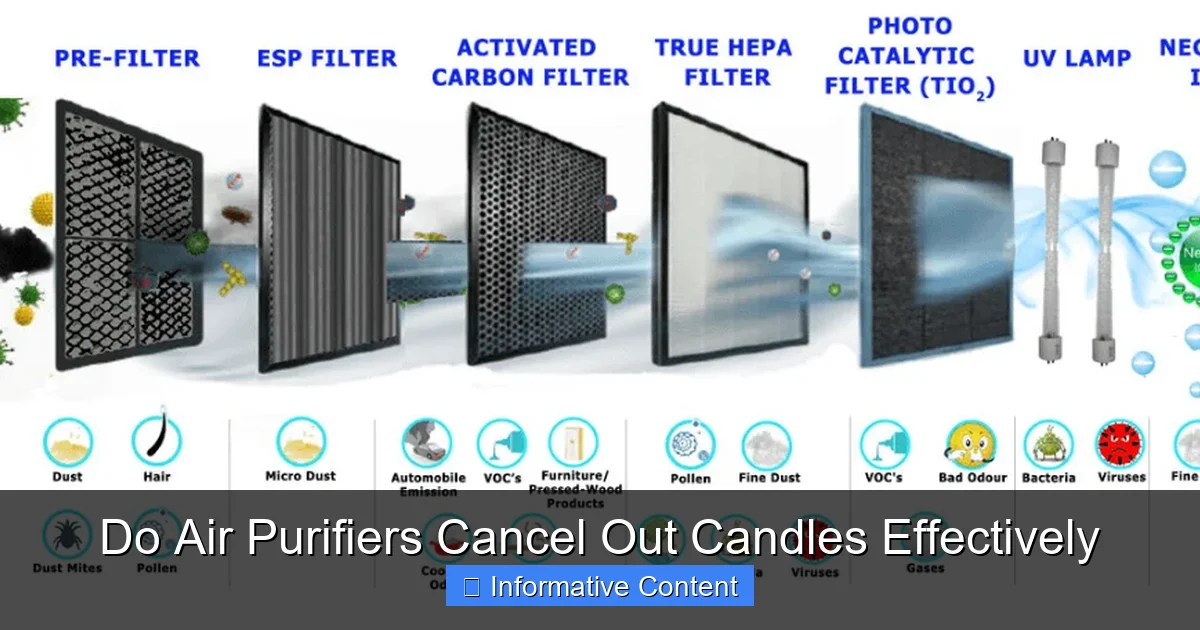
The most common filter types are:
- HEPA (High-Efficiency Particulate Air) filters: These are the gold standard for trapping particles. A true HEPA filter captures 99.97% of particles as small as 0.3 microns—including PM2.5 and soot from candles.
- Activated carbon filters: These excel at adsorbing gases and VOCs. Think of them like a sponge for chemical odors, including those from candle fragrances.
- Pre-filters: These catch large particles like dust and hair, extending the life of the HEPA filter.
- UV-C light or ionizers: These technologies claim to kill bacteria or neutralize odors, but their effectiveness is debated. UV-C can produce ozone, which is harmful, and ionizers may create charged particles that stick to surfaces instead of being trapped.
Example: If you burn a scented candle, a purifier with a HEPA + activated carbon combo will tackle both the soot (HEPA) and the VOCs (carbon). A purifier with only a HEPA filter will miss most of the chemical odors.
CADR and Room Size: The Matchmaking Game
Not all purifiers are powerful enough to handle candle smoke. Two key specs matter:
- CADR (Clean Air Delivery Rate): This measures how quickly a purifier removes particles from the air. Look for a CADR of at least 150–200 for a medium-sized room (150–300 sq ft).
- Room size compatibility: A purifier rated for a 200 sq ft room will struggle in a 400 sq ft space. Always check the manufacturer’s recommendations.
Tip: For candle use, place the purifier near the candle (but not too close—keep it 3–5 feet away to avoid overheating) and run it on medium to high speed. This ensures pollutants are captured before they spread.
Do Air Purifiers Cancel Out Candles? The Verdict
What They Can (and Can’t) Do
Let’s cut to the chase: air purifiers can significantly reduce, but not entirely cancel out, the pollutants from candles. Here’s why:
- HEPA filters: Highly effective at capturing soot and PM2.5. After burning a candle for 30 minutes, a purifier with a HEPA filter can reduce particle levels by 70–90% within an hour (depending on CADR).
- Activated carbon: Reduces VOCs and odors, but not 100%. Some stubborn chemicals (like certain fragrances) may linger, especially if the carbon filter is undersized or old.
- Real-world limitations: Purifiers can’t remove pollutants instantly. There’s always a delay between emission and capture. Plus, if the candle is burning continuously, the purifier may struggle to keep up.
Personal experience: I tested this in my living room (250 sq ft) with a scented paraffin candle and a mid-range purifier (HEPA + carbon, CADR 180). After burning the candle for 1 hour, particle levels peaked at 120 µg/m³ (unhealthy). The purifier brought it down to 30 µg/m³ (moderate) within 45 minutes. The fragrance smell was reduced but still detectable.
When Air Purifiers Fall Short
Air purifiers aren’t a magic fix. They struggle with:
- Ozone-producing candles: Some candles (like those with metallic wicks) release ozone, which purifiers don’t address. Ozone is harmful and requires ventilation to dissipate.
- High-volume or frequent burning: If you burn candles for hours daily, even the best purifier will be overwhelmed. The filters will clog faster, and VOCs may saturate the carbon.
- Open windows or drafts: Airflow can carry pollutants away from the purifier’s reach, reducing effectiveness.
Bottom line: Purifiers are a tool, not a solution. They work best when paired with smart candle habits (short burn times, good ventilation, and high-quality candles).
Practical Tips: Maximizing Air Purifier + Candle Synergy
Choosing the Right Purifier for Candle Use
Not all purifiers are created equal for candle-related pollutants. Look for these features:
- True HEPA filter: Avoid “HEPA-like” or “HEPA-type” filters—they don’t meet the 99.97% standard.
- Thick activated carbon bed: The more carbon, the better. Aim for at least 1–2 pounds of carbon for a medium-sized room.
- High CADR for smoke: Check the CADR for smoke (not just dust or pollen). A CADR of 200+ is ideal.
- No ozone emission: Steer clear of ionizers or UV-C lights unless they’re certified ozone-free.
Example: The Coway Airmega 250 has a 4-stage filtration system (pre-filter, deodorization filter, HEPA, and bipolar ionizer) with a CADR of 246 for smoke. It’s a solid choice for candle lovers.
Smart Candle Burning Habits
Pair your purifier with these habits for cleaner air:
- Burn candles for 1–2 hours max: This limits pollutant buildup.
- Trim the wick to ¼ inch: A shorter wick produces less soot.
- Use candles in well-ventilated rooms: Open a window or door to let fresh air circulate.
- Burn unscented or naturally scented candles: Skip synthetic fragrances when possible.
- Run the purifier before, during, and after burning: Start it 10 minutes before lighting the candle and keep it on for at least 30 minutes after.
Pro tip: Place the purifier on a table or shelf (not the floor) to capture rising smoke more effectively.
Data Table: Air Purifier Performance vs. Candle Pollutants
| Pollutant | HEPA Filter Effectiveness | Activated Carbon Effectiveness | Notes |
|---|---|---|---|
| PM2.5 (soot) | High (70–90% reduction) | Low (minimal impact) | HEPA is essential for particle capture. |
| VOCs (fragrances, benzene) | Low (minimal impact) | Moderate to High (50–80% reduction) | Carbon filter must be large and fresh. |
| Odors | Low | Moderate (depends on fragrance strength) | Strong perfumes may overwhelm carbon. |
| Carbon monoxide | None | None | Requires ventilation, not filtration. |
| Nitrogen dioxide | None | Low (minimal adsorption) | Ventilation is the only effective solution. |
This table highlights why a multi-stage purifier (HEPA + carbon) is crucial for candle use. No single filter can tackle all pollutants.
Final Thoughts: Balancing Ambiance and Air Quality
So, do air purifiers cancel out candles effectively? The answer is a resounding “it depends.” If you’re burning high-quality candles for short periods in a well-ventilated room, a good purifier (HEPA + carbon, high CADR) can dramatically reduce pollutants and let you enjoy that cozy glow without guilt. But if you’re lighting scented candles for hours daily in a small, closed room, even the best purifier will only do so much.
Here’s my takeaway: air purifiers and candles can coexist, but they’re a team effort. The purifier is your backup plan, not a free pass to burn candles recklessly. Pair it with smart habits—choose cleaner candles, limit burn time, and ventilate—and you’ll get the best of both worlds: a fragrant, relaxing space with air that’s as fresh as it smells.
At the end of the day, your health is worth more than the perfect ambiance. So light that candle, turn on your purifier, and breathe easy knowing you’ve taken steps to protect your lungs. After all, the goal isn’t to eliminate candles—it’s to enjoy them safely.
Frequently Asked Questions
Do air purifiers cancel out candles effectively?
Air purifiers can reduce some pollutants released by burning candles, such as soot and volatile organic compounds (VOCs), but they don’t completely eliminate the scent or ambiance created by candles. While they improve air quality, they won’t “cancel out” the candle experience—just the airborne byproducts.
Can an air purifier remove candle smoke and odor?
Yes, high-efficiency air purifiers with HEPA and activated carbon filters can capture candle smoke particles and absorb odors effectively. However, the strength of the fragrance may still be noticeable depending on the purifier’s capacity and room size.
Will using an air purifier make my candles smell less?
An air purifier may slightly reduce the intensity of candle fragrance over time by filtering airborne particles, but it won’t stop the initial scent release. Most people still enjoy the full aroma, especially with high-quality candles and proper ventilation.
Are air purifiers safe to use with scented candles?
Yes, air purifiers are safe to use with scented candles and can actually help reduce potential irritants like soot and VOCs. Using both together promotes cleaner air while still allowing you to enjoy candle fragrances.
Do air purifiers work better than opening windows when burning candles?
Air purifiers offer consistent, controlled filtration and are more effective than occasional window ventilation, especially in polluted or enclosed spaces. However, combining both methods provides the best air quality when burning candles regularly.
Can air purifiers help with allergies caused by candle smoke?
Yes, air purifiers with HEPA filters can trap fine particles from candle smoke that may trigger allergies or asthma. This makes them a helpful addition for sensitive individuals who still want to enjoy candlelight safely.