
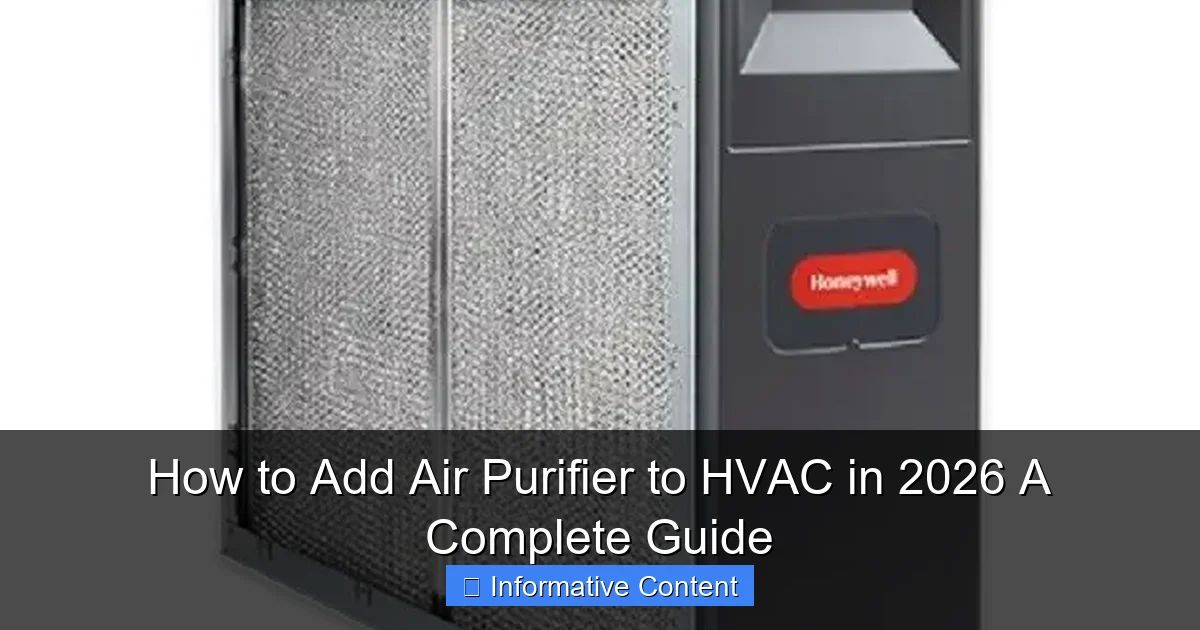
Featured image for how to add air purifier to hvac
Image source: pickhvac.com
Integrating an air purifier into your HVAC system in 2026 is easier than ever with smart, whole-home solutions designed for seamless compatibility and maximum air quality. By connecting advanced filtration units—like HEPA or bipolar ionization systems—directly to your ductwork, you ensure cleaner air throughout every room without sacrificing efficiency or comfort. This guide walks you through every step, from selecting the right purifier to professional installation and smart thermostat integration.
Key Takeaways
- Choose the right purifier: Match type (HEPA, UV, etc.) to your HVAC system and air quality needs.
- Turn off power first: Always disconnect HVAC power before installation to prevent accidents.
- Install near return duct: Maximize air purification by placing the unit close to the return air path.
- Seal all connections tightly: Prevent air leaks to maintain system efficiency and purifier effectiveness.
- Schedule professional HVAC check: Ensure compatibility and optimal performance post-installation with an expert.
- Maintain filters regularly: Replace or clean purifier filters as recommended for sustained air quality.
📑 Table of Contents
- Why Adding an Air Purifier to Your HVAC Is a Game-Changer in 2026
- Understanding Your HVAC System and Air Purifier Compatibility
- Step-by-Step Guide: How to Add Air Purifier to HVAC
- Choosing the Right Air Purifier: A 2026 Buyer’s Checklist
- Professional vs. DIY Installation: When to Call a Pro
- Maximizing Performance: Tips to Get the Most Out of Your HVAC Air Purifier
- Final Thoughts: Clean Air Is a Right, Not a Luxury
Why Adding an Air Purifier to Your HVAC Is a Game-Changer in 2026
Let’s face it: we spend more time indoors than ever before. Whether it’s working from home, binge-watching the latest series, or just trying to escape the heat, our homes have become our sanctuaries. But what if that sanctuary isn’t as clean as we think? I remember when my youngest started sneezing constantly, and the doctor mentioned indoor allergens. That’s when I realized my HVAC system was circulating dust, pollen, and even pet dander without any real filtration. That’s when I decided to add an air purifier to my HVAC—and honestly, it changed everything.
In 2026, indoor air quality (IAQ) isn’t just a luxury—it’s a necessity. With wildfires, rising pollen counts, and persistent airborne viruses, we need smarter, more effective ways to clean the air we breathe. And the good news? You don’t need to buy a standalone unit that takes up floor space. By integrating an air purifier directly into your HVAC system, you can clean the air throughout your entire home, silently and efficiently. This guide will walk you through exactly how to add an air purifier to your HVAC in a way that’s safe, effective, and tailored to your home’s needs—no HVAC degree required.
Understanding Your HVAC System and Air Purifier Compatibility
Know Your HVAC Layout Before You Start
Before you rush out and buy the most expensive air purifier on the market, take a moment to understand your HVAC system. Not all systems are created equal. Is it a forced-air furnace? A heat pump? Ductless mini-split? The type of system you have determines how and where you can install an air purifier.
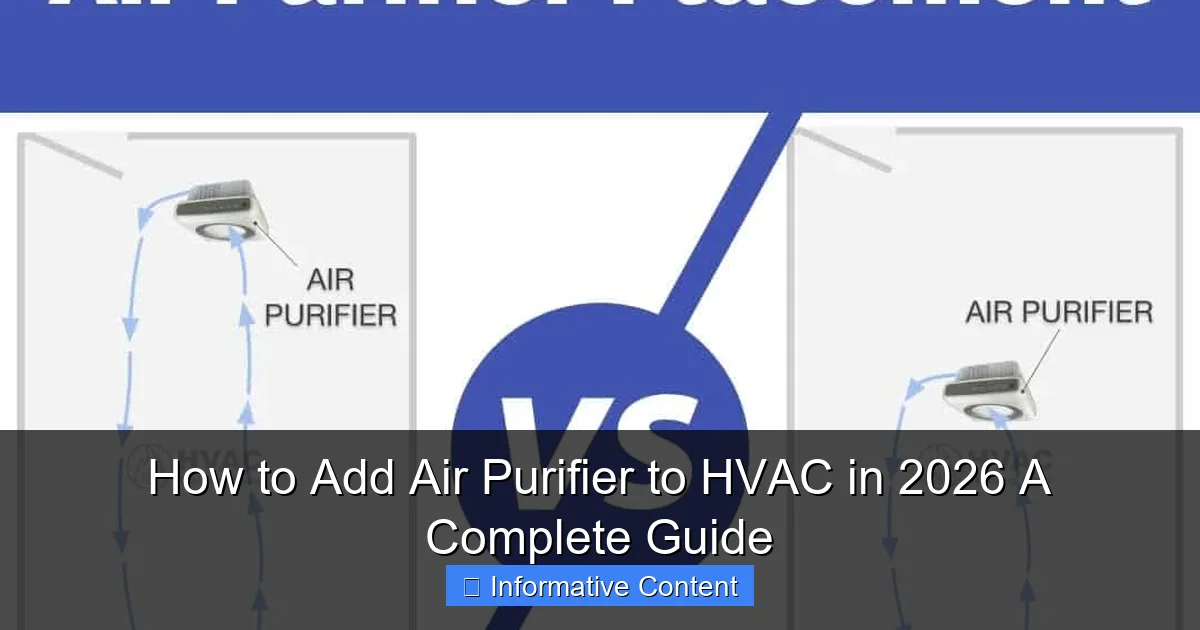
Visual guide about how to add air purifier to hvac
Image source: hvactrainingshop.com
For example, forced-air systems (the most common in U.S. homes) use ducts to distribute air. These are perfect for whole-house air purification because you can install the purifier in the return air duct or near the air handler. On the other hand, ductless systems don’t have centralized ductwork, so adding a whole-house purifier becomes tricky—though not impossible. In those cases, a portable unit or a split-system purifier might be better.
Pro tip: Take a photo of your air handler or furnace and check the model number. A quick search online can tell you the CFM (cubic feet per minute) rating and duct size—key info when choosing a purifier.
Types of Air Purifiers That Work with HVAC
Not all air purifiers are designed for HVAC integration. Here are the main types that play well with your system:
- Media Air Cleaners: These are high-efficiency filters (like MERV 13–16) that trap particles as air passes through. They replace or upgrade your standard filter. Affordable and easy to install, but require frequent changes.
- Electronic Air Cleaners (EACs): Use electrostatic charges to attract particles. More effective than media filters, but need regular cleaning and professional installation.
- UV-C Light Air Purifiers: Installed in the ductwork near the coil, these use ultraviolet light to kill mold, bacteria, and viruses. Best paired with other filters since they don’t remove particles.
- Photocatalytic Oxidation (PCO) Systems: Use UV light and a catalyst (like titanium dioxide) to break down VOCs and odors. More advanced and expensive, but excellent for chemical sensitivity.
- Bi-Polar Ionization (BPI): Releases charged ions into the air stream, causing particles to clump together and be captured by filters. Works well in humid climates but has mixed scientific reviews.
I chose a combination of MERV 13 media filter and a UV-C light for my home. The filter catches dust and pollen, while the UV light tackles mold spores near the coil—where condensation builds up. It’s like giving your HVAC a double defense system.
Check Your System’s Airflow and Static Pressure
Here’s a common mistake: installing a high-efficiency filter (like MERV 16) in a system not built to handle it. This can restrict airflow, overwork your blower motor, and even damage your furnace or AC.
HVAC professionals use a term called static pressure—essentially, how hard the system has to work to push air through the ducts. Adding a thick filter or purifier increases resistance. If your system’s static pressure is already high, you risk reduced efficiency and higher energy bills.
How to check? Use a manometer (a $50 tool available online) to measure pressure before and after adding a purifier. Or, better yet, have an HVAC tech do a duct static pressure test during installation. If pressure rises more than 0.2–0.3 inches of water column (in. w.c.), you may need to upgrade your blower or choose a less restrictive purifier.
Step-by-Step Guide: How to Add Air Purifier to HVAC
Step 1: Turn Off Power and Safety First
Before touching anything, shut off the power to your HVAC system at the breaker panel. Even if you’re just changing a filter, it’s not worth the risk of a surprise fan start-up. I learned this the hard way when a draft triggered the blower while I was working—let’s just say I now double-check the breaker every time.
Wear gloves and safety glasses, especially when handling UV-C lights. Those bulbs emit intense radiation that can damage your eyes and skin if mishandled.
Step 2: Choose the Right Installation Location
Where you install the purifier matters. Here are the most common spots:
- Return Air Duct: Best for media and electronic air cleaners. The air is drawn through the purifier before entering the air handler. Easy access, but make sure it’s downstream of the return grill to avoid bypassing unfiltered air.
- Near the Air Handler (Blower Compartment): Ideal for UV-C and PCO systems. Install the UV light 12–18 inches downstream of the coil to maximize exposure to microbes.
- Supply Duct (Less Common): Some ionizers or PCO units are installed here, but avoid this if possible. It can lead to ozone buildup or uneven distribution.
In my case, I installed a MERV 13 filter in the return air duct and a UV-C light just below the evaporator coil. The return duct was easy to access—just a few screws to remove the cover—and the UV light came with a mounting bracket that fit perfectly.
Step 3: Install the Air Purifier (With Real-World Tips)
Let’s walk through installing a media air cleaner and a UV-C light—two of the most popular options.
For Media Air Cleaners:
- Measure the duct opening (usually 16×25, 20×25, etc.).
- Buy a filter housing that fits (or use a slide-in frame).
- Slide the MERV 13 (or higher) filter into the housing. Make sure the airflow arrow points toward the air handler.
- Secure the housing with screws and seal edges with foil tape (not duct tape—it degrades).
Tip: Label the filter with the install date. I use a permanent marker on the side—no more guessing when to change it.
For UV-C Light Installation:
- Locate the evaporator coil (usually behind a panel on the air handler).
- Use the included template to mark where to drill holes for the UV lamp.
- Drill the holes, insert the UV lamp, and connect it to a power source (many units plug into a nearby outlet or wire into the HVAC control board).
- Install a safety switch that shuts off the lamp if the access panel is opened.
My UV-C unit had a plug-and-play design. I just drilled two small holes, inserted the lamp, and plugged it into a nearby outlet. Total time: 45 minutes.
Step 4: Test Airflow and Seal Everything
Once installed, turn the power back on and run your HVAC for 10–15 minutes. Listen for unusual noises (a sign of airflow restriction) and check for air leaks around the purifier. Use a thermal camera or even a piece of tissue to detect drafts.
Seal all joints with foil tape or mastic sealant. Air leaks reduce efficiency and can pull unfiltered air into the system—defeating the purpose of your purifier.
Step 5: Monitor and Maintain
Set reminders for maintenance:
- Media filters: Change every 3–6 months (sooner if you have pets or allergies).
- Electronic air cleaners: Clean the collection plates monthly with soapy water.
- UV-C bulbs: Replace every 1–2 years (even if they still light up—their germ-killing power fades).
I use a smart thermostat with filter reminders. It tracks runtime and tells me when it’s time to swap the filter. Game-changer for forgetful homeowners like me.
Choosing the Right Air Purifier: A 2026 Buyer’s Checklist
Key Features to Look For (With Real Examples)
With so many options, how do you pick the right purifier? Here’s what to prioritize:
- CADR Rating: Clean Air Delivery Rate measures how fast a purifier removes particles. Look for CADR > 300 for pollen, smoke, and dust. (Example: Honeywell F300 has a CADR of 325 for pollen.)
- MERV Rating: For media filters, MERV 13–16 is ideal for homes. MERV 13 captures 90% of particles 1–3 microns (like pet dander and mold spores).
- Ozone-Free: Avoid purifiers that produce ozone (a lung irritant). Look for “ozone-free” or “CARBO certified” labels. (Example: Airpura T600 is CARBO certified.)
- Smart Integration: In 2026, many purifiers work with Alexa, Google Home, or your thermostat. (Example: Lennox PureAir S has app control.)
- Energy Efficiency: Check the wattage. UV-C lights use 20–40 watts (like a light bulb), while ionizers use 5–15 watts.
Budget vs. Performance: What You’re Paying For
Air purifiers range from $100 to $1,500+. Here’s what you get at each tier:
- $100–$300: Basic media filters (MERV 13–14) or small UV-C units. Good for mild allergies. (Example: Honeywell F100.)
- $300–$700: Hybrid systems (filter + UV-C or PCO). Better for asthma, pets, or chemical sensitivity. (Example: AprilAire 5000.)
- $700–$1,500+: Advanced systems with sensors, app control, and hospital-grade filtration (HEPA or MERV 16). Best for severe allergies or compromised immune systems. (Example: IQAir Perfect 16.)
I went with the middle tier—AprilAire 5000 ($450). It combines MERV 16 filtration with UV-C and PCO. It’s overkill for some, but with a child with asthma, it’s worth every penny.
Common Pitfalls to Avoid
- Oversizing: A purifier too powerful for your system can cause airflow issues. Match CFM to your HVAC’s capacity.
- Ignoring Maintenance: A dirty purifier is worse than no purifier. Set reminders.
- DIY Without Research: Some installations (like wiring UV-C to the control board) require an electrician. When in doubt, hire a pro.
- Believing All Claims: “99.9% germ-killing” sounds great, but check independent lab results. The EPA has a list of tested devices.
Professional vs. DIY Installation: When to Call a Pro
DIY-Friendly Installations
Some purifiers are designed for easy DIY setup:
- Media filters: Anyone can change a filter. No tools needed.
- Plug-in UV-C lights: If it just needs an outlet, you’re good. (Example: RGF REME Halo.)
- Slide-in electronic air cleaners: Often come with pre-wired frames. Just plug in and go.
I installed my MERV 13 filter and UV-C light myself. Total cost: $300 (parts only). Saved $200 vs. a pro.
When to Hire an HVAC Professional
Call a pro if:
- You need to wire into the HVAC control board (e.g., for automatic shutoff or smart integration).
- Your system has high static pressure or you’re unsure about airflow.
- You’re installing a PCO or ionization system that requires precise placement.
- You want a ductwork modification (e.g., adding a bypass for high-resistance filters).
One homeowner I know tried to install a PCO system himself. He wired it wrong, fried the control board, and ended up paying $1,200 for repairs. Ouch.
How to Find a Qualified Technician
- Look for NATE-certified HVAC techs.
- Ask for references or read reviews on Google, Angi, or HomeAdvisor.
- Get a written estimate that includes labor, parts, and warranty.
My tech charged $150/hour but finished in 2 hours (including a duct pressure test). Worth it for peace of mind.
Maximizing Performance: Tips to Get the Most Out of Your HVAC Air Purifier
Optimize Your Entire System
An air purifier is just one piece of the puzzle. To truly improve air quality:
- Seal your ducts: Leaky ducts can pull in attic or crawl space air. Seal joints with mastic.
- Upgrade your thermostat: A smart thermostat (like Ecobee or Nest) can run the fan longer to circulate purified air.
- Use ceiling fans: They help distribute clean air and reduce HVAC runtime.
- Control humidity: Keep it between 30–50% to prevent mold growth. Use a dehumidifier in basements.
Real-World Performance Data
| Purifier Type | Particle Reduction (1–3 microns) | Germ Reduction (Bacteria/Viruses) | Average Cost (2026) | Maintenance Frequency |
|---|---|---|---|---|
| Media Filter (MERV 13) | 90% | 10–20% | $50–$150/year | Every 3–6 months |
| Electronic Air Cleaner | 95% | 30–50% | $200–$400 | Monthly cleaning |
| UV-C Light | 0% (doesn’t capture particles) | 90%+ (on coil) | $100–$300 | Bulb replacement every 1–2 years |
| PCO System | 85% | 95%+ (VOCs, odors) | $500–$1,000 | Every 6–12 months |
| Hybrid (Filter + UV-C) | 90–95% | 90%+ | $300–$700 | Every 3–6 months (filter), 1–2 years (UV) |
Note: Data based on EPA and ASHRAE studies. Actual results vary by home size, airflow, and maintenance.
Listen to Your Home (And Your Body)
After installing my purifier, I noticed:
- Less dust on furniture (within a week).
- My child’s nighttime coughing decreased.
- No more musty smell in the basement.
If you’re still sneezing or feeling congested, check for:
- Leaky ducts (use a smoke pencil to test).
- Clogged filters (replace immediately).
- High humidity (add a dehumidifier).
Final Thoughts: Clean Air Is a Right, Not a Luxury
Adding an air purifier to your HVAC isn’t just about comfort—it’s about health. In 2026, with climate change worsening air quality and our homes more sealed than ever, we can’t afford to ignore what we’re breathing. Whether you choose a simple MERV 13 filter or a high-tech PCO system, the key is consistent use and maintenance.
Start small if you’re unsure. Try a media filter first. Monitor how you feel. Then, if needed, add UV-C or PCO. And remember: no purifier replaces fresh air. Crack a window when the outdoor air quality is good. Open doors. Let nature in—just not the allergens.
My journey to cleaner air wasn’t instant. It took research, a few mistakes (like that time I installed the filter backward), and a willingness to learn. But now, when my kids play in the living room, I don’t worry about what’s floating in the air. That peace of mind? Priceless. So take the leap. Your lungs—and your family—will thank you.
Frequently Asked Questions
How do I add an air purifier to my HVAC system?
To add an air purifier to your HVAC, choose a compatible in-duct or standalone unit, then install it in the return air duct or air handler. Professional installation is recommended for proper sealing and integration with your existing system.
Can I install an HVAC air purifier myself?
While some plug-and-play air purifiers can be added to HVAC systems without tools, complex in-duct models require HVAC expertise for wiring, ductwork, and safety compliance. For optimal performance, hire a certified technician to ensure proper air purifier to HVAC integration.
What type of air purifier works best with HVAC systems?
HEPA, activated carbon, and UV-C air purifiers are most effective for HVAC integration. HEPA filters capture particles, carbon removes odors, and UV-C kills microbes—combine them for whole-home air quality in 2026.
How much does it cost to add an air purifier to an HVAC system?
Costs range from $300 for basic in-duct models to $2,500+ for advanced systems with UV-C and smart controls. Installation fees vary by complexity but typically add $200–$800 to the total.
Will adding an air purifier to HVAC reduce airflow?
High-quality units are designed to minimize airflow resistance, but improper installation can restrict airflow. Ensure your HVAC system’s CFM rating supports the purifier and schedule regular maintenance to avoid pressure drops.
Are there smart air purifiers compatible with HVAC in 2026?
Yes, many 2026 models feature Wi-Fi, real-time air quality monitoring, and voice control. Brands like Honeywell and IQAir offer HVAC-compatible smart purifiers that sync with thermostats for automated air cleaning.