
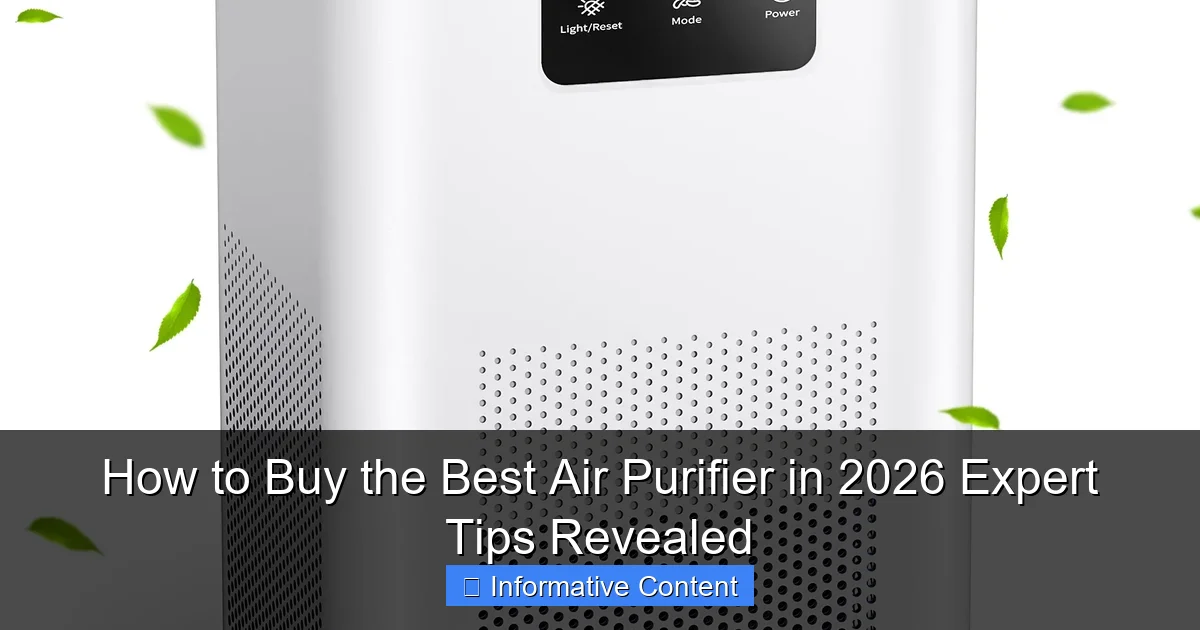
Featured image for how to buy the best air purifier
Image source: i5.walmartimages.com
Choose an air purifier with a HEPA filter and high CADR rating to ensure maximum removal of allergens, smoke, and airborne particles. Match the purifier’s coverage area to your room size and prioritize models with smart sensors, low noise levels, and energy-efficient operation for 2026’s top performance. Always verify third-party certifications like AHAM Verified and ENERGY STAR to avoid overpriced, underperforming units.
Key Takeaways
- Match the purifier to your room size for optimal air cleaning efficiency.
- Choose HEPA filters to trap 99.97% of airborne particles effectively.
- Check CADR ratings to ensure fast, effective pollutant removal.
- Prioritize smart features like air quality sensors and app control.
- Factor in noise levels for bedrooms or quiet spaces.
- Review maintenance costs including filter replacements and energy use.
- Verify certifications like AHAM, CARB, or Energy Star for safety.
📑 Table of Contents
- How to Buy the Best Air Purifier in 2026: Expert Tips Revealed
- Why You Actually Need an Air Purifier in 2026
- Key Features to Look for When Buying the Best Air Purifier
- Types of Air Purifiers: Which One Is Right for You?
- Top Air Purifier Brands and Models in 2026
- Air Purifier Buying Guide: What Size and Features Do You Need?
- Common Mistakes to Avoid When Buying an Air Purifier
- Air Purifier Comparison Table (2026 Top Models)
- Final Thoughts: How to Buy the Best Air Purifier in 2026
How to Buy the Best Air Purifier in 2026: Expert Tips Revealed
Imagine walking into your home after a long day, expecting a breath of fresh, clean air—only to be met with the faint smell of yesterday’s dinner, pet dander floating in the sunlight, or that musty odor that just won’t quit. You’re not alone. Millions of people are breathing in air that’s far from ideal, especially indoors, where pollutants can be up to five times more concentrated than outside, according to the EPA.
That’s where air purifiers come in. These quiet, unassuming devices have become essential tools for improving indoor air quality, especially as we spend more time at home. Whether you’re dealing with allergies, asthma, smoke, or just want to feel like you’re breathing easier, the right air purifier can make a world of difference. But with so many models on the market in 2026—each boasting different features, filters, and price tags—how do you know which one is truly the best for your needs?
In this guide, I’ll walk you through everything you need to know to buy the best air purifier in 2026. From understanding how they work to comparing top models and avoiding common pitfalls, I’ll share practical tips based on real-world use, expert insights, and the latest technology trends. Think of this as your no-nonsense, friend-to-friend guide to cleaner air—without the sales pitch.
Why You Actually Need an Air Purifier in 2026
You might be thinking, “My home isn’t that dirty. Do I really need an air purifier?” The short answer? Probably yes—especially if you live in a city, have pets, suffer from allergies, or just want to reduce your exposure to invisible pollutants.

Visual guide about how to buy the best air purifier
Image source: indoorbreathing.com
The Hidden Dangers in Your Home’s Air
Indoor air pollution is a silent problem. Unlike a dusty shelf or a smelly trash can, you can’t always see or smell the contaminants floating around your living room. But they’re there: dust mites, mold spores, pollen, pet dander, volatile organic compounds (VOCs) from cleaning products, and even ultrafine particles from cooking or candles.
For example, if you’ve ever noticed your allergies flaring up at home but not at work, it could be due to indoor allergens trapped in your carpets, furniture, or HVAC system. Or maybe you’ve lit a scented candle to relax, only to realize it’s releasing formaldehyde and benzene into the air—both known irritants.
Who Benefits Most from Air Purifiers?
While anyone can benefit from cleaner air, certain groups stand to gain the most:
- Allergy and asthma sufferers: Air purifiers with HEPA filters can capture 99.97% of particles as small as 0.3 microns, including common allergens like pollen and dust.
- Pet owners: Shed fur and dander are major triggers for respiratory issues. A good purifier can significantly reduce airborne pet allergens.
- Parents with young children: Kids’ immune systems are still developing. Cleaner air means fewer respiratory infections and better sleep.
- People in urban areas: If you live near traffic or industrial zones, outdoor pollutants like PM2.5 can seep indoors. An air purifier acts as a shield.
- Smokers or those exposed to secondhand smoke: While no purifier can eliminate all smoke toxins, some models with activated carbon filters can reduce odors and certain chemicals.
The Science Behind Cleaner Air
Air purifiers work by pulling air through a series of filters that trap pollutants. The most effective ones use a combination of mechanical filtration (like HEPA), activated carbon, and sometimes UV light or ionizers. The result? Air that’s significantly cleaner and safer to breathe.
Studies have shown that using an air purifier can reduce indoor particulate matter by up to 60% in just a few hours. That’s not just a number—it’s the difference between waking up with a stuffy nose and breathing easily all night.
Key Features to Look for When Buying the Best Air Purifier
Not all air purifiers are created equal. In fact, some are little more than glorified fans with a mesh screen. To find the best air purifier in 2026, you need to know what features actually matter—and which ones are just marketing fluff.
HEPA Filter: The Gold Standard
If there’s one feature you absolutely need, it’s a true HEPA (High-Efficiency Particulate Air) filter. Look for “True HEPA” or “HEPA H13” on the label—not “HEPA-type” or “HEPA-like,” which are often misleading.
A true HEPA filter must meet strict standards: it must capture at least 99.97% of particles 0.3 microns in size. That includes dust, pollen, mold spores, and even some bacteria. For context, a human hair is about 70 microns wide—so we’re talking about capturing particles over 200 times smaller.
For example, the Levoit Core 400S uses a 3-stage filtration system with a true HEPA H13 filter, making it one of the most effective models for allergy relief. It’s also quiet and energy-efficient, perfect for bedrooms or living rooms.
Activated Carbon Filter: Tackling Odors and Gases
While HEPA filters are great for particles, they can’t remove gases, odors, or chemicals. That’s where activated carbon comes in. Made from porous carbon, this filter absorbs volatile organic compounds (VOCs), smoke, cooking smells, and even some household chemicals.
If you cook frequently, live with a smoker, or use strong cleaning products, a model with a substantial carbon filter is essential. Look for purifiers that specify the weight of the carbon—more is usually better. For instance, the Blueair Blue Pure 211+ includes a 1.2-pound activated carbon filter, which is impressive for its size and price.
CADR Rating: How Fast Does It Clean?
CADR stands for Clean Air Delivery Rate. It measures how quickly an air purifier can remove smoke, dust, and pollen from a room. The higher the CADR, the faster the purifier works.
Here’s a quick guide:
- Smoke CADR: Best for removing smoke and fine particles.
- Dust CADR: Measures effectiveness against larger particles like dust and dander.
- Pollen CADR: Important for allergy sufferers.
For a 300-square-foot room, aim for a CADR of at least 200. The Coway Airmega 400, for example, has a CADR of 350 for dust and pollen, making it ideal for larger spaces.
Room Size and Coverage Area
One of the biggest mistakes people make is buying a purifier that’s too small for their space. Always check the manufacturer’s recommended room size. If your living room is 400 square feet, don’t buy a model rated for 200 square feet—even if it’s on sale.
Some brands exaggerate coverage areas, so look for third-party testing or AHAM (Association of Home Appliance Manufacturers) certification. AHAM-verified models have been independently tested for performance and safety.
Noise Level: Quiet Operation Matters
You don’t want a purifier that sounds like a jet engine. Noise is measured in decibels (dB). For bedrooms, aim for a model that runs at 30–40 dB on low—about the sound of a whisper. On high, it might reach 50–60 dB, similar to a quiet conversation.
The Dyson Purifier Cool TP07 is a great example: it’s whisper-quiet on low and doubles as a fan, making it perfect for year-round use.
Smart Features and Connectivity
In 2026, many top air purifiers come with smart features like app control, air quality sensors, and auto mode. These aren’t just gimmicks—they can significantly improve usability.
For instance, the IQAir HealthPro Plus includes a real-time air quality monitor that adjusts fan speed automatically. You can also track air quality trends via its app, which is helpful if you’re trying to identify pollution sources in your home.
Other smart features to consider:
- Wi-Fi connectivity and app control
- Auto mode (adjusts fan speed based on air quality)
- Filter change indicators
- Sleep mode (quieter operation at night)
Types of Air Purifiers: Which One Is Right for You?
Air purifiers come in several types, each with its own strengths and weaknesses. Understanding the differences will help you choose the best air purifier for your specific needs.
HEPA Air Purifiers
These are the most common and effective type. They use a physical filter to trap particles and are ideal for allergies, asthma, and general air cleaning. Best for: Most homes, especially those with pets or allergy sufferers.
Activated Carbon Air Purifiers
These focus on removing odors, smoke, and chemicals. They’re often used in combination with HEPA filters. Best for: Smokers, kitchens, or homes with strong odors.
Ionizers and Ozone Generators
Ionizers release charged particles that attach to pollutants, causing them to fall out of the air. While they can be effective, some models produce ozone—a lung irritant. The EPA warns against ozone-generating purifiers, as they can worsen respiratory conditions.
Stick to ionizers that are certified ozone-safe, or better yet, avoid them altogether if you have asthma or COPD.
UV-C Light Purifiers
UV-C light can kill bacteria and viruses by damaging their DNA. However, it’s most effective when air passes slowly through the unit—something most home purifiers don’t allow. UV-C is best used as a supplement to HEPA filtration, not a replacement.
PECO (Photo Electrochemical Oxidation)
Found in brands like Molekule, PECO technology claims to destroy pollutants at the molecular level. While innovative, independent tests have shown mixed results. It’s a newer technology, so long-term reliability and cost-effectiveness are still being evaluated.
Top Air Purifier Brands and Models in 2026
With so many options, it’s helpful to know which brands and models consistently deliver performance, reliability, and value. Here’s a breakdown of the best air purifiers in 2026 across different categories.
Best Overall: Coway Airmega 400
The Coway Airmega 400 is a powerhouse. It covers up to 1,560 square feet, has a dual HEPA filtration system, and includes a real-time air quality monitor. It’s also energy-efficient and quiet. At around $600, it’s a premium choice—but worth it for large homes or serious allergy sufferers.
Best for Allergies: Levoit Core 400S
This smart purifier uses a true HEPA H13 filter and covers up to 403 square feet. It connects to an app, has auto mode, and runs quietly. At under $300, it’s one of the best values for allergy relief.
Best for Large Rooms: Blueair Blue Pure 211+
With a CADR of 350 and coverage for up to 540 square feet, the Blue Pure 211+ is ideal for open-concept living spaces. It’s also stylish, with washable pre-filters in multiple colors. Priced around $300, it’s a solid mid-range option.
Best Smart Features: Dyson Purifier Cool TP07
This sleek tower purifier doubles as a fan and includes a full air quality sensor suite. It displays real-time pollution levels on an LCD screen and connects to the Dyson app. At $650, it’s pricey—but perfect for tech lovers who want style and function.
Best Budget Option: Winix 5500-2
At under $150, the Winix 5500-2 offers true HEPA filtration, a carbon filter, and a plasmaWave ionizer (ozone-safe). It covers up to 360 square feet and is AHAM-certified. It’s not fancy, but it gets the job done.
Air Purifier Buying Guide: What Size and Features Do You Need?
Choosing the right air purifier isn’t just about picking the most expensive model. It’s about matching the unit to your space, lifestyle, and health needs. Here’s a step-by-step guide to help you decide.
Step 1: Measure Your Room
Use a tape measure or a room calculator app to find the square footage of the space where you’ll use the purifier. Don’t forget to consider ceiling height—some manufacturers assume 8-foot ceilings, but if yours are higher, you may need a more powerful unit.
Step 2: Match the Purifier to the Room Size
As a rule of thumb, the purifier’s coverage area should be at least equal to your room size. For extra safety, go 20–30% larger. For example, if your bedroom is 250 square feet, choose a model rated for 300–350 square feet.
Step 3: Consider Your Air Quality Challenges
Make a list of your main concerns:
- Allergies? → Prioritize HEPA filtration.
- Odors or smoke? → Look for a strong carbon filter.
- Pets? → Choose a model with a pre-filter to catch hair.
- Chemicals or VOCs? → Consider a purifier with advanced carbon or PECO technology.
Step 4: Think About Usage and Maintenance
How often will you run it? Do you want it on 24/7? If so, energy efficiency and filter cost matter. HEPA filters typically last 6–12 months and cost $50–$100 to replace. Carbon filters may need replacing every 3–6 months.
Some models, like the Honeywell HPA300, have washable pre-filters, which can save money over time.
Step 5: Set a Budget
Air purifiers range from $50 to over $1,000. Here’s a quick breakdown:
- Budget ($50–$150): Basic HEPA models like Winix 5500-2. Good for small rooms.
- Mid-range ($150–$400): Best value. Models like Levoit Core 400S or Blue Pure 211+.
- Premium ($400+): Advanced features, larger coverage, smart tech. Coway Airmega, Dyson, IQAir.
Remember: a cheaper purifier that doesn’t meet your needs is a waste of money. Invest in quality.
Common Mistakes to Avoid When Buying an Air Purifier
Even with all this information, it’s easy to make mistakes. Here are the most common pitfalls—and how to avoid them.
Buying Based on Price Alone
A $70 purifier might seem like a steal, but if it uses a “HEPA-type” filter and has a CADR of 50, it won’t do much. Focus on performance, not price.
Ignoring Filter Replacement Costs
Some purifiers are cheap upfront but have expensive filters. For example, Molekule filters can cost over $200 per year. Calculate the total cost of ownership before buying.
Overlooking Noise Levels
A loud purifier won’t get used. If you’re placing it in a bedroom, test the noise level or read reviews. Look for “sleep mode” or “whisper-quiet” features.
Assuming Bigger Is Always Better
A huge purifier might be overkill for a small apartment. It could be noisy, expensive, and unnecessary. Match the size to your space.
Not Reading the Fine Print
Some brands claim “99.99% efficiency” but only under ideal lab conditions. Look for real-world performance data and third-party certifications like AHAM or Energy Star.
Air Purifier Comparison Table (2026 Top Models)
| Model | Coverage (sq ft) | HEPA Filter | Carbon Filter | CADR (Dust/Pollen) | Noise (Low/High dB) | Price |
|---|---|---|---|---|---|---|
| Coway Airmega 400 | 1,560 | Yes (Dual) | Yes | 350 / 350 | 22 / 52 | $600 |
| Levoit Core 400S | 403 | Yes (H13) | Yes | 260 / 260 | 24 / 54 | $280 |
| Blueair Blue Pure 211+ | 540 | Yes | Yes (1.2 lbs) | 350 / 350 | 31 / 56 | $300 |
| Dyson TP07 | 400 | Yes | Yes | 165 / 165 | 28 / 58 | $650 |
| Winix 5500-2 | 360 | Yes | Yes | 243 / 246 | 27 / 58 | $140 |
Final Thoughts: How to Buy the Best Air Purifier in 2026
Buying the best air purifier in 2026 doesn’t have to be overwhelming. Start by understanding your needs—whether it’s allergy relief, odor control, or just peace of mind. Then, focus on key features like true HEPA filtration, adequate room coverage, and low noise levels. Don’t forget to consider long-term costs like filter replacements and energy use.
Remember, the most expensive model isn’t always the best. The Levoit Core 400S proves that you can get top-tier performance without breaking the bank. And if you have a large home or serious air quality concerns, the Coway Airmega 400 is a worthy investment.
Ultimately, the best air purifier is the one you’ll actually use—quietly, consistently, and effectively. With the right information, you can breathe easier, sleep better, and enjoy a healthier home. So take a deep breath, do your research, and make a choice that’s right for you. Your lungs will thank you.
Frequently Asked Questions
What is the best air purifier for allergies in 2026?
For allergies, choose an air purifier with a True HEPA filter, which captures 99.97% of particles like pollen, dust mites, and pet dander. Look for models with high CADR ratings (especially for smoke, dust, and pollen) to ensure fast, efficient filtration in your space.
How do I choose the right size air purifier for my room?
Match the purifier’s coverage area (listed in square feet) to your room size—most brands provide this info. For larger or open-concept spaces, opt for a unit with 1.5x the room’s square footage to ensure optimal air changes per hour.
What features should I look for when buying the best air purifier?
Prioritize HEPA filters, CADR ratings, noise levels (under 50 dB for bedrooms), and smart features like air quality sensors or app control. Additional perks include activated carbon filters for odors and washable pre-filters to reduce long-term costs.
Are expensive air purifiers worth the investment in 2026?
Higher-end models often deliver better filtration, quieter operation, and smart tech, but budget-friendly options with HEPA filters can still be effective. Focus on performance metrics like CADR and filter quality rather than price alone.
How often do I need to replace air purifier filters?
Replace HEPA filters every 6–12 months and carbon filters every 3–6 months, depending on usage and air quality. Some models have indicator lights to remind you, while reusable pre-filters should be cleaned monthly.
Can an air purifier help with wildfire smoke or pet odors?
Yes—look for a purifier with both a True HEPA filter (for smoke particles) and an activated carbon filter (for VOCs and odors). High CADR ratings for smoke and gases ensure faster relief during wildfire season or in pet-heavy homes.