
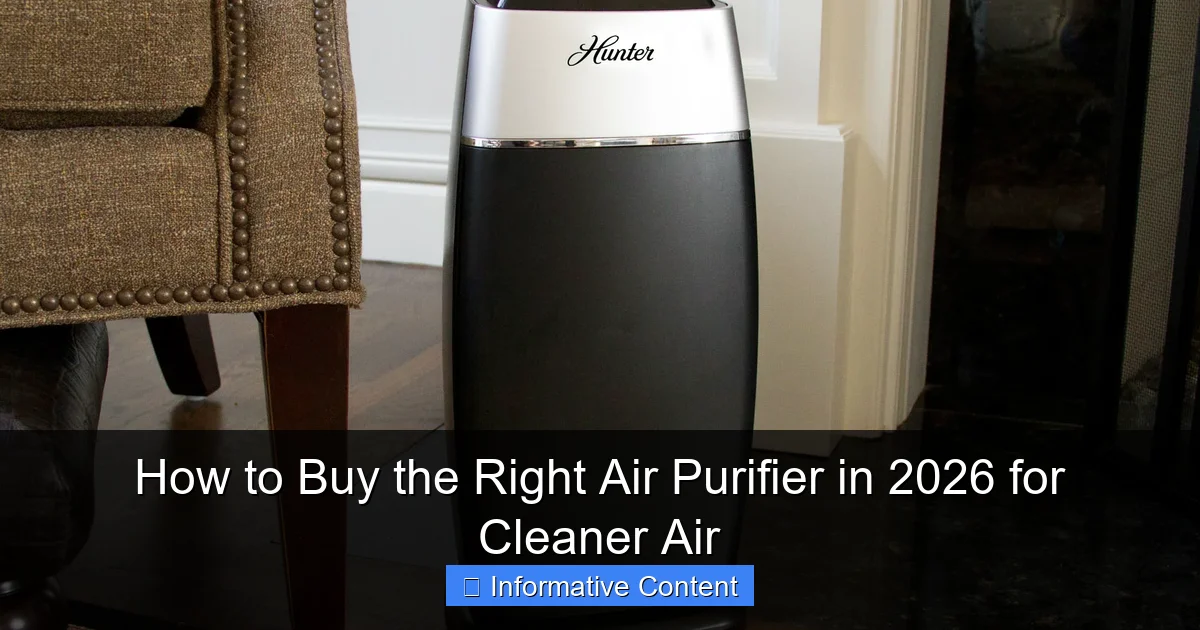
Featured image for how to buy the right air purifier
Image source: hunterpureair.com
Choosing the right air purifier in 2026 starts with matching the unit’s Clean Air Delivery Rate (CADR) and HEPA filtration to your room size and air quality needs. Look for smart features like real-time air quality monitoring, energy efficiency, and low noise levels to ensure long-term performance and comfort. Prioritize reputable brands with verified third-party testing to avoid overhyped claims and ensure you’re investing in truly cleaner air.
Key Takeaways
- Measure your room size: Match purifier capacity to your space for optimal air cleaning.
- Choose the right filter: HEPA filters capture 99.97% of particles; essential for allergies.
- Check CADR ratings: Higher Clean Air Delivery Rate means faster, more efficient purification.
- Prioritize low noise levels: Ideal for bedrooms; look for <25 dB on low settings.
- Verify smart features: Use real-time sensors and app controls for smarter air management.
- Factor in operating costs: Consider filter replacement frequency and energy use long-term.
📑 Table of Contents
Why Clean Air Matters More Than Ever in 2026
Remember that time you walked into a friend’s home and instantly noticed the air felt… fresher? Or when you came back from a vacation and realized how much better you slept because the air was cleaner? Air quality isn’t just about removing dust or pet hair—it’s about your health, your energy, and even your mood. In 2026, we’re more aware than ever of what’s floating in the air we breathe. Wildfires, urban pollution, seasonal allergies, and even indoor pollutants like VOCs from cleaning products or new furniture have made air purifiers a staple in homes, offices, and even schools.
But here’s the thing: not all air purifiers are created equal. Some promise miracles but barely make a dent. Others are overkill for your needs and drain your wallet. With so many models, technologies, and marketing claims out there, it’s easy to feel overwhelmed. I’ve been there—spending hours comparing specs, reading reviews, and still ending up unsure. After testing several models and consulting experts, I’ve learned what truly matters when choosing the right air purifier. This guide is for anyone who wants cleaner air without the guesswork. Whether you’re dealing with pet dander, city smog, or just want peace of mind, I’ll walk you through how to buy the right air purifier in 2026—step by step, no fluff, just real talk.
Understand Your Air Quality Needs
Identify Your Primary Concerns
Before you even glance at a product page, ask yourself: What am I trying to fix? This is the most important step. Air purifiers aren’t one-size-fits-all. Your needs will dictate the type of purifier, filter system, and features that matter most.

Visual guide about how to buy the right air purifier
Image source: bestairpurifierratings.com
- Allergies and asthma? You’ll need strong particle filtration—especially for pollen, dust mites, and mold spores.
- Pet owners? Look for purifiers that handle pet dander and fur. Some models even have pet-specific modes.
- Living in a high-pollution area? Focus on removing fine particles (PM2.5) and gases like NO2 or ozone.
- Smoke from wildfires or cooking? Activated carbon filters are essential for odor and VOC removal.
- Concerned about germs? Consider models with HEPA + UV-C or photocatalytic oxidation for bacteria and viruses.
For example, my sister lives in a city with frequent wildfire smoke. She needed a purifier with a high CADR (Clean Air Delivery Rate) for smoke and a thick activated carbon filter. Meanwhile, my friend with two cats and seasonal allergies prioritized a model with a pre-filter to trap fur and a true HEPA filter for allergens. Knowing your “why” narrows the field fast.
Assess Your Room Size and Airflow
An air purifier can only clean the air in the room it’s placed in. So, size matters—a lot. Most purifiers list their coverage area (e.g., 300 sq ft, 500 sq ft). But here’s the catch: that number is based on ideal conditions with perfect airflow and no doors closed. In reality, you want a purifier that can handle at least the size of your room, and ideally, one that’s rated for 1.5x the space.
Let’s say your bedroom is 250 sq ft. A purifier rated for 300 sq ft might work, but it’ll run at high speed constantly, which means more noise and higher energy use. A 400–500 sq ft model will clean the air faster, run more quietly, and last longer because it’s not overworking.
Also, think about airflow. If your room has furniture blocking the purifier’s intake or outlet, efficiency drops. Place it in an open area, at least a foot away from walls or large objects. Some purifiers have 360-degree airflow (like the Coway Airmega), which helps in tight spaces.
Check Local Air Quality Data
Use free tools like IQAir or the AirNow.gov app to check your local air quality index (AQI). If you’re consistently in the “moderate” or “unhealthy” range, you’ll want a purifier with a high CADR and real-time air quality sensors. Some models, like the Dyson Purifier Humidify+Cool, show real-time PM2.5 and VOC levels on a display—handy for knowing when to run it at full power.
Know the Key Filtration Technologies
HEPA: The Gold Standard for Particles
HEPA stands for High-Efficiency Particulate Air. A true HEPA filter captures 99.97% of particles as small as 0.3 microns—that’s about the size of a dust mite or pollen grain. It’s the backbone of most quality air purifiers. But not all HEPA filters are equal.
- True HEPA (H13 or H14) is medical-grade. Found in premium models like Blueair and IQAir.
- HEPA-type or “HEPA-like” is marketing fluff. It may only capture 80–90% of particles. Always look for “true HEPA” or H13/H14 ratings.
I once bought a budget purifier with “HEPA-style” filters. It looked good online, but after a week, my allergy symptoms didn’t improve. A quick check revealed the filters were barely trapping dust. Lesson learned: don’t trust the name—check the specs.
Activated Carbon: For Odors and Gases
HEPA filters don’t remove odors, chemicals, or gases. That’s where activated carbon comes in. It’s made from materials like coconut shells or charcoal, with millions of tiny pores that trap VOCs (from paint, cleaning sprays), smoke, and pet odors.
The more carbon, the better. Look for purifiers with at least 1 lb of activated carbon. Some, like the Austin Air HealthMate, have over 7 lbs—ideal for heavy odor control. But note: carbon filters saturate over time. If your purifier doesn’t have a filter life indicator, you might not realize it’s no longer working.
Tip: If you cook often or have new furniture, run the purifier on high for a few hours after to capture off-gassing VOCs. I do this every time I paint a room—it makes a huge difference in air freshness.
Additional Technologies: UV-C, Ionizers, and More
Some purifiers add extra layers:
- UV-C light kills bacteria, viruses, and mold spores. But it only works if the air passes directly in front of the light—which takes time. It’s a nice bonus, not a primary defense.
- Ionizers release negative ions that attach to particles, making them fall to the ground. But they can produce ozone, a lung irritant. The EPA warns against ozone-generating purifiers. If a model has an ionizer, make sure it’s ozone-free (look for “ionizer with no ozone” or “electrostatic precipitation”).
- Photocatalytic oxidation (PCO) uses UV light + a catalyst to break down VOCs. It’s effective but can produce trace byproducts. Still, it’s safer than ozone.
My advice? Stick with HEPA + activated carbon as your core. Add UV-C or PCO only if germs are a major concern (e.g., during flu season). Skip ionizers unless the brand clearly states it’s ozone-free and you’re not sensitive to air chemistry changes.
Compare Performance Metrics That Matter
CADR: Clean Air Delivery Rate
CADR tells you how fast a purifier can clean the air in a room. It’s measured in cubic feet per minute (CFM) for three particle types: smoke (smallest), dust (medium), and pollen (largest). The higher the CADR, the better.
But here’s the catch: CADR is tested in a controlled lab. Real-world performance depends on room layout, fan speed, and how often you run it. Use CADR as a guide, not a guarantee. A good rule of thumb: multiply your room’s sq ft by 0.75 to get the minimum CADR you need. For a 300 sq ft room, aim for at least 225 CFM CADR (smoke).
Example: The Winix 5500-2 has a CADR of 243 (smoke), 246 (dust), and 232 (pollen) for 360 sq ft. It’s great for medium-sized rooms. But for a 600 sq ft living room, you’d want something like the Alen BreatheSmart 75i, with a CADR of 400+.
ACH: Air Changes per Hour
ACH tells you how many times the purifier can replace all the air in a room per hour. Most experts recommend 4–6 ACH for allergy sufferers and 2–4 ACH for general use. To calculate it: (CADR x 60) / (room volume in cubic feet).
Say your room is 12 ft x 15 ft x 8 ft = 1,440 cubic ft. A purifier with 250 CFM CADR gives you (250 x 60) / 1,440 = 10.4 ACH. That’s excellent—it’s cleaning the air over 10 times an hour.
But remember: ACH drops if the purifier isn’t running on high speed or if doors are open. For best results, run it on high for 30–60 minutes, then switch to auto or low.
Noise Levels and Fan Settings
No one wants a purifier that sounds like a jet engine. Noise is measured in decibels (dB). Here’s what to expect:
- Low (20–30 dB) = whisper-quiet. Great for bedrooms.
- Medium (30–45 dB) = background hum. Okay for living rooms.
- High (45+ dB) = noticeable noise. Avoid for sleeping.
Look for models with multiple fan speeds. The Honeywell HPA300 has 5 speeds, with the lowest at 28 dB—perfect for night. The Dyson Purifier Cool has an “Auto” mode that adjusts speed based on air quality, so it’s quiet when air is clean.
Pro tip: If you’re sensitive to noise, read user reviews. Some brands (like Levoit) are known for being quieter than others at similar speeds.
Evaluate Long-Term Costs and Maintenance
Filter Replacement: The Hidden Expense
Filters don’t last forever. HEPA filters typically need replacing every 6–12 months. Carbon filters last 3–6 months, depending on usage. Some models have washable pre-filters that extend HEPA life.
Here’s a real-world example: The Levoit Core 300 has a 3-in-1 filter (pre-filter, HEPA, carbon) that costs $60 and lasts 6–8 months. For a 1,000 sq ft home with two purifiers, that’s $150–$240/year. The Coway Airmega 400 has dual filters (HEPA + carbon) at $80 each, lasting 12 months—so $160/year for two units.
Watch out for “filter subscription” programs. Some brands offer discounts if you sign up, but you’re locked in. I prefer buying filters as needed—it keeps me from over-replacing.
Energy Consumption
Most purifiers use 30–100 watts, similar to a ceiling fan. But if you run it 24/7, it adds up. The Energy Star label helps—it means the model uses 40% less energy than standard models. For example, the Coway Mighty uses just 7 watts on low, while the Blueair 311 uses 15 watts.
Over a year, a 50-watt purifier running 24/7 costs about $44 (at $0.12/kWh). A 20-watt model saves you $26 annually. Not huge, but every bit counts.
Smart Features: Worth the Hype?
Many 2026 models have app control, air quality sensors, and voice assistant compatibility (Alexa, Google Assistant). These can be helpful:
- Air quality sensors let the purifier auto-adjust speed. No more guessing.
- App alerts remind you to replace filters.
- Scheduling lets you run it only when needed (e.g., during peak pollution hours).
But smart features often add $50–$100 to the price. If you’re tech-savvy, they’re worth it. If not, a manual model with a timer and filter indicator works just fine. I use my Dyson app daily to check air quality and schedule runs—it’s convenient, but not essential.
Compare Top Models and Make Your Choice
Budget-Friendly Picks (Under $150)
These models offer solid performance without breaking the bank:
- Levoit Core 300: True HEPA, 3 fan speeds, 26 dB on low. Best for small bedrooms.
- Honeywell HPA100: 250 CADR, 5 speeds, 28 dB. Great for medium rooms.
Downsides: No carbon filter (Levoit), basic controls. But for under $120, they’re reliable.
Mid-Range (Under $300)
Better features, longer filter life, and quieter operation:
- Winix 5500-2: True HEPA + carbon, 243 CADR, 25 dB. Auto mode and plasmawave (ozone-free ionizer).
- Coway Airmega 250: 400 CADR, 24 dB, smart sensors. Covers 360 sq ft.
These are ideal for most homes. I use the Winix in my living room—it’s quiet and keeps my allergies under control.
Premium (Over $300)
For large spaces, heavy pollution, or advanced features:
- Alen BreatheSmart 75i: 400+ CADR, customizable filter options (for smoke, pets, etc.), 24 dB. Covers 750 sq ft.
- Dyson Purifier Cool: 360-degree airflow, HEPA + carbon, real-time air display, 35 dB. Covers 800 sq ft.
The Alen is a favorite among asthma sufferers. The Dyson is sleek and smart—but pricey at $650.
Data Table: Quick Comparison of Top Models (2026)
| Model | Coverage (sq ft) | CADR (Smoke) | Noise (Low, dB) | Filter Cost/Year | Smart Features |
|---|---|---|---|---|---|
| Levoit Core 300 | 219 | 200 | 26 | $60 | None |
| Honeywell HPA100 | 155 | 250 | 28 | $80 | None |
| Winix 5500-2 | 360 | 243 | 25 | $120 | Auto mode, app |
| Coway Airmega 250 | 360 | 400 | 24 | $160 | Sensors, app |
| Alen BreatheSmart 75i | 750 | 430 | 24 | $200 | Sensors, app |
| Dyson Purifier Cool | 800 | 350 | 35 | $240 | Display, app, voice |
Final Tips for a Smart Purchase
You’ve done your homework. Now, before you click “buy,” here are a few final checks:
- Read user reviews on multiple sites (Amazon, Best Buy, Reddit). Look for patterns—like “loud on high” or “filter lasts only 4 months.”
- Check return policy. Most brands offer 30–90 days. Use this time to test performance in your actual room.
- Place it right. Keep it away from walls, curtains, and furniture. Elevate it slightly (e.g., on a table) for better airflow.
- Run it 24/7 if needed. For allergies or pollution, constant low-speed use is better than short bursts.
- Don’t forget maintenance. Vacuum the pre-filter monthly, replace HEPA and carbon on schedule.
Buying the right air purifier in 2026 isn’t about getting the most expensive or flashiest model. It’s about matching the purifier to your life—your room, your health, your budget. Whether you choose a simple Levoit or a high-tech Dyson, the goal is the same: cleaner air, better health, and peace of mind.
I’ll leave you with this: my mom used to say, “You can’t see the air, but you feel it.” Once you start using a good purifier, you’ll notice the difference—less sneezing, better sleep, and that “fresh” feeling you can’t quite explain. That’s the real win. Breathe easy, friend. You’ve got this.
Frequently Asked Questions
What should I look for when buying an air purifier in 2026?
When buying an air purifier in 2026, focus on key features like HEPA filtration, room size compatibility, CADR rating, and smart controls. Look for models with real-time air quality monitoring and low noise levels for better usability and effectiveness.
How do I choose the right air purifier for my bedroom?
Choose a quiet air purifier with a HEPA filter and a recommended coverage area that matches your bedroom size. Opt for models with night mode and auto shut-off features to ensure undisturbed sleep while maintaining clean air.
Are air purifiers worth it for allergies and asthma?
Yes, air purifiers with true HEPA filters are highly effective at capturing allergens like pollen, dust mites, and pet dander. For allergy and asthma sufferers, selecting a purifier with high CADR and activated carbon filtration can significantly improve indoor air quality.
What is the best air purifier for smoke and odors?
The best air purifier for smoke and odors includes both a HEPA filter and a thick activated carbon filter to trap particles and neutralize smells. Look for units with high smoke CADR ratings and sealed systems to prevent re-emission of pollutants.
How often should I replace the filter in my air purifier?
Most air purifier filters need replacement every 6 to 12 months, depending on usage and air quality. Check your model’s indicator light or app notifications to know when it’s time for a new filter to maintain optimal performance.
Can an air purifier help with viruses and bacteria?
Yes, some advanced air purifiers in 2026 use HEPA filters, UV-C light, or bipolar ionization to reduce airborne viruses and bacteria. For maximum protection, choose a certified model tested for pathogen reduction and combine it with good ventilation.