

Featured image for how to calculate air purifier capacity
Image source: lettiandco.com
Choosing the right air purifier starts with calculating its capacity to match your room size—measured in square footage and air changes per hour (ACH). Use the formula: Room Area (sq ft) × Ceiling Height (ft) × ACH ÷ 60 = Required CADR (CFM) to ensure optimal air cleaning efficiency in 2026 and beyond.
Key Takeaways
- Measure room size: Calculate square footage to match purifier capacity accurately.
- Check CADR ratings: Prioritize units with CADR ≥ 2/3 of room area.
- Factor in ACH: Aim for 4–6 air changes per hour for optimal results.
- Verify filter type: HEPA or advanced filters handle smaller particles effectively.
- Assess airflow needs: Adjust for high ceilings or open layouts in calculations.
- Compare noise levels: Balance performance with quiet operation for daily use.
📑 Table of Contents
- Why Air Purifier Capacity Matters More Than Ever in 2026
- What Does “Air Purifier Capacity” Really Mean?
- How to Calculate Air Purifier Capacity Step-by-Step
- Room-by-Room Guide: Matching Purifier Capacity to Your Home
- Advanced Factors That Affect Air Purifier Capacity
- Data Table: Air Purifier Capacity by Room Type (2026 Guide)
- Final Thoughts: Making the Right Choice in 2026
Why Air Purifier Capacity Matters More Than Ever in 2026
Let’s be honest—air quality isn’t something most of us think about… until it hits us. Maybe it’s a sneeze attack during pollen season. Or the musty smell in your basement apartment. Or worse, a family member with asthma struggling to breathe. I remember the first time I noticed my daughter coughing every night. We lived near a busy intersection, and I thought, “What if the air inside our home isn’t as clean as it should be?” That’s when I started researching air purifiers. But here’s the catch: not every air purifier works for every space. And that’s where air purifier capacity comes in.
Understanding air purifier capacity isn’t just about picking the most expensive model or the one with the flashiest ads. It’s about matching the right purifier to your room size, lifestyle, and air quality needs. In 2026, with rising pollution levels, wildfire smoke, and indoor allergens, getting this right is more important than ever. A purifier that’s too small? It’ll run nonstop and still leave you breathing in dust and dander. One that’s too large? It’s overkill, wastes energy, and costs more than you need to spend. So, how do you calculate air purifier capacity the right way? Let’s break it down—step by step, room by room.
What Does “Air Purifier Capacity” Really Mean?
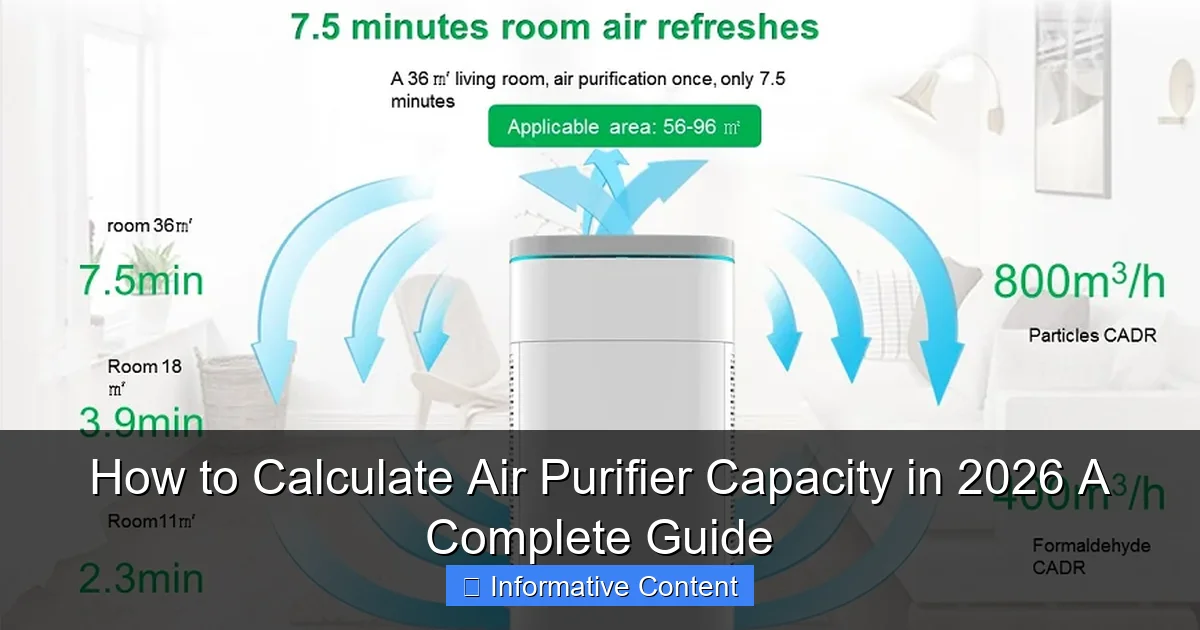
When we talk about air purifier capacity, we’re not just talking about physical size or how much it weighs. We’re talking about its ability to clean the air in a given space—efficiently, consistently, and at a rate that makes a real difference. Think of it like a vacuum cleaner: a small handheld vac might clean a rug, but it won’t handle your entire living room. Same idea with air purifiers. Capacity is about performance, not just appearance.
Visual guide about how to calculate air purifier capacity
Image source: olansi.net
Understanding CADR: The Gold Standard
The most common way to measure air purifier capacity is through CADR, or Clean Air Delivery Rate. It’s a number assigned by the Association of Home Appliance Manufacturers (AHAM) that tells you how fast a purifier can remove smoke, dust, and pollen from the air. For example, a purifier with a CADR of 200 for dust means it delivers 200 cubic feet per minute (CFM) of clean air. Higher CADR = faster cleaning.
Here’s the kicker: CADR is measured in three categories:
- Smoke – fine particles like wildfire smoke or cigarette smoke
- Dust – larger particles like pet dander or pollen
- Pollen – seasonal allergens
Each category has its own CADR score, and you want a purifier that performs well across all three—especially if you have allergies or live in a high-pollution area.
Why CADR Alone Isn’t Enough
CADR is helpful, but it’s not the full story. I learned this the hard way. I bought a purifier with a high CADR, but it was noisy and only covered a small room. Turns out, the CADR rating assumes ideal conditions—no furniture blocking airflow, no closed doors, and perfect room layout. In real life, walls, doors, and even your couch can slow down air circulation.
Also, CADR doesn’t tell you about air changes per hour (ACH), which is how many times the purifier replaces the air in your room every hour. More on that in a moment. Bottom line: use CADR as a starting point, but don’t stop there.
The Role of Room Size and Air Changes Per Hour (ACH)
Here’s where things get personal. Your air purifier’s capacity should match your room size and how many air changes per hour you need. For general use, 2–4 ACH is fine. But if you have asthma, allergies, or live in a wildfire-prone area, experts recommend 4–6 ACH—or even higher in extreme cases.
Let’s say you have a 300-square-foot bedroom with 8-foot ceilings. That’s 2,400 cubic feet of air (300 x 8). If you want 4 air changes per hour, your purifier needs to process 9,600 cubic feet of air per hour (2,400 x 4), or 160 CFM (9,600 ÷ 60 minutes). So, you’d look for a purifier with a CADR close to 160 or higher.
Pro tip: If you’re unsure about your room’s cubic footage, just multiply length x width x ceiling height. Most homes have 8-foot ceilings, but if yours are higher (like 9 or 10 feet), that adds up fast.
How to Calculate Air Purifier Capacity Step-by-Step
Now that you know the key terms, let’s walk through a real-world calculation. I’ll use my own living room as an example—because nothing beats learning from real life.
Step 1: Measure Your Room’s Cubic Footage
First, measure the room. My living room is 18 feet long, 15 feet wide, and has 9-foot ceilings. So:
- Length: 18 ft
- Width: 15 ft
- Height: 9 ft
Cubic footage = 18 x 15 x 9 = 2,430 cubic feet. This is the total volume of air in the room.
Step 2: Decide on Air Changes Per Hour (ACH)
What kind of air quality do you need?
- 2–3 ACH: General use, low pollution
- 4–5 ACH: Allergies, pets, urban living
- 6+ ACH: Asthma, wildfire smoke, post-construction cleanup
Since I live in a city with high pollen counts and have a dog, I aim for 5 ACH. That means the purifier needs to clean the entire room’s air 5 times every hour.
Step 3: Calculate Required Airflow (in CFM)
Total air to clean per hour = Cubic footage x ACH = 2,430 x 5 = 12,150 cubic feet per hour.
Convert to CFM (cubic feet per minute): 12,150 ÷ 60 = 202.5 CFM.
So, I need a purifier that can deliver at least 200 CFM of clean air. That’s my minimum target.
Step 4: Match CFM to CADR and Room Size Ratings
Now, check the product specs. Look for:
- CADR rating – should be at or above your CFM target (200+ in this case)
- Recommended room size – should match or exceed your room size (275 sq ft or more, since 18×15=270)
- ACH rating – some brands list this directly (e.g., “up to 4 ACH in 300 sq ft”)
I found a purifier with a CADR of 220 for dust, 210 for pollen, and 190 for smoke. Its recommended room size is 320 sq ft. That’s perfect for my 270 sq ft room and meets my CFM needs. Bonus: it’s Energy Star certified, so it won’t spike my electric bill.
Step 5: Consider Real-World Factors
Remember, the calculation is ideal. In reality:
- Doors and walls reduce airflow
- Furniture placement matters (don’t block the inlet or outlet)
- Ceiling fans help circulate air, boosting effectiveness
- Open windows or HVAC systems change air exchange rates
So, I placed the purifier in a central spot, away from walls, and run a ceiling fan on low. This helps the purifier work more efficiently—like giving it a little wind boost.
Room-by-Room Guide: Matching Purifier Capacity to Your Home
Not all rooms are created equal. A purifier that’s perfect for your bedroom might be overkill for your bathroom—or underpowered for your open-concept living area. Let’s break it down room by room.
Bedroom: Quiet and Effective
You spend 7–8 hours here every night. The air quality matters. For a typical 12×12 ft bedroom (144 sq ft, 8 ft ceiling = 1,152 cu ft):
- Target ACH: 4–5 (for allergy sufferers)
- Required CFM: 77–96 (1,152 x 4–5 ÷ 60)
- CADR needed: 80–100
Tip: Choose a purifier with a sleep mode or night mode—quiet operation is key. Look for decibel levels under 30 dB on low. Some models even have auto-sensors that adjust fan speed based on air quality.
Living Room: Open Spaces Need More Power
Living rooms are often larger and have open layouts. A 20×20 ft room with 9 ft ceilings is 3,600 cu ft. At 4 ACH, you need 240 CFM.
- CADR: 240+ (aim for 250 to be safe)
- Room size rating: 400+ sq ft
Tip: Place the purifier where airflow isn’t blocked—near a central doorway or open area. Avoid corners unless the unit is designed for them.
Kitchen: Smoke, Odors, and Cooking Fumes
Kitchens produce grease, smoke, and strong smells. A 10×12 ft kitchen (960 cu ft) needs 64–80 CFM at 4–5 ACH.
- CADR: 70–85 (especially for smoke)
- Look for: activated carbon filter (great for odors and VOCs)
Tip: Run the purifier during and after cooking. Some smart models sync with range hoods or detect VOC spikes automatically.
Basement: Mold, Musty Smells, and Low Airflow
Basements are damp, poorly ventilated, and prone to mold. A 15×20 ft basement (2,400 cu ft) needs 160–200 CFM at 4–5 ACH.
- CADR: 170+
- Look for: HEPA filter + carbon + anti-microbial coating
Tip: Combine with a dehumidifier. Mold thrives in moisture, so reducing humidity helps the purifier work better.
Nursery or Baby Room: Extra Sensitivity
Infants breathe faster and are more vulnerable to air pollution. A 10×10 ft nursery (800 cu ft) needs 53–67 CFM at 4–5 ACH.
- CADR: 60+ (prioritize low noise and no ozone)
- Look for: medical-grade HEPA, no ozone emission, nightlight or soft glow
Tip: Avoid ionizers or ozone generators—they can irritate baby lungs.
Advanced Factors That Affect Air Purifier Capacity
Even after calculating CFM and CADR, there are hidden factors that can make or break your purifier’s performance. Let’s dive into the nitty-gritty.
Filter Type and Efficiency
Not all filters are equal. Here’s what matters:
- HEPA filters – capture 99.97% of particles as small as 0.3 microns (dust, pollen, mold)
- Activated carbon – absorbs odors, VOCs, and gases (great for kitchens, smokers)
- Pre-filters – catch large particles, extend HEPA life
- UV-C or ionizers – kill germs, but some produce ozone (avoid if sensitive)
Pro tip: Check the MERV rating (Minimum Efficiency Reporting Value). MERV 13+ is good for allergens. But remember: higher MERV can reduce airflow, so balance efficiency with fan power.
Fan Speed and Noise Levels
A high CADR often means a powerful fan—but also more noise. I once had a purifier that sounded like a jet engine on high. Not ideal for sleeping.
Look for models with multiple fan speeds and quiet operation modes. Check the decibel (dB) rating:
- <25 dB: whisper quiet (great for bedrooms)
- 30–40 dB: soft hum (acceptable for living rooms)
- 50+ dB: noticeable (best for daytime use)
Smart Features and Sensors
In 2026, many purifiers come with air quality sensors, app control, and auto modes. These can help maintain capacity over time by:
- Adjusting fan speed based on real-time air quality
- Sending filter replacement alerts
- Integrating with smart home systems (Alexa, Google Home)
Example: I have a purifier that turns on high when it detects cooking smoke. No more smoky kitchen—just clean air.
Energy Use and Cost Over Time
A high-capacity purifier can use more electricity. Check the watts and look for Energy Star certification. A 50-watt purifier running 24/7 costs about $60/year at $0.15/kWh. Not bad for better health.
Tip: Use a timer or smart plug to run it only when needed—like during allergy season or after painting.
Data Table: Air Purifier Capacity by Room Type (2026 Guide)
| Room Type | Typical Size (sq ft) | Ceiling Height | Cubic Feet | Target ACH | Required CFM | CADR Target | Key Features to Look For |
|---|---|---|---|---|---|---|---|
| Bedroom | 144 | 8 ft | 1,152 | 4–5 | 77–96 | 80–100 | Sleep mode, quiet (<30 dB), HEPA |
| Living Room | 400 | 9 ft | 3,600 | 4 | 240 | 240+ | High CADR, smart sensors, wide coverage |
| Kitchen | 120 | 8 ft | 960 | 4–5 | 64–80 | 70–85 | Activated carbon, odor control, auto mode |
| Basement | 300 | 8 ft | 2,400 | 4–5 | 160–200 | 170+ | Anti-microbial, dehumidifier combo, durable |
| Nursery | 100 | 8 ft | 800 | 4–5 | 53–67 | 60+ | No ozone, nightlight, medical-grade HEPA |
| Home Office | 150 | 8 ft | 1,200 | 3–4 | 60–80 | 70–90 | Low noise, compact, VOC reduction |
Final Thoughts: Making the Right Choice in 2026
Calculating air purifier capacity isn’t about chasing the highest number or the biggest brand. It’s about understanding your space, your health needs, and your lifestyle. I’ve learned that the best purifier isn’t the most powerful—it’s the one that fits your life.
Start with your room size. Multiply length x width x height to get cubic feet. Decide how many air changes you need—2 for general use, 4–6 for health concerns. Convert that to CFM. Then, find a purifier with a CADR close to that number, a room size rating that matches, and features that suit your needs (quiet, smart, odor control, etc.).
And don’t forget the real-world tweaks: place it centrally, keep it away from walls, use ceiling fans, and maintain the filters. A purifier with perfect specs won’t help if the filter is clogged or it’s stuck in a corner.
In 2026, air quality is a health issue, not a luxury. Whether you’re battling pollen, wildfire smoke, or just want to breathe easier at night, getting the capacity right makes all the difference. So take your time. Do the math. Read the specs. And remember: clean air isn’t just about what you see—it’s about what you feel. Breathe easier. Live better.
Frequently Asked Questions
How do you calculate air purifier capacity for a room?
To calculate air purifier capacity, multiply the room’s length, width, and height to get the volume in cubic feet. Then, match this to an air purifier’s CADR (Clean Air Delivery Rate) or ACH (Air Changes per Hour) rating to ensure it can effectively clean the space.
What is CADR and how does it relate to air purifier capacity?
CADR measures how efficiently an air purifier removes smoke, dust, and pollen from the air. A higher CADR means greater air purifier capacity, so choose a unit with a CADR rating at least two-thirds the size of your room’s square footage.
How often should an air purifier clean the air in a room?
Most experts recommend 4–6 air changes per hour (ACH) for optimal air quality. To calculate air purifier capacity, ensure the unit’s ACH rating meets this standard based on your room size and usage needs.
Can an air purifier be too powerful for a small room?
While a high-capacity air purifier can clean a small room quickly, it may cycle too fast and waste energy. However, it’s generally better to have slightly more capacity than needed rather than an underpowered unit.
How do I calculate air purifier capacity for large or open spaces?
For large or open areas, calculate the total cubic footage and look for an air purifier with a high CADR and multiple fan speeds. Some models are designed specifically for large rooms and can handle higher air purifier capacity demands.
Does ceiling height affect air purifier capacity calculations?
Yes, higher ceilings increase the room’s volume, requiring a higher air purifier capacity. Always factor in ceiling height when calculating room volume to ensure the purifier can effectively clean all the air.