

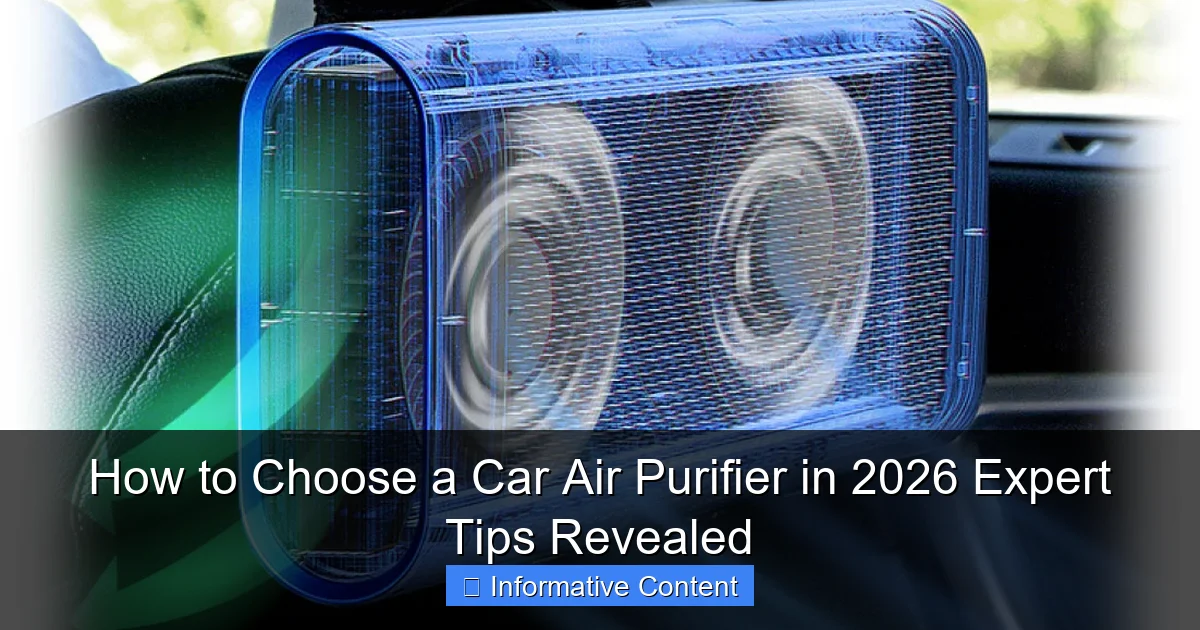
Featured image for how to choose a car air purifier
Image source: hmeproducts.com
Prioritize a car air purifier with a true HEPA filter and activated carbon layer in 2026 to effectively capture allergens, smoke, and harmful VOCs. Match the purifier’s CADR rating to your vehicle size and opt for low-noise, energy-efficient models with smart sensors for real-time air quality feedback. Always verify third-party testing and filter replacement costs to ensure long-term value and performance.
Key Takeaways
- Prioritize HEPA filters: Ensure true HEPA H13+ for maximum particle capture.
- Check CADR ratings: Match clean air delivery rate to your car’s size.
- Verify noise levels: Choose under 50 dB for quiet, distraction-free driving.
- Assess power source: Opt for USB-C or 12V for reliable in-car charging.
- Look for smart sensors: Real-time air quality alerts boost convenience and safety.
- Consider filter lifespan: Replace every 3-6 months for consistent performance.
📑 Table of Contents
- Why You Need a Car Air Purifier in 2026
- Understanding How Car Air Purifiers Work
- Key Features to Look for in a 2026 Car Air Purifier
- Matching the Purifier to Your Lifestyle and Car Type
- Common Mistakes to Avoid When Buying a Car Air Purifier
- Top 5 Car Air Purifiers in 2026: A Quick Comparison
- Final Tips for Getting the Most Out of Your Car Air Purifier
Why You Need a Car Air Purifier in 2026
Let’s be honest—your car isn’t just a vehicle. It’s your morning commute sanctuary, your weekend getaway companion, and sometimes, even your mobile office. But have you ever stopped to think about what you’re breathing in while you’re driving? Between city traffic, pollen, pet dander, cigarette smoke, and the lingering scent of last night’s takeout, your car’s cabin air quality can be worse than the air outside. In fact, studies show that indoor air—yes, including your car—can be up to five times more polluted than outdoor air. And with more people spending hours behind the wheel, the need for clean, fresh air in your vehicle has never been more urgent.
Enter the car air purifier: a compact, often stylish gadget designed to filter out harmful particles, neutralize odors, and even kill airborne pathogens. But with so many models on the market in 2026—ranging from budget-friendly USB-powered units to high-tech smart purifiers—how do you choose the right one? That’s exactly what this guide is for. Whether you’re a parent worried about your kids breathing in allergens, a rideshare driver exposed to countless passengers, or just someone who wants to enjoy a fresher, healthier ride, I’ll walk you through everything you need to know to pick the perfect car air purifier for your needs.
Understanding How Car Air Purifiers Work
The Science Behind Clean Air in Your Car
Before you buy, it helps to understand what’s happening inside your car air purifier. Most models use a combination of filtration, ionization, and odor-neutralizing technologies to improve air quality. Think of it like a mini HVAC system for your vehicle, but focused solely on cleaning the air you breathe.
Visual guide about how to choose a car air purifier
Image source: soleusairwest.com
The core of most purifiers is a filter system. The most common types are:
- HEPA filters (High-Efficiency Particulate Air): These capture at least 99.97% of particles as small as 0.3 microns—think dust, pollen, mold spores, and even some bacteria.
- Activated carbon filters: These absorb odors, volatile organic compounds (VOCs), and gases like formaldehyde and benzene. Great for neutralizing smoke, food smells, and chemical fumes.
- Pre-filters: A coarse mesh that traps larger particles like pet hair and dust, extending the life of the main filter.
For example, the Philips GoPure 5212 uses a 3-stage system: pre-filter, HEPA, and activated carbon. It’s a solid choice for city drivers dealing with traffic pollution and pet owners with shedding dogs in the backseat.
Beyond Filters: Ionizers and UV-C Light
Some purifiers go beyond physical filtration. Ionizers release negatively charged ions that attach to airborne particles, making them too heavy to float. They then fall to surfaces (or get caught in the filter). While effective, ionizers can produce trace amounts of ozone, a lung irritant. So, if you have asthma or are sensitive to air quality, look for ozone-free ionizers.
Another advanced feature is UV-C light, which uses ultraviolet radiation to kill bacteria, viruses, and mold spores. The IQAir Atem Car uses a combination of HEPA, carbon, and a UV-C chamber—ideal if you’re concerned about germs, especially during cold and flu season.
Tip: Always check if the purifier has third-party certifications (like CARB compliance for ozone safety) before buying. It’s not just about marketing—it’s about your health.
Key Features to Look for in a 2026 Car Air Purifier
1. Filtration Efficiency and Filter Type
This is the heart of the matter. A purifier is only as good as its filters. In 2026, most reputable brands use true HEPA or medical-grade HEPA filters (H13 or H14). Avoid “HEPA-like” or “HEPA-type” filters—these don’t meet the same standards. For example, the Blueair Cabin P1 uses a true H13 HEPA filter, which captures ultrafine particles down to 0.1 microns, including smoke and viruses.
Also, consider how often filters need replacing. Some last 6 months, others up to 12. The Sharp IG-GC2E has a washable pre-filter and a carbon filter that lasts about 8 months—great for low maintenance. But remember: cheaper purifiers often skimp on filter quality, so don’t let price be your only guide.
2. Airflow and CADR Rating
CADR (Clean Air Delivery Rate) tells you how quickly a purifier can clean the air in a given space. For cars, you want a CADR of at least 100–150 CFM (cubic feet per minute) to keep up with rapid air changes when driving. The Honeywell HPA020B has a CADR of 125 CFM and can refresh the air in a mid-sized sedan in under 5 minutes.
But airflow isn’t just about speed—it’s about coverage. A purifier with a 360° intake (like the Dyson Pure Cool Me) draws air from all directions, making it more efficient in tight spaces like a car cabin.
3. Power Source and Portability
Most car purifiers run on USB (via your car’s 12V outlet or USB port). This is convenient, but check the power draw. Some high-performance units need more juice than your phone charger can provide. The Winix 5500-2 has a 12V adapter and a built-in battery for short-term use—perfect for road trips.
Size matters too. A bulky unit might block your view or interfere with cup holders. Look for compact, lightweight designs (under 2 pounds) that fit snugly on your dashboard or console. The Airthereal APH260 is just 6 inches tall and fits in most cup holders.
4. Smart Features and Connectivity
In 2026, smart purifiers are on the rise. Some connect via Bluetooth or Wi-Fi to a smartphone app, letting you monitor air quality in real time, set schedules, or receive filter replacement alerts. The LG PuriCare Mini has an app that shows PM2.5 levels and even suggests when to run the purifier based on traffic or weather.
But don’t get swayed by gimmicks. If you just want clean air, a simple on/off switch is fine. Save the smart features for when you actually need them—like if you have allergies or live in a high-pollution area.
Matching the Purifier to Your Lifestyle and Car Type
For City Commuters: Tackling Traffic Pollution
If you drive in a busy urban area, your main concern is PM2.5 (fine particulate matter) and nitrogen dioxide from vehicle exhaust. Look for a purifier with a high CADR and a strong carbon filter. The Philips GoPure 5212 excels here, with a 135 CFM CADR and a carbon layer that reduces traffic-related odors and VOCs.
Pro tip: Run your purifier on “high” during rush hour, then switch to “low” for quieter, energy-saving operation once you’re on the highway.
For Families and Pet Owners: Allergens and Odors
Kids and pets bring joy—and mess. Shedding fur, dander, food spills, and “mystery smells” are common. You’ll want a purifier with a pre-filter for large particles and a carbon filter for odor control. The Winix 5500-2 includes a plasma wave ionizer (ozone-free) that breaks down pet odors and allergens.
Bonus: Some models, like the Sharp IG-GC2E, have a “pet mode” that increases airflow when it detects higher particle levels—perfect for after a muddy walk in the park.
For Rideshare Drivers: Germ and Odor Control
If you drive for Uber or Lyft, your car is a shared space. Passengers bring in germs, food, and sometimes smoke. A purifier with UV-C light and ionization helps kill viruses and bacteria. The IQAir Atem Car is a favorite among drivers—its UV-C chamber runs continuously, and it has a medical-grade filter for maximum protection.
Also, consider a purifier with a quiet mode so it doesn’t disturb passengers. The Blueair Cabin P1 operates at just 22 dB on low—so quiet, you’ll forget it’s on.
For Off-Road and SUV Drivers: Larger Cabin Coverage
SUVs and trucks have bigger interiors, so a compact purifier might not cut it. Look for models with higher CADR ratings (150+ CFM) or dual units. Some drivers place one purifier on the dashboard and another in the back seat for full coverage. The Honeywell HPA300 (designed for rooms but adaptable) can cover up to 465 sq ft—ideal for a large SUV.
Common Mistakes to Avoid When Buying a Car Air Purifier
Overpaying for “Smart” Features You Don’t Need
Yes, the LG PuriCare Mini has an app that tracks air quality. But do you really need to check PM2.5 levels from your phone every 10 minutes? For most people, a simple LED indicator (green = good, red = bad) is enough. Save $30–$50 by skipping unnecessary tech.
Ignoring Filter Replacement Costs
Some purifiers are cheap upfront but expensive long-term. A $50 unit with $80/year in filter replacements is a bad deal. Always calculate the total cost of ownership. The Airthereal APH260 costs $65 but has filters that last 12 months and cost $25 to replace—much more affordable than competitors.
Choosing the Wrong Size or Placement
A purifier that’s too big blocks your view. One that’s too small doesn’t clean the air effectively. Measure your dashboard or console space before buying. And avoid placing it near vents—it disrupts airflow. The Dyson Pure Cool Me has a curved design that fits snugly on most dashboards without blocking vents.
Assuming “Ionizer” Means “Better”
While ionizers help, they’re not a replacement for a good filter. And as mentioned, some produce ozone. If you have asthma, allergies, or are driving with kids, stick to ozone-free models. The Blueair Cabin P1 uses ionization but is CARB-certified ozone-safe.
Top 5 Car Air Purifiers in 2026: A Quick Comparison
To help you decide, here’s a comparison of five top-rated models based on real-world performance, price, and features:
| Model | Filtration Type | CADR (CFM) | Smart Features | Filter Lifespan | Price | Best For |
|---|---|---|---|---|---|---|
| Philips GoPure 5212 | HEPA + Carbon + Pre-filter | 135 | LED air quality indicator | 6–8 months | $99 | City commuters, pet owners |
| Blueair Cabin P1 | True H13 HEPA + Carbon | 120 | App connectivity (optional) | 12 months | $149 | Allergy sufferers, families |
| IQAir Atem Car | HyperHEPA + Carbon + UV-C | 110 | App with real-time monitoring | 6 months | $199 | Rideshare drivers, germ control |
| Winix 5500-2 | HEPA + Carbon + PlasmaWave | 125 | Auto mode, sleep mode | 6–8 months | $89 | Pet owners, odor control |
| Airthereal APH260 | HEPA + Carbon + Ionizer | 100 | None (manual control) | 12 months | $65 | Budget buyers, minimalists |
Note: Prices are approximate and may vary by retailer. Always check for bundle deals (e.g., free filter with purchase).
Final Tips for Getting the Most Out of Your Car Air Purifier
Buying the purifier is just the start. To keep your car air clean, follow these tips:
- Run it daily, even if you’re just driving for 15 minutes. Pollutants build up quickly.
- Replace filters on time. A clogged filter does more harm than good—it can push dirty air back into your car.
- Use recirculation mode on your car’s AC. It reduces outdoor air intake, letting the purifier work more efficiently.
- Wipe down surfaces weekly. Dust and pet hair settle on dashboards and seats—clean them to reduce the load on your purifier.
- Don’t smoke or eat in the car. No purifier can fully eliminate the smell of smoke or strong food odors.
And remember: a purifier isn’t a magic wand. It helps, but it’s part of a bigger strategy. Keep your car clean, change your cabin air filter regularly, and avoid idling in heavy traffic when possible.
Choosing a car air purifier in 2026 isn’t about finding the most expensive or tech-heavy model. It’s about matching the right features to your life—whether you’re a daily commuter, a pet parent, or a rideshare pro. By focusing on filtration quality, airflow, and real-world usability, you’ll breathe easier every time you hit the road. After all, your car should feel like a safe space, not a pollution trap. So take your time, do your research, and invest in clean air. Your lungs (and your passengers) will thank you.
Frequently Asked Questions
What is the best type of car air purifier for removing allergens?
HEPA filter-based car air purifiers are ideal for trapping allergens like pollen, dust, and pet dander. Look for models with True HEPA filters to ensure 99.97% efficiency on particles as small as 0.3 microns.
How do I choose a car air purifier that fits my vehicle’s size?
Check the purifier’s Clean Air Delivery Rate (CADR) and match it to your car’s interior volume. Compact cars need lower CADR (20-40 m³/h), while SUVs require higher ratings (50+ m³/h) for optimal performance.
Are car air purifiers with ionizers safe to use?
Most modern ionizers are safe, but avoid models that produce high levels of ozone (labeled “ozone-free” is best). Ionizers help remove ultrafine particles but work best when combined with a HEPA or activated carbon filter.
How often should I replace the filters in my car air purifier?
Replace HEPA filters every 6-12 months, and activated carbon filters every 3-6 months, depending on usage and air quality. Some smart purifiers include filter-life indicators to simplify maintenance.
Can a car air purifier eliminate odors and smoke?
Yes, purifiers with activated carbon filters excel at absorbing odors, smoke, and VOCs. For heavy smoke, choose a model with a high-quality, thick carbon bed for maximum odor neutralization.
What features should I look for in a car air purifier in 2026?
Prioritize smart sensors (PM2.5, VOC, humidity), auto-mode adjustments, low noise (under 40 dB), and USB-C power compatibility. New 2026 models often include app connectivity for real-time air quality tracking.