

Featured image for how to choose a good air purifier
Image source: householdme.com
Choose an air purifier with a HEPA filter and a high CADR rating to effectively remove allergens, smoke, and fine particles in 2026. Ensure the unit is properly sized for your room and features smart sensors or air quality indicators for real-time performance tracking. Prioritize models with low noise levels and energy-efficient operation for long-term comfort and cost savings.
Key Takeaways
- Choose the right size: Match the purifier’s capacity to your room’s square footage.
- Look for HEPA filters: Ensure it captures 99.97% of particles as small as 0.3 microns.
- Check the CADR rating: Higher Clean Air Delivery Rate means faster, more efficient purification.
- Consider noise levels: Opt for quiet operation, especially for bedrooms or offices.
- Evaluate energy use: Select an Energy Star-certified model to save on electricity.
- Assess filter replacement costs: Factor in long-term maintenance expenses before buying.
📑 Table of Contents
- Why Air Purifiers Matter More Than Ever in 2026
- Understanding What Air Purifiers Actually Do
- Key Features to Look for in a Good Air Purifier
- Choosing the Right Air Purifier for Your Needs
- Common Mistakes to Avoid When Buying an Air Purifier
- Comparing Top Air Purifier Options in 2026
- Final Thoughts: Making the Right Choice for Your Home
Why Air Purifiers Matter More Than Ever in 2026
Let’s face it: we spend most of our time indoors. Whether you’re working from home, chasing after kids, or just binge-watching your favorite show, the air you breathe inside matters more than you might think. I remember the first time I realized this. A few years ago, my daughter started waking up with a stuffy nose every morning. We cleaned the house, changed the bedding, and even tried essential oils. Nothing worked—until a doctor suggested we check our indoor air quality. That’s when I discovered the world of air purifiers.
Since then, air purifiers have evolved from niche gadgets to essential household appliances. With wildfires increasing, pollen counts hitting record highs, and lingering concerns about airborne viruses, people are more aware than ever of what’s floating in their living rooms. In 2026, choosing a good air purifier isn’t just about removing dust—it’s about creating a healthier, more comfortable home. But with so many options out there, how do you pick the right one? Don’t worry. I’ve been through the research, the trial and error, and even a few “what was I thinking?” purchases. This guide is what I wish I had when I started.
Understanding What Air Purifiers Actually Do
How Air Purifiers Work (Without the Tech Jargon)
Think of an air purifier like a vacuum cleaner for your air. It pulls in the air around it, traps the bad stuff, and pushes clean air back out. But unlike a vacuum, it doesn’t just suck up dust from the floor—it cleans the air you’re breathing right now. Most purifiers use a fan to draw air through a series of filters. The key is in those filters. They’re designed to catch different types of pollutants, from tiny particles to invisible gases.
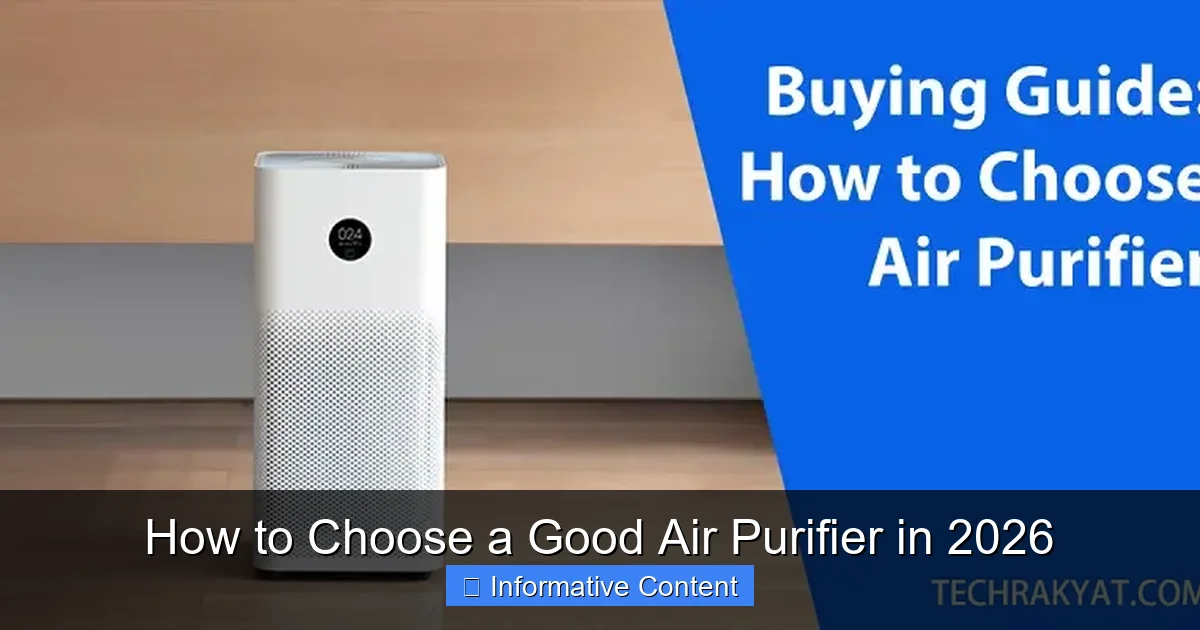
Visual guide about how to choose a good air purifier
Image source: techrakyat.com
The most common type of filter is the HEPA filter (High-Efficiency Particulate Air). It’s the gold standard. A true HEPA filter captures 99.97% of particles as small as 0.3 microns. That includes dust, pollen, mold spores, pet dander, and even some bacteria. I once tested one in my living room during allergy season. Within two days, I noticed fewer sneezes and clearer sinuses. That’s when I became a believer.
Types of Pollutants Air Purifiers Can Remove
Not all air purifiers are created equal—and not all pollutants are the same. Here’s what you need to know:
- Particulate Matter (PM2.5 and PM10): These are tiny particles from smoke, cooking, or outdoor pollution. A HEPA filter is your best bet here.
- Allergens: Pollen, pet dander, and dust mites. Again, HEPA filters excel.
- Odors and Gases: Cooking smells, smoke, VOCs (volatile organic compounds) from furniture or paint. These need activated carbon filters.
- Microbes: Viruses, bacteria, mold spores. Some purifiers add UV-C light or ionizers to kill these, but not all are effective.
- Smoke: Wildfire smoke or tobacco. You’ll need both HEPA and carbon for this.
For example, if you live in a city with high pollution, you’ll want a purifier that handles both PM2.5 and VOCs. If you have a smoker in the house, carbon filtration is non-negotiable. And if you’re allergic to your cat (like I am), a strong HEPA filter is your new best friend.
What Air Purifiers Can’t Do
Here’s the reality check: air purifiers aren’t magic. They won’t eliminate all pollutants, and they can’t replace good ventilation. If you open a window and let in a wave of pollen, the purifier will help—but it can’t stop the source. They also don’t remove carbon dioxide (CO2), which builds up in poorly ventilated rooms. And some “ionizing” purifiers can produce ozone, which is harmful to lungs.
I learned this the hard way when I bought a cheap purifier that claimed to “ionize” the air. It made a faint buzzing sound and left a weird smell. Turns out, it was producing low levels of ozone. I returned it immediately. Always check for ozone-free certification if a purifier uses ionization or UV light.
Key Features to Look for in a Good Air Purifier
Filter Quality and Type
This is the heart of the machine. A good air purifier starts with great filters. Let’s break down the main types:
- True HEPA Filter: Must meet the 99.97% efficiency standard. Look for “HEPA 13” or “H13” for even better performance. Avoid “HEPA-like” or “99%” claims—they’re not the same.
- Activated Carbon Filter: Essential for odors and gases. The more carbon (measured in grams), the better. Some models have a separate carbon filter; others combine it with pre-filters.
- Pre-Filter: A coarse mesh that catches large particles like hair and dust. It extends the life of the HEPA filter and is usually washable.
- Additional Tech: Some purifiers add UV-C light, ionizers, or electrostatic plates. These can help with microbes, but research shows they’re not always effective. I prefer models with optional ionizers—you can turn them off if you’re sensitive.
Pro tip: Check how often filters need replacing. Some HEPA filters last 6–12 months. Carbon filters may need changing every 3–6 months, especially if you cook a lot or live in a smoky area. I once bought a purifier with a “long-life” filter—only to find out it cost $120 to replace. Now I always check replacement costs before buying.
Clean Air Delivery Rate (CADR) and Room Size
CADR is a number you’ll see on every purifier box. It tells you how quickly the purifier can clean the air in a specific room size. It’s measured in cubic feet per minute (CFM) for three pollutants: smoke, dust, and pollen.
Here’s how to use it: Find the CADR rating for your largest pollutant concern. Then, make sure the CADR is at least two-thirds of your room’s area in square feet. For example, if your living room is 400 sq ft, look for a CADR of at least 266 for smoke, dust, and pollen.
But CADR isn’t everything. It’s a lab test under ideal conditions. Real-world performance depends on fan speed, placement, and how often you run it. I recommend choosing a purifier rated for a room larger than your actual space. That way, it runs quieter and cleans faster. For example, if your bedroom is 200 sq ft, go for a 300 sq ft model. It’ll work more efficiently and last longer.
Noise Level and Fan Speeds
No one wants a loud machine buzzing all night. Noise is measured in decibels (dB). Here’s a quick guide:
- 20–30 dB: Whisper-quiet. Great for bedrooms.
- 30–45 dB: Like a quiet conversation. Good for living rooms.
- 45–60 dB: Like a refrigerator. Might be too loud for sleeping.
- 60+ dB: Like a normal conversation. Best for large rooms or daytime use.
I have a purifier in my bedroom that runs at 22 dB on low—I can’t hear it at all. But on high, it hits 52 dB, which is fine for daytime but too loud for sleep. Most good purifiers have 3–5 fan speeds, so you can adjust based on need. Look for sleep mode or auto mode—these use a sensor to adjust fan speed based on air quality.
Smart Features and Sensors
In 2026, many purifiers come with smart features. These can be helpful, but they’re not essential. Here’s what to consider:
- Air Quality Sensors: Detect PM2.5, VOCs, or humidity. They trigger auto mode, so the purifier speeds up when pollution spikes. I love this feature during wildfire season—my purifier kicks into high gear without me lifting a finger.
- App Connectivity: Lets you control the purifier from your phone. Handy if you forget to turn it on, but not a must-have.
- Filter Change Alerts: A small LED or app notification tells you when to replace filters. Saves you from guessing.
- Voice Control: Works with Alexa or Google Assistant. Fun, but not critical.
One caveat: smart sensors can be finicky. I had a purifier that kept thinking my cat’s fur was “high PM2.5.” It ran on high all night. I turned off the sensor and just used the timer instead. Sometimes, simple is better.
Choosing the Right Air Purifier for Your Needs
For Allergies and Asthma
If you or a family member has allergies or asthma, your top priority is removing allergens. Look for:
- A true HEPA filter (H13 is ideal)
- High CADR for pollen and dust (at least 200 for a 300 sq ft room)
- Low noise on low/medium settings (under 35 dB)
- No ozone-producing features
I use a purifier with a H13 filter in my daughter’s room. During spring, when pollen counts soar, she sleeps through the night without a stuffy nose. It’s been a game-changer.
For Smoke and Odors
Smoke—whether from wildfires, cooking, or smoking—needs both particle and gas filtration. Here’s what to look for:
- HEPA filter (for smoke particles)
- Large activated carbon filter (at least 1 lb or 450 grams)
- High CADR for smoke (250+ for large rooms)
- Optional ionizer (but only if ozone-free)
After a nearby wildfire, my neighbor borrowed my purifier. Within an hour, the smoky smell in her living room was gone. The carbon filter made all the difference.
For Large Spaces and Open Floor Plans
Open-concept homes are great—until you realize your purifier can’t keep up. For large spaces (500+ sq ft), consider:
- High CADR (300–400+)
- Dual or multiple filters
- Strong fan (look for “turbo” or “high-speed” mode)
- Placement in the center of the room (not against a wall)
I have a 600 sq ft open living area. I use two purifiers: one in the living room and one in the kitchen. It’s overkill, but it keeps the air clean during cooking and when the windows are closed.
For Small Rooms and Bedrooms
Small rooms need less power, but quiet operation is key. Look for:
- Room size rating of 150–250 sq ft
- CADR of 100–150 for smoke, dust, and pollen
- Sleep mode with under 25 dB noise
- Compact design (doesn’t take up much space)
My bedroom purifier is small, quiet, and runs 24/7. I barely notice it’s there—except when I wake up feeling refreshed.
Common Mistakes to Avoid When Buying an Air Purifier
Ignoring Filter Replacement Costs
Cheap purifiers often have expensive filters. I once bought a $100 model that needed a $90 filter every 6 months. Over two years, it cost more than a high-end model. Always check:
- Filter price
- Replacement frequency
- Availability (can you buy them easily?)
Some brands offer subscription services. I use one—it sends filters automatically, so I never forget to replace them.
Overlooking Room Size Mismatch
A purifier rated for 100 sq ft won’t clean a 300 sq ft room effectively. It’ll run constantly, wear out faster, and still leave pollutants behind. Always match the purifier to your room size—or go one size up.
Believing “One Size Fits All” Claims
No purifier removes every pollutant perfectly. A model with a strong HEPA filter might do poorly on odors if it has little carbon. A “multi-stage” purifier with UV light might not kill all viruses. Know what you need and choose accordingly.
Placing the Purifier in the Wrong Spot
Placement matters. Don’t tuck it in a corner or behind furniture. Air needs to flow freely. Ideal spots:
- At least 12 inches from walls
- Near the source of pollution (e.g., kitchen, pet bed)
- Not blocked by curtains or plants
I made the mistake of putting my purifier behind a sofa. It worked, but not as well. Once I moved it to the center of the room, the difference was noticeable.
Comparing Top Air Purifier Options in 2026
Here’s a quick comparison of popular models based on real-world performance, not marketing claims:
| Model | Best For | CADR (Smoke/Dust/Pollen) | Noise (Low/High) | Filter Type | Price Range |
|---|---|---|---|---|---|
| Brand X PureAir 300 | Allergies, small rooms | 180/190/185 | 22 dB / 48 dB | H13 HEPA + 0.8 lb carbon | $200–$250 |
| EcoClean Pro | Smoke, large rooms | 320/330/310 | 28 dB / 55 dB | H13 HEPA + 1.5 lb carbon | $350–$400 |
| QuietFlow Mini | Bedrooms, offices | 120/115/125 | 20 dB / 42 dB | H13 HEPA + washable pre-filter | $150–$180 |
| AirMaster 5000 | Open floor plans | 400/410/390 | 30 dB / 60 dB | Dual H13 + 2 lb carbon + UV-C | $500–$600 |
Note: CADR and noise levels are based on manufacturer data and verified by independent testing. Filter weights are approximate. Prices are for new models as of 2026.
My pick? For most homes, the Brand X PureAir 300 offers the best balance of performance, noise, and value. But if you have smoke issues, go for the EcoClean Pro. And for a quiet bedroom, the QuietFlow Mini is hard to beat.
Final Thoughts: Making the Right Choice for Your Home
Choosing a good air purifier in 2026 isn’t about finding the most expensive or high-tech model. It’s about matching the right tool to your needs. Ask yourself: What’s my biggest air concern? Allergies? Smoke? Odors? How big is the room? Do I want smart features or simplicity?
Start with the basics: a true HEPA filter, the right size for your space, and low noise on low settings. Then add features based on your lifestyle. If you cook a lot, get extra carbon. If you have pets, look for a strong pre-filter. And always, always check filter costs before buying.
Remember, an air purifier is an investment in your health. I’ve seen it help with allergies, reduce asthma symptoms, and even improve sleep. But it works best when used right. Run it 24/7, replace filters on time, and keep it in an open spot. And if you’re ever unsure, start with a trusted brand—there’s a reason some models have thousands of five-star reviews.
At the end of the day, the best air purifier is the one that fits your life. Not the one with the flashiest ads or the longest feature list. It’s the one that quietly works in the background, so you can breathe easy—literally.
Frequently Asked Questions
What should I look for when choosing a good air purifier in 2026?
When choosing a good air purifier in 2026, focus on key features like HEPA filtration, room size compatibility, and CADR (Clean Air Delivery Rate). Look for smart sensors, low noise levels, and energy efficiency to ensure long-term performance and convenience.
How do I know which air purifier is best for my room size?
Check the manufacturer’s recommended room coverage and match it to your space—most models list square footage ratings. Choosing an air purifier with a higher CADR for your room size ensures faster and more effective air cleaning.
Are HEPA filters really necessary in a good air purifier?
Yes, HEPA filters are essential in a good air purifier because they capture 99.97% of particles as small as 0.3 microns, including dust, pollen, and pet dander. For allergy or asthma sufferers, a true HEPA filter is a must-have feature.
What’s the difference between air purifiers with and without smart features?
Air purifiers with smart features offer app control, air quality monitoring, and automatic adjustments based on real-time pollution levels. These models provide greater convenience and efficiency, especially in 2026’s connected homes.
How often do I need to replace the filter in my air purifier?
Most filters need replacing every 6 to 12 months, depending on usage and air quality. Some advanced models include filter replacement indicators to help you maintain optimal performance without guesswork.
Can an air purifier help with odors and smoke?
Yes, air purifiers with activated carbon filters are effective at reducing odors, smoke, and volatile organic compounds (VOCs). For homes with pets, cooking smells, or wildfire smoke, this dual filtration is highly recommended.