
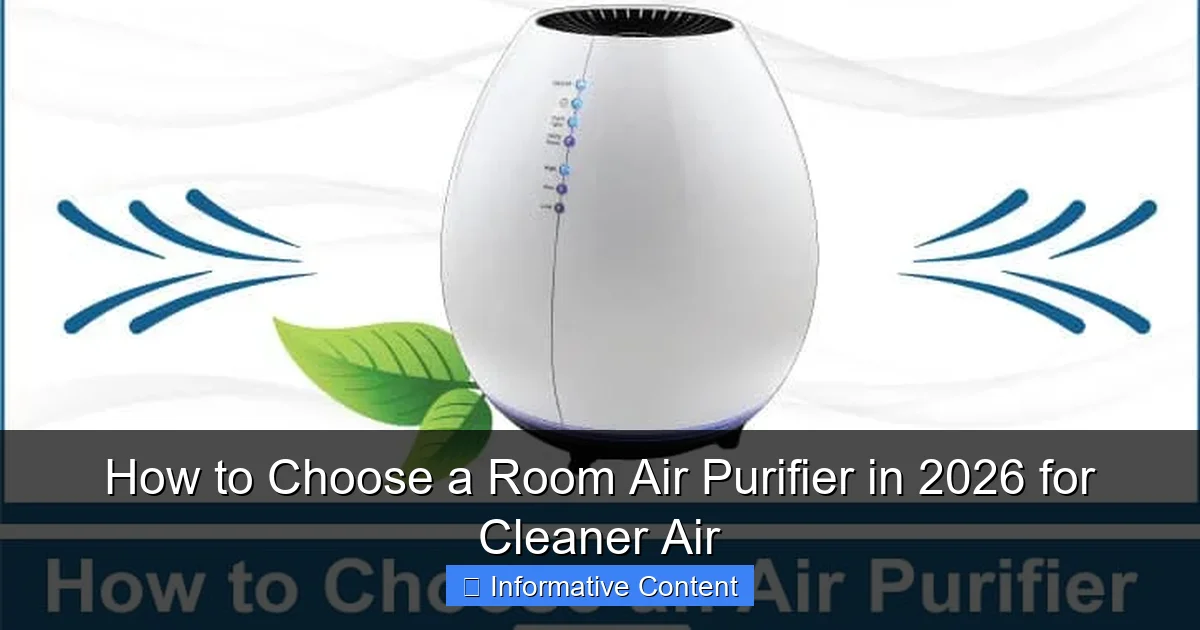
Featured image for how to choose a room air purifier
Image source: idealpurifiers.com
Choosing the right room air purifier in 2026 starts with matching the unit’s Clean Air Delivery Rate (CADR) to your room size for maximum efficiency. Look for HEPA filters to capture 99.97% of airborne particles, including allergens and pollutants, and consider smart features like real-time air quality monitoring and auto mode for seamless operation. Prioritize low noise levels and energy efficiency to ensure comfort and sustainability in everyday use.
Key Takeaways
- Match the purifier to your room size: Choose one with a CADR rating suitable for your space.
- Prioritize HEPA filtration: True HEPA filters capture 99.97% of airborne particles like dust and pollen.
- Check for activated carbon filters: Essential for removing odors, smoke, and volatile organic compounds (VOCs).
- Consider noise levels: Look for models under 50 dB for quiet operation in bedrooms or offices.
- Evaluate energy efficiency: Opt for ENERGY STAR-certified models to reduce long-term operating costs.
- Review maintenance needs: Factor in filter replacement frequency and cost for ongoing performance.
- Use smart features wisely: Air quality sensors and auto modes enhance convenience and effectiveness.
📑 Table of Contents
- How to Choose a Room Air Purifier in 2026 for Cleaner Air
- 1. Understand Your Air Quality Needs
- 2. Know the Key Features and Technologies
- 3. Match the Purifier to Your Room Size
- 4. Prioritize Noise Levels and Energy Efficiency
- 5. Evaluate Design, Maintenance, and User Experience
- 6. Compare Top Models in 2026: A Data Snapshot
- Final Thoughts: Your Path to Cleaner Air in 2026
How to Choose a Room Air Purifier in 2026 for Cleaner Air
Picture this: You walk into your home after a long day, expecting to breathe in the fresh, clean air of your personal sanctuary. Instead, you’re greeted by the faint scent of last night’s dinner, a hint of dust, or worse—the telltale stuffiness that signals poor indoor air quality. If this sounds familiar, you’re not alone. In 2026, indoor air pollution is a growing concern, and a room air purifier might be the solution you’ve been looking for.
Air purifiers have come a long way since their early days. Today, they’re smarter, quieter, and more effective than ever. But with so many options on the market—ranging from budget-friendly models to high-tech, app-connected devices—choosing the right one can feel overwhelming. That’s where this guide comes in. Whether you’re dealing with allergies, pet dander, wildfire smoke, or just want to freshen up your space, we’ll walk you through the key factors to consider when selecting a room air purifier in 2026. Think of this as your friendly, no-nonsense roadmap to cleaner, healthier air at home.
1. Understand Your Air Quality Needs
Before diving into brands and features, take a step back and ask: *What’s the main reason I need an air purifier?* Your answer will shape your choice more than any spec sheet.

Visual guide about how to choose a room air purifier
Image source: punsuniverse.com
Identify Your Primary Concerns
- Allergies and asthma: If pollen, dust mites, or mold spores trigger your allergies, you’ll want a purifier with a high-efficiency particulate air (HEPA) filter. These capture at least 99.97% of particles as small as 0.3 microns—smaller than a human hair.
- Pet owners: Pets shed dander, hair, and sometimes bring in outdoor pollutants. Look for purifiers with pre-filters to trap larger particles and activated carbon filters to neutralize pet odors.
- Smoke (wildfire or tobacco): Smoke contains fine particles and volatile organic compounds (VOCs). You’ll need a purifier with both a HEPA filter *and* a strong carbon filter.
- General air freshening: If you’re just trying to reduce stale air, cooking smells, or VOCs from new furniture, a purifier with a carbon filter and optional ionizer might suffice.
For example, if you live in a wildfire-prone area like California or Oregon, a purifier with a high CADR (Clean Air Delivery Rate) for smoke is a must. On the other hand, a city dweller dealing with traffic-related pollution might prioritize VOC removal.
Consider Your Home’s Airflow
Even the best purifier can’t clean the air if it’s not moving through the filter. If your home has poor ventilation (e.g., sealed windows, no HVAC system), you’ll need a more powerful purifier or multiple units. Pro tip: Open windows occasionally to let in fresh air, but use the purifier during high-pollution times (like rush hour or pollen season).
2. Know the Key Features and Technologies
Air purifiers aren’t all created equal. Some rely on tried-and-true methods, while others use cutting-edge tech. Here’s what to look for—and what to skip.
HEPA Filters: The Gold Standard
If you’re serious about air quality, HEPA filtration is non-negotiable. True HEPA filters meet strict standards set by the U.S. Department of Energy. But beware: Some brands label their filters as “HEPA-type” or “HEPA-style,” which means they don’t meet the full standard. Always look for “True HEPA” or “H13 HEPA” (even better, as H13 captures 99.95% of particles at 0.1 microns).
Example: The Levoit Core 300 uses a 3-stage filtration system with a True HEPA filter, making it a solid choice for allergy sufferers.
Activated Carbon Filters: For Odors and Gases
Carbon filters are the unsung heroes of air purifiers. They adsorb (not absorb!) gases, VOCs, and odors. The more carbon in the filter, the better. Look for purifiers with at least 1–2 pounds of activated carbon for noticeable odor control.
Tip: Carbon filters need replacing more often than HEPA filters (every 3–6 months) because they get saturated over time. A purifier with a washable carbon filter (like the Dyson Purifier Humidify+Cool) can save money long-term.
UV-C Light and Ionizers: Helpful or Hype?
- UV-C light: Kills bacteria and viruses by damaging their DNA. But it’s not a replacement for filtration—UV-C works best when paired with a HEPA filter.
- Ionizers: Release negatively charged ions to attract particles, making them stick to surfaces (or the purifier’s collection plate). However, ionizers can produce ozone, a lung irritant. If you’re sensitive, skip purifiers with ionizers or choose “ozone-free” models.
For instance, the Blueair 311 Auto uses ionizers but is certified ozone-free, making it a safer bet.
Smart Features: Convenience vs. Cost
In 2026, many purifiers come with app connectivity, air quality sensors, and voice control. These features are handy if you want real-time air quality data or to automate cleaning. But they often come with a higher price tag. Ask yourself: Do you really need to monitor PM2.5 levels from your phone, or is a simple manual purifier enough?
3. Match the Purifier to Your Room Size
Buying a purifier that’s too small for your space is like using a teaspoon to bail out a sinking boat. Here’s how to get the right fit.
Check the Room Coverage Area
Most purifiers list their coverage in square feet (or square meters). To find the right size, measure your room’s dimensions and multiply length × width. Then, look for a purifier rated for *at least* that size.
Example: A 300-square-foot bedroom needs a purifier rated for 300+ square feet. For larger rooms (500+ sq ft), consider a high-capacity model like the Honeywell HPA300, which covers up to 465 sq ft.
CADR: The Air Cleaning Speedometer
The Clean Air Delivery Rate (CADR) measures how quickly a purifier removes smoke, dust, and pollen from the air. The higher the CADR, the faster it works. The Association of Home Appliance Manufacturers (AHAM) recommends a CADR of at least two-thirds of your room’s area.
Formula: CADR ≥ (Room size in sq ft) × 2/3
For a 300 sq ft room: CADR ≥ 200
Pro tip: If you have high ceilings (over 8 feet), multiply your room size by 1.25 before calculating CADR.
Multiple Rooms? Try a Portable or Multi-Unit Setup
If you want clean air in multiple rooms, you have two options:
- Portable purifiers: Move them between rooms (e.g., from bedroom to living room).
- Multi-unit systems: Place one purifier per room. This is more expensive but ensures consistent air quality everywhere.
For open-plan spaces, a single large purifier (like the Winix 5500-2) might suffice if it’s centrally located.
4. Prioritize Noise Levels and Energy Efficiency
An air purifier that’s too loud or expensive to run defeats the purpose. Here’s how to keep things quiet and cost-effective.
Decibel (dB) Levels: Quiet is Key
Most purifiers list noise levels in decibels (dB). For reference:
- 20–30 dB: Whisper-quiet (ideal for bedrooms).
- 40–50 dB: Moderate (like a quiet conversation).
- 60+ dB: Loud (similar to a vacuum cleaner).
For nighttime use, look for purifiers with a “sleep mode” (usually 20–30 dB). The Medify MA-40 runs at just 22 dB on low, making it a great choice for light sleepers.
Energy Efficiency: Save Money Long-Term
Purifiers run 24/7, so energy use adds up. Check the wattage (listed on the spec sheet):
- Under 50 watts: Energy-efficient (costs about $5–$10 per year).
- 50–100 watts: Moderate (costs $10–$20 per year).
- 100+ watts: Power-hungry (costs $20+ per year).
Look for Energy Star-certified models, which use up to 40% less energy. The Winix AM90 is Energy Star-rated and uses just 35 watts on medium.
Filter Replacement Costs: The Hidden Expense
Filters aren’t cheap—and some brands charge premium prices for replacements. Before buying, check:
- How often filters need replacing (every 6–12 months for HEPA, 3–6 months for carbon).
- Cost per filter (e.g., $30 for a HEPA filter vs. $60 for a “premium” version).
- Availability of third-party filters (some brands block third-party options).
For example, the IQAir HealthPro Plus has a 5-year HEPA filter, saving you money over time.
5. Evaluate Design, Maintenance, and User Experience
A purifier isn’t just a tech gadget—it’s part of your home. Design and ease of use matter.
Size and Aesthetics: Fit Your Space
Purifiers come in all shapes: tall and slim, compact cubes, or sleek towers. Consider:
- Where will you place it? (Avoid blocking vents or airflow.)
- Does the color/style match your decor? (Some brands offer multiple finishes.)
The Dyson Purifier Cool doubles as a fan, blending into modern homes.
Filter Access and Maintenance
Changing filters should be easy—no tools required. Look for:
- Front-loading or top-loading designs (no need to flip the purifier).
- Filter replacement indicators (so you don’t guess when to change them).
- Washable pre-filters (saves money and reduces waste).
Example: The Blueair 211+ has a simple pull-out tray for filter changes.
User-Friendly Controls
Buttons, dials, or touchscreens—pick what suits you. If you’re tech-savvy, app-controlled purifiers (like the Coway Airmega) let you schedule cleaning cycles or monitor air quality remotely. If not, a simple 3-speed dial (like the Levoit LV-H132) is just fine.
6. Compare Top Models in 2026: A Data Snapshot
To help you cut through the noise, here’s a quick comparison of popular room air purifiers in 2026:
| Model | Best For | Coverage (sq ft) | CADR (Dust/Smoke/Pollen) | Noise (dB) | Energy Use (W) | Filter Cost (Yearly) | Smart Features |
|---|---|---|---|---|---|---|---|
| Levoit Core 300 | Allergies, small rooms | 219 | 141/140/145 | 24–52 | 24 | $40 | None |
| Winix 5500-2 | Large rooms, pet owners | 360 | 232/243/246 | 27–56 | 70 | $60 | Auto mode, app |
| Dyson Purifier Humidify+Cool | All-in-one (humidifier + purifier) | 800 | 300/300/300 | 25–65 | 100 | $120 | App, voice control |
| Honeywell HPA300 | High-capacity, smoke | 465 | 320/300/300 | 40–60 | 80 | None | |
| Blueair 311 Auto | Smart features, ozone-free | 540 | 350/340/360 | 31–62 | 60 | App, air quality sensor |
Remember: The “best” purifier depends on your needs. A budget model like the Levoit Core 300 is perfect for a bedroom, while the Dyson Humidify+Cool is ideal if you want a multi-functional device for a large living space.
Final Thoughts: Your Path to Cleaner Air in 2026
Choosing a room air purifier doesn’t have to be stressful. Start by understanding your air quality needs—whether it’s allergies, smoke, or just general freshness. Then, focus on the essentials: HEPA filtration, room size, noise levels, and energy efficiency. Don’t get dazzled by flashy tech unless it truly adds value to your life.
Think of your purifier as a long-term investment in your health. A good one can reduce allergy symptoms, improve sleep, and even lower stress (because breathing clean air just *feels* better). And remember: No purifier can replace basic habits like dusting, vacuuming, or opening windows. Use it as a tool to *enhance* your air quality, not fix all problems overnight.
In 2026, the air purifier market is more competitive than ever, with innovations in smart tech, energy efficiency, and filter longevity. But at the end of the day, the best purifier is the one that fits *your* lifestyle. Whether you’re a tech enthusiast, a budget shopper, or a health-focused parent, there’s a perfect match out there. Breathe easy—you’ve got this.
Frequently Asked Questions
What size room air purifier do I need?
To choose the right size, check the purifier’s CADR (Clean Air Delivery Rate) and ensure it matches your room’s square footage. For optimal performance, pick a model rated for a space 20-30% larger than your actual room size.
How to choose a room air purifier with the best filter type?
Look for a True HEPA filter (captures 99.97% of particles as small as 0.3 microns) combined with an activated carbon filter for odors and VOCs. In 2026, advanced models may also include antimicrobial or bipolar ionization features for added protection.
Are smart features worth it when choosing a room air purifier?
Smart air purifiers offer real-time air quality monitoring, app controls, and filter replacement alerts, which enhance convenience. If you value data-driven insights and automation, these features can significantly improve your air quality management in 2026.
How often do I need to replace the filters?
Most HEPA filters last 6-12 months, while carbon filters may need replacement every 3-6 months, depending on usage and air quality. Check your model’s indicator light or app notifications to stay on schedule.
What noise level should I expect from a room air purifier?
Quiet models operate at 20-30 decibels (like a whisper) on low settings, while higher speeds may reach 50-60 dB. For bedrooms, prioritize purifiers with a “sleep mode” for minimal disruption during the night.
How to choose a room air purifier for allergies or asthma?
Opt for a unit with a True HEPA filter and high CADR for allergens like pollen, dust, and pet dander. In 2026, look for certifications like Asthma & Allergy Friendly® to ensure proven effectiveness.