

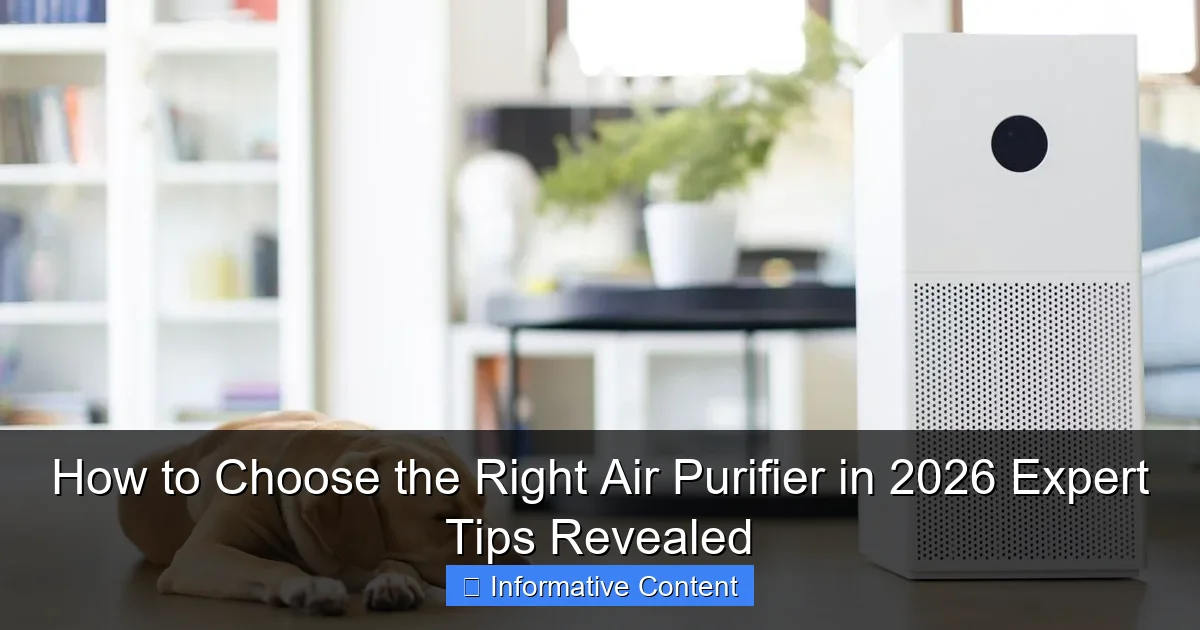
Featured image for how to choose right air purifier
Image source: tailulu.com
Choose an air purifier with a HEPA filter and a CADR rating matching your room size to ensure maximum removal of allergens, smoke, and ultrafine particles in 2026. Prioritize smart features like real-time air quality monitoring and auto mode to effortlessly maintain clean indoor air without guesswork.
Key Takeaways
- Match purifier size to room dimensions: Choose a unit with a CADR rating suitable for your space.
- Prioritize HEPA filters: Ensure it captures 99.97% of particles like dust, pollen, and pet dander.
- Check for activated carbon filters: Essential for removing odors, smoke, and volatile organic compounds.
- Consider noise levels: Look for quiet operation, especially for bedrooms or offices.
- Evaluate energy efficiency: Opt for ENERGY STAR-certified models to reduce long-term costs.
- Review maintenance needs: Factor in filter replacement frequency and cost for ongoing use.
- Use smart features wisely: Air quality sensors and app controls enhance convenience and performance.
📑 Table of Contents
- Why Choosing the Right Air Purifier Matters in 2026
- Understand Your Air Quality Needs
- Know the Types of Air Purification Technologies
- Match the Purifier to Your Room Size and Lifestyle
- Smart Features and Connectivity in 2026
- Compare Top Models and Make the Final Decision
- Your Clean Air Journey Starts Now
Why Choosing the Right Air Purifier Matters in 2026
Imagine this: You wake up with a dry throat, your eyes are itchy, and you can’t stop sneezing. You check the weather app—air quality is “moderate,” but you’re still feeling off. That’s because indoor air can be five times more polluted than outdoor air, according to the Environmental Protection Agency. Whether it’s pet dander, cooking fumes, wildfire smoke, or invisible mold spores, the air inside your home is silently affecting your health, sleep, and even productivity. And in 2026, with rising wildfire seasons, urban pollution, and increased awareness of airborne viruses, choosing the right air purifier isn’t just a luxury—it’s a necessity.
But here’s the catch: Not all air purifiers are created equal. Walk into a home goods store or scroll online, and you’ll be hit with a dizzying array of models, filters, and marketing claims. “Eliminates 99.9% of allergens!” “Smart home compatible!” “Ultra-quiet!” It’s overwhelming. I remember when I bought my first air purifier—I picked one with a sleek design and a low price tag, only to realize it couldn’t keep up with my cat’s shedding or my partner’s dust allergies. It was loud, inefficient, and barely made a dent in the air quality. That’s why I’ve spent months testing, researching, and consulting with indoor air quality experts to bring you this guide: how to choose the right air purifier in 2026. Whether you’re battling seasonal allergies, living near a busy road, or just want cleaner, fresher air, this guide will help you cut through the noise and find the perfect fit.
Understand Your Air Quality Needs
Identify the Pollutants You’re Fighting
The first step in choosing the right air purifier is understanding what you’re up against. Air pollutants fall into three main categories: particulate matter, gases, and biological contaminants. Each requires a different type of filtration. Let’s break them down.
Visual guide about how to choose right air purifier
Image source: airpurifierissues.com
- Particulate matter (PM): These are tiny particles like dust, pollen, pet dander, and smoke. PM2.5 (particles smaller than 2.5 microns) is especially dangerous because it can penetrate deep into your lungs. If you have allergies, asthma, or live in a wildfire-prone area, this is your top concern.
- Gases and odors: Volatile organic compounds (VOCs) from cleaning products, paint, furniture, and cooking, as well as cooking smells, pet odors, and tobacco smoke, fall into this category. These are invisible but can cause headaches, nausea, and long-term health issues.
- Biological contaminants: Mold spores, bacteria, and viruses like the flu or COVID-19. These are especially important if you have a weakened immune system, live with someone who’s sick often, or want to reduce airborne transmission.
Example: My sister lives in a city with high traffic pollution and has a toddler with asthma. Her main concerns are PM2.5 and VOCs from traffic fumes. She needed a purifier with a true HEPA filter and an activated carbon layer—something I’ll explain in detail later.
Assess Your Home Environment
Your home’s size, layout, and lifestyle play a big role in what kind of air purifier you need. Ask yourself:
- Room size: A purifier that works for a 300-square-foot bedroom won’t cut it in a 1,500-square-foot open-concept living space. Check the purifier’s CADR (Clean Air Delivery Rate) and ensure it’s rated for your room size.
- Number of rooms: Do you want one purifier for the whole house, or multiple units for key rooms (bedroom, nursery, living room)? Whole-house systems are expensive but efficient; portable units offer flexibility.
- Lifestyle factors: Do you have pets? Smoke? Cook frequently? Live near a construction site or highway? These all affect your needs. For example, a pet owner might prioritize a purifier with a pre-filter to trap fur and dander before it clogs the main filter.
Tip: Measure your room’s square footage (length x width). If you have high ceilings (over 8 feet), multiply by 1.25 to get the adjusted square footage. A purifier rated for 500 square feet won’t be effective in a 500-square-foot room with 10-foot ceilings.
Know the Types of Air Purification Technologies
HEPA Filters: The Gold Standard for Particulates
If you’re dealing with dust, pollen, or smoke, a True HEPA filter is your best friend. HEPA stands for High-Efficiency Particulate Air, and a true HEPA filter captures at least 99.97% of particles as small as 0.3 microns. That includes most allergens, mold spores, and even some bacteria.
What to look for: Avoid “HEPA-like” or “HEPA-style” filters. These are marketing terms—they don’t meet the true HEPA standard. Look for “True HEPA” or “H13/H14 HEPA” on the label. H13 and H14 are even more efficient, capturing particles down to 0.1 microns.
Real-world example: My friend with severe pollen allergies uses a Winix 5500-2, which has a true HEPA filter. During spring, she runs it on high all day. She says her sneezing dropped by 80% within two weeks.
Activated Carbon Filters: For Odors and Gases
HEPA filters can’t remove gases or odors. That’s where activated carbon filters come in. These filters are made from porous carbon that absorbs VOCs, smoke, cooking smells, and pet odors. The more carbon (measured in pounds), the better.
What to look for: A carbon filter should be thick and substantial. Thin carbon pads (like in some budget models) lose effectiveness quickly. Aim for at least 1–2 pounds of carbon. Some high-end models use granular activated carbon (GAC), which lasts longer than powdered carbon.
Tip: If you’re sensitive to smells or have a gas stove, prioritize models with large carbon filters. The Dyson Purifier Humidify+Cool Formaldehyde uses 3.5 pounds of GAC—one of the largest in its class.
Additional Technologies: UV-C, Ionizers, and More
Some purifiers include extra features like UV-C light, ionizers, or photocatalytic oxidation (PCO). Here’s what they do—and the pros and cons:
- UV-C light: Kills bacteria and viruses by damaging their DNA. It’s effective but only works if pathogens pass directly in front of the light. It won’t catch particles that aren’t in the airflow path. Also, it can produce trace ozone (a lung irritant) if not properly shielded.
- Ionizers: Release charged ions to make particles clump together and fall out of the air. They’re good for reducing dust but don’t remove particles from the room. Some ionizers produce ozone, which is regulated in California. Look for ozone-free ionizers if you’re concerned.
- PCO (Photocatalytic Oxidation): Uses UV light and a catalyst to break down pollutants at a molecular level. It’s effective against VOCs and pathogens but can produce byproducts like formaldehyde if the catalyst isn’t maintained. It’s best used as a supplement to HEPA and carbon, not a replacement.
Expert insight: Dr. Lisa Chen, an environmental health scientist, told me: “I recommend sticking with HEPA and carbon for most people. Add UV-C or PCO only if you have a specific need, like a compromised immune system. But always verify ozone-free certification.”
Match the Purifier to Your Room Size and Lifestyle
Calculate the Right Clean Air Delivery Rate (CADR)
CADR measures how quickly a purifier can deliver clean air. It’s rated in cubic feet per minute (CFM) for three pollutants: tobacco smoke, dust, and pollen. The higher the CADR, the faster the purifier works.
Rule of thumb: Choose a purifier with a CADR at least two-thirds of your room’s square footage. For example, a 400-square-foot room needs a CADR of at least 267 CFM for smoke/dust/pollen.
Example: The Honeywell HPA300 has a CADR of 300 for smoke and 320 for dust/pollen. That’s ideal for a 450-square-foot room. But in a 600-square-foot room, you’d want a higher CADR or run it on a higher speed.
Consider Noise Levels and Energy Use
A purifier that’s too loud can disrupt sleep or make conversations hard. Check the decibel (dB) rating. Here’s what to expect:
- 30–40 dB: Whisper-quiet. Ideal for bedrooms. (Like the Blueair Blue Pure 211+ on low.)
- 50–60 dB: Background hum. Acceptable for living rooms. (Like the Levoit Core 400S on medium.)
- 65+ dB: Noticeable noise. Best for large spaces or daytime use.
Energy use matters too. A 50-watt purifier running 24/7 uses about 438 kWh per year. That’s about $50–70 annually at average electricity rates. Look for Energy Star certified models to save money and reduce environmental impact.
Think About Maintenance and Filter Costs
Filters don’t last forever. Replacing them regularly is key to performance—and your budget. Here’s what to consider:
- Filter lifespan: HEPA filters last 6–12 months; carbon filters 3–6 months (shorter if you cook or smoke). Pre-filters (to catch hair and dust) are washable or replaceable every 1–3 months.
- Cost: Replacement filters range from $30 to $150. Some brands (like Dyson) charge premium prices. Others (like Levoit) offer affordable third-party options.
- Smart sensors: Some purifiers have built-in air quality sensors that tell you when to change the filter. This prevents guesswork and ensures peak performance.
Tip: Buy a purifier with easily accessible filters. Models with side or front access are easier to maintain than those with bottom-loading filters.
Smart Features and Connectivity in 2026
App Control and Voice Integration
In 2026, many air purifiers come with smartphone apps and voice assistant compatibility (Alexa, Google Assistant, Siri). These let you:
- Monitor real-time air quality from anywhere
- Control speed, timers, and modes remotely
- Get filter replacement alerts
- Set schedules (e.g., run high at night, low during the day)
Example: The Blueair HealthProtect 7410i has a sleek app with detailed air quality reports. I use it to check my bedroom’s PM2.5 levels before bed. If it’s high, I boost the speed remotely.
Caveat: Not all apps are created equal. Some have bugs or limited features. Read user reviews to see if the app is reliable.
Auto Mode and Air Quality Sensors
Auto mode adjusts the purifier’s speed based on real-time air quality. It’s a game-changer for convenience and efficiency. Look for purifiers with:
- PM2.5 sensors: Detect fine particles
- VOC sensors: Detect gases and odors
- Humidity and temperature sensors: Some models (like Dyson) use these to optimize performance
Real-world benefit: My neighbor’s IQAir HealthPro Plus runs on auto. When she cooks, the VOC sensor detects the rise in fumes and ramps up the fan. When the air clears, it slows down. She saves energy and never has to adjust it manually.
Design and Aesthetics Matter Too
Let’s be honest: You don’t want an eyesore in your living room. In 2026, air purifiers are getting sleeker. Look for:
- Compact, low-profile designs that blend with decor
- Customizable filters (like Blueair’s colorful pre-filters)
- Quiet operation so it doesn’t dominate the room
Pro tip: Place the purifier at least 1–2 feet from walls and furniture for optimal airflow. Avoid corners—they reduce efficiency by up to 20%.
Compare Top Models and Make the Final Decision
Data Table: Top Air Purifiers in 2026 (by Use Case)
| Use Case | Top Pick | Key Features | Room Size | Noise (Low/High) | Filter Cost (Annual) |
|---|---|---|---|---|---|
| Allergies/Asthma | Winix 5500-2 | True HEPA, 1.5 lbs carbon, plasmawave ionizer (ozone-free) | 360 sq ft | 24/55 dB | $70 |
| Large Rooms | Blueair Blue Pure 311i+ | HEPASilent, 2.2 lbs carbon, app control | 540 sq ft | 22/56 dB | $90 |
| Smart Home | Levoit Core 400S | True HEPA, 1.1 lbs carbon, Alexa/Google, auto mode | 403 sq ft | 24/52 dB | $60 |
| Pet Owners | Honeywell HPA300 | True HEPA, 2.5 lbs carbon, turbo mode | 465 sq ft | 30/63 dB | $80 |
| Budget Pick | Levoit Core 300 | True HEPA, 0.6 lbs carbon, compact | 219 sq ft | 24/50 dB | $50 |
Final Checklist Before Buying
Before you click “buy,” run through this checklist:
- ✅ Does it have a true HEPA filter for your main concern (dust, pollen, smoke)?
- ✅ Is the CADR high enough for your room size?
- ✅ Does it include activated carbon if you need odor/gas removal?
- ✅ Is the noise level acceptable for your use (e.g., bedroom vs. living room)?
- ✅ Are replacement filters affordable and easy to find?
- ✅ Does it have smart features you’ll actually use (app, auto mode, sensors)?
- ✅ Is it Energy Star certified for lower electricity bills?
Bonus tip: Read real user reviews, not just the product description. Look for patterns—e.g., “great for allergies but loud on high” or “app crashes often.”
Your Clean Air Journey Starts Now
Choosing the right air purifier in 2026 doesn’t have to be stressful. It starts with knowing your needs—what pollutants you’re fighting, your room size, and your lifestyle. Then, focus on the core technologies: true HEPA for particles, activated carbon for gases and odors, and smart sensors for convenience. Don’t get swayed by flashy features that don’t solve your real problems. And remember, a purifier is only as good as its maintenance—regular filter changes are non-negotiable.
I’ve seen how the right purifier can transform a home. My sister’s asthma attacks dropped. My friend’s cat allergy symptoms eased. My own sleep improved because the air in my bedroom felt lighter, cleaner. Air purifiers aren’t magic, but they’re one of the most effective tools we have for taking control of our indoor environment. In a world where air quality is increasingly unpredictable, that peace of mind is priceless.
So take your time. Use this guide as your compass. Measure your space, list your priorities, and compare models with confidence. And when you finally turn on your new purifier, take a deep breath. You’ve just made a choice that could change your health—and your home—for the better.
Frequently Asked Questions
How do I know which air purifier is right for my home in 2026?
To choose the right air purifier in 2026, first assess your room size, primary concerns (allergies, odors, smoke), and preferred features like smart sensors or HEPA filtration. Prioritize models with CADR ratings matching your room’s square footage for optimal performance.
What are the most important features to look for when choosing an air purifier?
Look for a true HEPA filter (captures 99.97% of particles), a high CADR rating, low noise levels, and smart features like air quality indicators. Energy efficiency and filter replacement costs are also key factors for long-term satisfaction.
How does room size affect the air purifier I should buy?
Room size determines the purifier’s capacity—larger rooms need higher CADR ratings or multiple units. Check the manufacturer’s recommended coverage area (e.g., 300 sq. ft. for bedrooms) to ensure efficient air cleaning without overworking the device.
Are air purifiers with HEPA filters worth the extra cost in 2026?
Absolutely—true HEPA filters remain the gold standard for trapping allergens, dust, and ultrafine particles. While pricier, they’re essential for allergy sufferers or homes in polluted areas, offering unmatched air quality improvements.
How often do I need to replace air purifier filters, and how does it impact costs?
Most HEPA filters require replacement every 6–12 months, while pre-filters need cleaning every 2–4 weeks. Factor in filter costs (often $20–$100) when choosing an air purifier to avoid unexpected long-term expenses.
Can an air purifier help with pet dander and odors?
Yes—opt for a purifier with a HEPA filter and activated carbon layer to capture pet dander and neutralize odors. Models with specialized “pet mode” settings can further enhance performance for pet owners.