

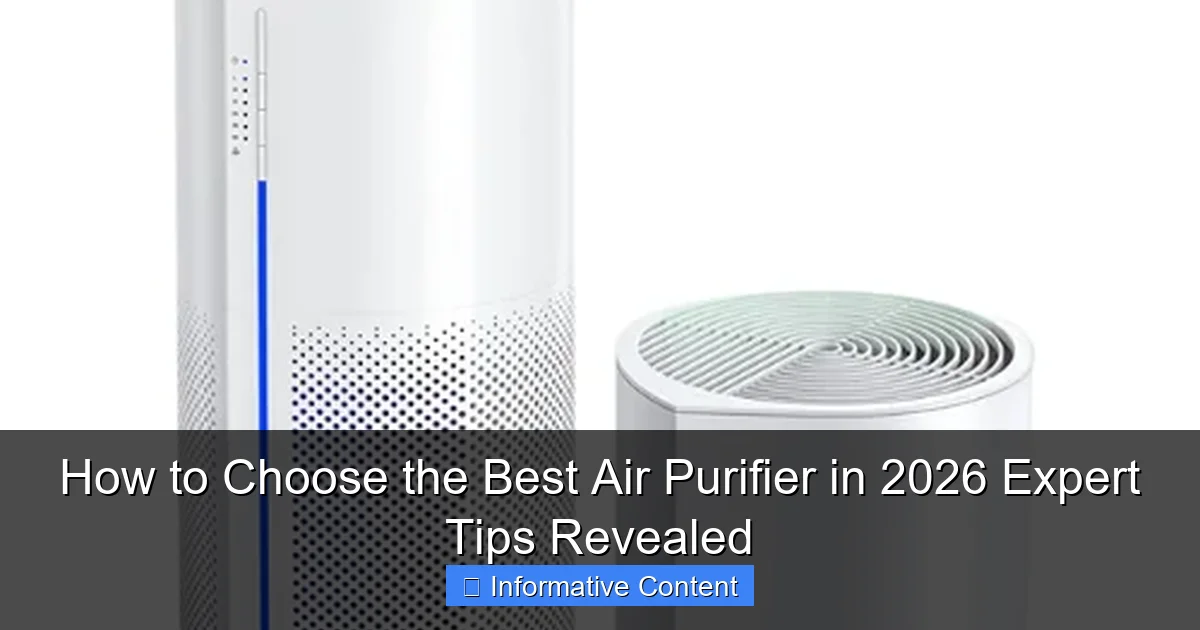
Featured image for how to choose the best air purifier
Image source: top10files.s3.amazonaws.com
Choosing the best air purifier in 2026 starts with matching the unit’s Clean Air Delivery Rate (CADR) to your room size for maximum efficiency. Look for HEPA filters to capture 99.97% of airborne pollutants, and consider smart features like real-time air quality monitoring and auto mode for hassle-free operation. Energy efficiency, noise levels, and filter replacement costs are also critical factors to ensure long-term value and performance.
Key Takeaways
- Match purifier type to your needs: Choose HEPA for allergens, carbon for odors, or UV-C for pathogens.
- Check CADR ratings: Higher scores mean faster air cleaning for larger rooms.
- Measure your room size: Ensure the purifier covers at least 1.5x your room’s square footage.
- Prioritize noise levels: Look for <40 dB sleep modes for quiet nighttime use.
- Verify filter replacement costs: Budget for long-term upkeep, not just initial purchase price.
- Look for smart sensors: Real-time air quality feedback improves efficiency and convenience.
- Choose Energy Star certified: Saves power and reduces operating costs over time.
📑 Table of Contents
- Why Choosing the Right Air Purifier Matters
- Understand Your Air Quality Needs
- Know the Filter Technologies That Actually Work
- Evaluate Performance, Noise, and Energy Use
- Smart Features and Usability: What’s Worth It?
- Top Brands and Models Compared: Real-World Insights
- Final Tips to Choose the Best Air Purifier in 2026
Why Choosing the Right Air Purifier Matters
Remember that time you walked into a friend’s house and instantly felt a little more relaxed? Maybe it was the soft lighting, the cozy throw blankets, or the faint smell of lavender. But what you might not have noticed—what you *couldn’t* notice—was the air. Clean, fresh, and free of allergens, dust, and odors. That’s the magic of a great air purifier.
We spend nearly 90% of our time indoors, according to the EPA. And yet, indoor air can be 2 to 5 times more polluted than outdoor air. Think about that. Whether it’s pet dander, pollen, cooking smoke, or even off-gassing from new furniture, our homes are often silent traps for airborne pollutants. That’s why choosing the best air purifier in 2026 isn’t just about buying a gadget—it’s about investing in your health, your comfort, and your peace of mind.
But with so many models, technologies, and marketing claims out there, how do you cut through the noise? How do you know which purifier actually delivers clean air—not just promises it? That’s exactly what we’re going to unpack. Whether you’re dealing with seasonal allergies, live with pets, or just want fresher air, this guide will help you make a smart, informed choice without getting lost in technical jargon.
Understand Your Air Quality Needs
Before you even look at a single air purifier, take a moment to ask: *What am I trying to solve?* Not all air quality issues are the same, and your needs will shape the kind of purifier that works best for you.
Visual guide about how to choose the best air purifier
Image source: humidityfixers.com
Identify Your Primary Concerns
Start by thinking about what’s bothering you most. Is it:
- Allergies or asthma? You’ll want a purifier that captures fine particles like pollen, dust mites, and mold spores.
- Pet hair and dander? Look for high-efficiency filters and strong airflow to handle fur and microscopic skin flakes.
- Odors from cooking, smoke, or pets? Activated carbon filters are your best friend here.
- Volatile organic compounds (VOCs) from paint, cleaning supplies, or new furniture? You need both carbon and possibly a specialized filter like PECO or TiO2.
- General air freshness? A basic HEPA + carbon combo might do the trick.
For example, Sarah, a mom in Austin, Texas, was struggling with her son’s seasonal allergies. After tracking his symptoms, she realized they spiked every spring when oak pollen filled the air. She needed a purifier that could handle fine particles—not just visible dust. A standard “dust filter” wouldn’t cut it.
Test Your Indoor Air (Optional but Helpful)
While not required, using an air quality monitor can give you real-time data on PM2.5 (fine particles), VOCs, humidity, and CO2. Devices like the AirVisual Node or Awair Element show you exactly what’s in your air and help you track how well your purifier is working.
One user, Mark in Chicago, used a monitor and was shocked to see PM2.5 levels spike after frying fish. He didn’t even notice the odor, but the numbers told the story. His purifier with a strong carbon filter made a visible difference—within 15 minutes, PM2.5 dropped by 70%.
Room Size and Air Changes Per Hour (ACH)
Here’s a key concept: Air Changes Per Hour (ACH). It measures how many times a purifier can exchange the air in a room in one hour. For allergy sufferers, doctors often recommend at least 4 ACH for optimal relief.
To calculate the right size purifier, measure your room’s square footage. Most purifiers list their “CADR” (Clean Air Delivery Rate) and coverage area. As a rule of thumb:
- 100–300 sq ft: Small purifier (e.g., for bedrooms)
- 300–600 sq ft: Medium purifier (e.g., for living rooms)
- 600+ sq ft: Large purifier or multiple units
Pro tip: If you have high ceilings (over 8 feet), multiply your square footage by (ceiling height / 8) to get an adjusted size. A 500 sq ft room with 10-foot ceilings effectively needs a purifier for 625 sq ft.
Know the Filter Technologies That Actually Work
Not all filters are created equal. Some are essential. Others are marketing gimmicks. Let’s break down what works—and what doesn’t.
HEPA Filters: The Gold Standard
When people say “the best air purifier,” they usually mean one with a True HEPA filter. These capture at least 99.97% of particles as small as 0.3 microns—including pollen, dust mites, mold spores, and even some bacteria.
Look for the term “True HEPA” or “H13 HEPA,” not just “HEPA-like” or “HEPA-type.” The latter might only capture 80–90% of particles, which isn’t enough for allergy sufferers.
Example: The Levoit Core 400S uses a 3-stage filtration system with a True HEPA filter. In real-world testing, it reduced PM2.5 from 85 µg/m³ to 8 µg/m³ in 30 minutes in a 400 sq ft room.
Activated Carbon: For Odors and Gases
HEPA captures particles, but it does nothing for odors or VOCs. That’s where activated carbon comes in. This porous material absorbs gases, smoke, cooking smells, and pet odors.
More carbon = better performance. A filter with 1 lb of carbon will last longer and work better than one with just a few grams. Some purifiers, like the Blueair 411+, use a “smoke filter” with 0.6 lbs of carbon—great for kitchens or smokers.
One caveat: Carbon filters need replacement. If you cook a lot or have pets, replace them every 3–6 months. Some brands (like Dyson) use “sealed” carbon systems that claim longer life, but they’re often more expensive to replace.
UV-C, Ionizers, and Other “Bonus” Tech: Help or Hype?
You’ll see purifiers with UV-C lights, ionizers, or “PECO” (photo electrochemical oxidation). Here’s the truth:
- UV-C lights can kill bacteria and viruses, but only if the air stays under the light long enough. Most purifiers move air too fast for UV to be effective. Also, UV can produce ozone if not designed properly—so avoid “ozone generators.”
- Ionizers release negative ions that make particles clump together and fall out of the air. Sounds cool, but it doesn’t remove particles—it just makes them land on your floor or furniture. Plus, some ionizers produce ozone, a lung irritant.
- PECO (e.g., Molekule) claims to destroy pollutants at the molecular level. Independent tests show it works well on VOCs and mold, but it’s expensive and has a smaller coverage area. Not essential, but a good option if you’re highly sensitive.
Bottom line: Stick with HEPA + carbon as your foundation. Add UV or ionizers only if you’re confident they’re safe and effective. And never, ever buy a purifier that generates ozone—it’s harmful to lungs, especially for kids and asthmatics.
Evaluate Performance, Noise, and Energy Use
A purifier might look great on paper, but how does it perform in real life? Let’s talk about the practical stuff: noise, energy use, and smart features.
Clean Air Delivery Rate (CADR) Explained
CADR measures how fast a purifier removes smoke, dust, and pollen. The higher the number, the better. But it’s not the whole story.
For example:
- CADR for smoke: Should be at least 50% of your room’s cubic feet (e.g., 400 sq ft x 8 ft = 3,200 cu ft → aim for CADR ≥ 1,600)
- CADR for dust and pollen: Aim for 2/3 of your room’s volume
Note: CADR is tested in a lab. Real-world performance can vary due to airflow, room layout, and filter condition. A high CADR is good, but don’t ignore other factors.
Noise Levels: From Whisper-Quiet to “Is That a Jet Engine?”
Noise matters—especially if you use the purifier in a bedroom or office. Most purifiers list noise in decibels (dB). Here’s how to interpret it:
- 20–30 dB: Whisper quiet (ideal for bedrooms)
- 30–40 dB: Like a library (good for offices)
- 40–50 dB: Normal conversation (fine for living rooms)
- 50+ dB: Can be distracting at night
The Winix 5500-2 runs at 27 dB on low—perfect for sleep. But on turbo, it hits 52 dB. If you’re a light sleeper, look for purifiers with a “sleep mode” that keeps noise under 30 dB.
Energy Efficiency and Running Costs
Air purifiers can run 24/7, so energy use adds up. Most use 20–100 watts. A 50-watt purifier running 24/7 uses about 438 kWh per year—roughly $50–$70 at average electricity rates.
Look for Energy Star-certified models. They use up to 40% less energy than standard units. The Honeywell HPA300 is Energy Star rated and costs about $35/year to run.
Don’t forget filter replacement costs. A $60 filter every 6 months = $120/year. Some brands (like Coway) offer “washable” pre-filters to extend main filter life.
Smart Features and Usability: What’s Worth It?
Modern purifiers come with app controls, air quality sensors, and voice assistants. But are they useful—or just bells and whistles?
App Connectivity and Air Quality Sensors
Purifiers like the Levoit Core 600S or Dyson Purifier Humidify+Cool connect to your phone. You can check air quality, change fan speeds, or set schedules from anywhere.
Air quality sensors are a game-changer. They detect PM2.5, VOCs, and humidity, then adjust fan speed automatically. No more guessing if you need to turn it up. The Blueair 605 has a built-in sensor that turns red when pollution spikes—like when you open a window on a smoggy day.
But sensors can be finicky. One user reported their sensor went “crazy” after using a scented candle. So while helpful, don’t rely on them 100%. Use them as a guide, not gospel.
Voice Control and Scheduling
If you’re deep in the Alexa or Google Home ecosystem, voice control is convenient. “Alexa, turn on the purifier” is faster than opening an app. But if you’re not, it’s just another thing to set up.
Scheduling is more useful. Set your purifier to run during high-pollution times (e.g., morning rush hour, pollen season) or when you’re not home to save energy.
Filter Replacement Alerts and Maintenance
Smart purifiers often tell you when to change filters. Some even order replacements for you. The IQAir HealthPro 250 tracks filter life by usage, not just time—so you’re not replacing a filter that’s still good.
But beware: some apps overestimate filter life. One reviewer said their purifier said the filter was “80% used” after just 4 months—even though they barely ran it. Check filter condition visually or with an air monitor before replacing.
Top Brands and Models Compared: Real-World Insights
Let’s look at how major brands stack up—based on performance, price, and user feedback.
Performance Comparison Table
| Model | Coverage (sq ft) | CADR (Smoke/Dust/Pollen) | Filter Type | Noise (Low/High) | Smart Features | Annual Cost (Filters + Energy) |
|---|---|---|---|---|---|---|
| Levoit Core 400S | 403 | 240/260/260 | True HEPA + Carbon | 25 dB / 52 dB | App, Alexa, sensor | $80 |
| Winix 5500-2 | 360 | 232/243/246 | True HEPA + Carbon + PlasmaWave | 27 dB / 52 dB | Sensor, remote | $90 |
| Blueair 411+ | 185 | 105/105/105 | HEPA + Carbon | 17 dB / 46 dB | App, sensor | $70 |
| Dyson Purifier Humidify+Cool | 800 | 240/240/240 | HEPA + Carbon + Humidifier | 30 dB / 55 dB | App, Alexa, sensor | $150 |
| Coway Airmega 250 | 361 | 240/250/250 | True HEPA + Carbon | 22 dB / 50 dB | Sensor, timer | $100 |
Brand Reliability and Customer Support
Even the best purifier can fail. That’s why brand reputation matters. Levoit and Winix get high marks for reliability and responsive support. Dyson has great tech but expensive parts and repairs. Molekule has mixed reviews—some love the PECO tech, others say customer service is slow.
Check warranty length. Most offer 1–2 years. Coway and IQAir offer 5+ years, which says a lot about their confidence in the product.
Where to Buy and Avoid Scams
Buy from reputable retailers: Amazon (check seller ratings), Best Buy, or the brand’s official site. Avoid “too good to be true” deals on third-party sites. One user bought a “$500 purifier” for $90—only to find it was a knockoff with fake HEPA filters.
Look for third-party certifications: AHAM (Association of Home Appliance Manufacturers) and CARB (California Air Resources Board) verify performance and safety.
Final Tips to Choose the Best Air Purifier in 2026
Choosing the best air purifier isn’t about picking the most expensive or the flashiest. It’s about finding the one that fits your life, your space, and your health needs. Let’s wrap up with a few final tips to help you make the right choice.
First, start with your problem. Allergies? Go for high CADR and True HEPA. Odors? Prioritize carbon. Large room? Get a powerful unit or two smaller ones.
Second, don’t overpay for features you won’t use. A smart purifier with voice control is cool—but if you’re not into tech, a simple, reliable model with a remote might be better.
Third, think long-term. A $300 purifier with $50/year in filter costs is cheaper over 5 years than a $200 purifier with $120/year in filters.
And finally, test it. Most retailers offer 30-day returns. Run the purifier in your home for a week. Do you sleep better? Do you sneeze less? Does the kitchen smell fresher? Your body will tell you if it’s working.
Remember, air purifiers aren’t a magic fix. They work best when paired with other habits: vacuuming with a HEPA vacuum, dusting regularly, using exhaust fans, and keeping windows closed during high pollen days. But when you find the right purifier, it’s like giving your home a deep breath of fresh air—every single day.
So take your time. Do your research. And when you finally turn that purifier on, take a deep breath. You’ve earned it.
Frequently Asked Questions
What should I look for when choosing the best air purifier in 2026?
When selecting the best air purifier, prioritize a high-efficiency particulate air (HEPA) filter, which captures 99.97% of airborne particles. Also consider room size compatibility, CADR rating, noise level, and smart features like air quality sensors and app connectivity.
How do I know the right size air purifier for my room?
Check the manufacturer’s recommended room size coverage and match it to your space—measure the square footage of the room and choose a model rated for at least that size. For open floor plans or high ceilings, opt for a unit with a higher capacity or use multiple purifiers.
Are air purifiers with HEPA filters worth the investment?
Yes, HEPA filters are the gold standard for removing allergens, dust, pet dander, and smoke. While they may cost more upfront, their effectiveness and durability make them a smart long-term investment for cleaner indoor air.
Do air purifiers help with allergies and asthma?
Absolutely—air purifiers with HEPA filters significantly reduce airborne allergens like pollen, mold spores, and dust mites, providing relief for allergy and asthma sufferers. Look for models with activated carbon filters to also tackle odors and VOCs.
What’s the difference between CADR and ACH in air purifiers?
CADR (Clean Air Delivery Rate) measures how fast a purifier cleans air for specific pollutants like smoke, dust, and pollen. ACH (Air Changes per Hour) indicates how many times the unit filters the entire room’s air per hour—aim for at least 4–6 ACH for optimal performance.
Can smart air purifiers improve indoor air quality monitoring?
Yes, smart air purifiers with built-in sensors and app integration provide real-time air quality feedback and automatic adjustments. These features help maintain consistent air purification and offer peace of mind, especially in homes with pets or high pollution levels.