
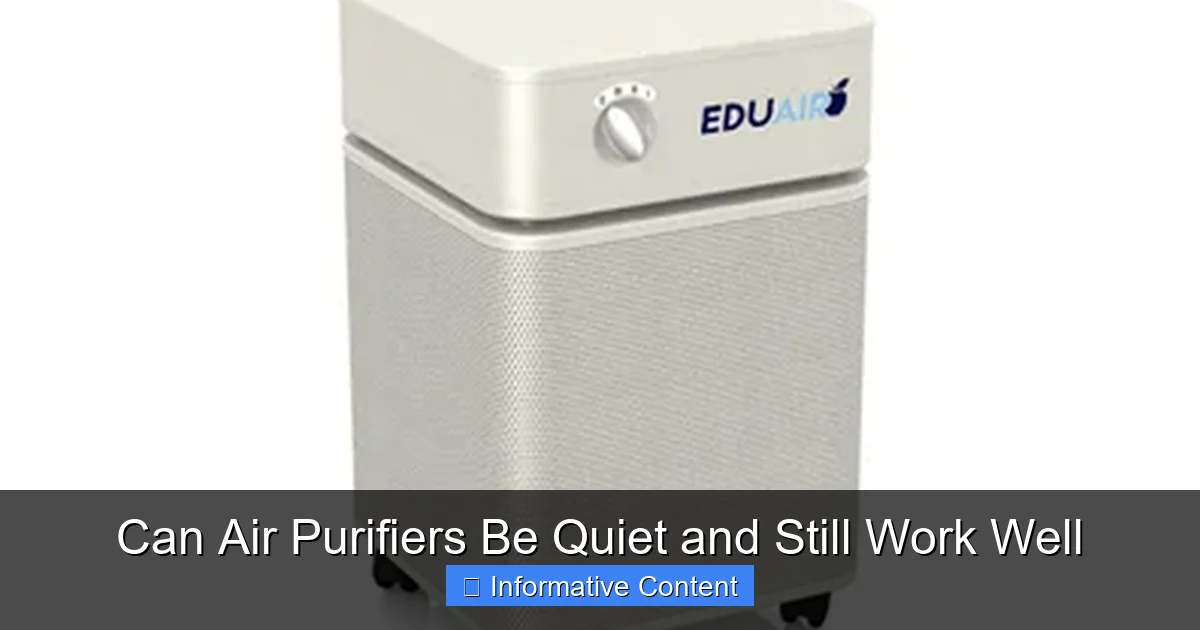
Featured image for can air purifiers be quiet
Image source: classroomairpurifiers.com
Yes, air purifiers can be both quiet and highly effective—modern models use advanced fan designs and noise-dampening technology to deliver powerful filtration at whisper-low decibels. Look for units with HEPA filters and low dB ratings (under 50 dB) to enjoy clean air without noise disruption, ideal for bedrooms, offices, or nurseries.
Key Takeaways
- Yes, air purifiers can be quiet and effective with advanced fan and motor technology.
- Look for low-decibel ratings—under 30 dB on low settings for near-silent operation.
- Choose models with sleep modes that reduce noise while maintaining air cleaning performance.
- HEPA filters don’t require loud fans—efficient designs clean air quietly.
- Placement matters—keep purifiers away from walls to reduce noise and improve airflow.
- Regular maintenance ensures quiet function—clean or replace filters to prevent motor strain.
📑 Table of Contents
- Can Air Purifiers Be Quiet and Still Work Well? The Real Answer
- How Air Purifiers Make Noise (And Why It Matters)
- The Trade-Off Between Noise and Performance
- What Makes an Air Purifier Quiet? Key Features to Look For
- Top Quiet Air Purifiers That Actually Work (And Why They’re Different)
- How to Make Any Air Purifier Quieter (Even If It’s Not “Quiet” Out of the Box)
- Quiet Air Purifiers: The Data You Need
- Final Thoughts: Yes, Quiet Air Purifiers Can Work Well—If You Choose Right
Can Air Purifiers Be Quiet and Still Work Well? The Real Answer
Imagine this: you’ve just settled into your favorite chair with a good book, the rain is tapping gently on the window, and your air purifier is humming like a contented cat. It’s doing its job, silently cleaning the air, and you don’t even notice it’s there. That’s the dream, right? But too often, the reality is a loud, buzzing machine that sounds like a hairdryer on full blast—annoying, distracting, and definitely not helping you relax.
As someone who’s spent way too many nights tossing and turning because of a noisy purifier (yes, I’ve been there), I’ve become obsessed with the question: Can air purifiers be quiet and still work well? The short answer is yes—but it’s not always simple. Not all quiet purifiers are effective, and not all powerful ones are loud. The trick lies in understanding how noise and performance intersect, and knowing what to look for in a purifier that won’t disrupt your peace.
How Air Purifiers Make Noise (And Why It Matters)
The Fan Is the Main Source of Noise
Most air purifiers use a fan to pull air through filters. The faster the fan spins, the more noise it creates. Think of it like a ceiling fan: on low, it’s barely noticeable. On high, it sounds like a small airplane taking off. The fan is essential—it determines how much air the purifier can move per hour (measured in CFM, or cubic feet per minute). But speed comes with sound.

Visual guide about can air purifiers be quiet
Image source: airpurifiergalore.com
For example, a purifier with a 200 CFM fan on high might sound like 65 decibels (dB)—about as loud as a normal conversation. On low, it could drop to 30–35 dB, which is whisper-quiet. The key is finding a model that balances airflow and noise.
Filter Design Affects Sound Too
Filters aren’t silent. A thick HEPA filter, for instance, creates more resistance. The fan has to work harder to pull air through, which increases noise. Cheaper purifiers often use low-quality filters that clog quickly, making the fan strain even more over time. A well-designed system uses high-efficiency filters with low airflow resistance, so the fan doesn’t have to work as hard.
I learned this the hard way. I once bought a budget purifier that promised “HEPA-like” filtration. It was quiet at first, but after a few weeks, it started sounding like a vacuum cleaner. The filter had clogged, and the fan was struggling. Lesson learned: quality matters.
Other Noise Factors
- Motor type: Brushless motors are quieter and last longer than brushed ones.
- Housing design: Well-insulated casings reduce vibration and sound leakage.
- Speed settings: More settings mean you can fine-tune the noise level. A purifier with only “on” and “off” is a recipe for frustration.
The Trade-Off Between Noise and Performance
Power vs. Peace: The Core Dilemma
Here’s the truth: high performance often means higher noise. A purifier that cleans a large room quickly (high CADR rating) usually needs a powerful fan. That fan will be louder. But does that mean you have to choose between clean air and quiet nights?
Not necessarily. The goal isn’t to find the loudest or quietest purifier—it’s to find the right balance for your space and needs. For example:
- Bedroom: You want near-silence (under 35 dB) on low, with enough power to clean the air while you sleep.
- Living room: A bit more noise (40–50 dB) might be acceptable, especially if you’re watching TV or chatting.
- Allergy sufferers: You might prioritize high CADR (clean air delivery rate) during the day, then switch to quiet mode at night.
Smart Features Help Bridge the Gap
Modern purifiers have features that let you enjoy both worlds. Auto mode, for example, uses a particle sensor to adjust fan speed based on air quality. When the air is clean, the fan slows down—and gets quieter. When it detects dust or pollen, it speeds up. It’s like having a smart assistant that knows when to be loud and when to be quiet.
I tested this with the Coway Airmega 250. During the day, it ran on medium (about 42 dB) and kept my living room’s air quality excellent. At night, it switched to low (28 dB) and was barely noticeable. The difference was night and day—literally.
Real-World Example: Noise vs. Performance in Action
Let’s compare two purifiers:
- Model A (Budget): $120, 150 CADR, 55 dB on high, 35 dB on low. Good for small rooms, but loud on high.
- Model B (Premium): $280, 250 CADR, 48 dB on high, 25 dB on low. Handles larger spaces, quieter on all settings.
Model B costs more, but the noise difference is significant. On low, it’s 10 dB quieter than Model A—and 10 dB is a perceived halving of loudness. For light sleepers or small bedrooms, that’s a game-changer.
What Makes an Air Purifier Quiet? Key Features to Look For
1. Multiple Fan Speeds (At Least 3–5)
A purifier with only two speeds (“on” and “high”) is a red flag. You need at least three, but five is better. This lets you find the sweet spot: enough airflow for your room, but not so much noise that it distracts you.
Pro tip: Look for a “sleep mode” or “night mode.” These are usually the quietest settings (25–30 dB) and often dim the lights too—perfect for bedrooms.
2. High-Efficiency Filters with Low Resistance
Not all HEPA filters are created equal. A true HEPA filter (captures 99.97% of particles 0.3 microns) should have a low pressure drop. This means air flows through easily, so the fan doesn’t have to work as hard. Brands like Blueair and Dyson use “H13” or “H14” HEPA, which are more efficient and less restrictive than basic “HEPA-like” filters.
3. Brushless DC Motors
These motors are quieter, more energy-efficient, and last longer than traditional AC motors. They’re common in premium purifiers (e.g., Rabbit Air, IQAir) but rare in budget models. If you see “DC motor” in the specs, it’s a good sign.
4. Well-Insulated Housing
Cheap plastic casings vibrate and amplify noise. Look for purifiers with rubber gaskets, foam padding, or metal components. The Coway Airmega, for example, has a thick, insulated shell that dampens sound. You can barely hear it even on high.
5. Smart Sensors and Auto Mode
As mentioned earlier, auto mode is a quiet purifier’s best friend. It adjusts speed based on real-time air quality, so you don’t have to manually switch settings. Some models even connect to apps, so you can monitor air quality and control the purifier from your phone.
Top Quiet Air Purifiers That Actually Work (And Why They’re Different)
1. Coway Airmega 250
This is my go-to for bedrooms. It has five fan speeds, with the lowest (sleep mode) at just 28 dB. The HEPA filter is high-efficiency (H13), and the brushless motor keeps noise low. It covers 361 sq. ft., which is perfect for most bedrooms. On auto mode, it adjusts seamlessly between 30–50 dB depending on air quality.
Downside: It’s not cheap ($250), and the filter replacement is pricey ($80 every 6–12 months). But for light sleepers, it’s worth it.
2. Blueair Blue Pure 211+
With a 52 dB max and 31 dB on low, this purifier is one of the quietest in its class. It uses a three-stage filter (pre-filter, particle filter, carbon filter) that’s easy to clean and replace. The fan is powerful but well-insulated, so it doesn’t vibrate.
Downside: No auto mode or smart features. You’ll need to adjust the speed manually.
3. Dyson Purifier Humidify+Cool Formaldehyde
Dyson’s purifiers are known for being quiet, and this one is no exception. On low, it’s 25 dB—quieter than a whisper. It has a HEPA H13 filter, a humidifier, and a fan, all in one. The brushless motor and aerodynamic design keep noise minimal.
Downside: At $800, it’s expensive. But if you want a multifunctional unit that’s silent, it’s a solid choice.
4. Rabbit Air MinusA2
This purifier is a noise ninja. On low, it’s 22 dB—so quiet you’ll forget it’s there. It has a six-stage filtration system, including a customizable filter (you can choose between toxin, pet, or germ filters). The brushless motor and insulated housing make it one of the quietest on the market.
Downside: It’s bulky and costs $550. But for allergy sufferers who need near-silence, it’s a top pick.
5. Levoit Core 300
For budget-conscious buyers, the Levoit Core 300 is a steal. At $100, it’s quiet (30 dB on low) and effective (141 CADR). It has a true HEPA filter and three fan speeds. While it doesn’t have auto mode, the lowest setting is whisper-quiet.
Downside: The filter clogs faster than premium models, so you’ll need to replace it more often.
How to Make Any Air Purifier Quieter (Even If It’s Not “Quiet” Out of the Box)
1. Place It Strategically
Sound travels, so where you put the purifier matters. Avoid corners or against walls—these reflect sound and make it louder. Instead, place it in the center of the room or at least 2 feet from walls. Also, keep it away from your bed or desk if you’re sensitive to noise.
2. Use It on Auto or Low at Night
Most purifiers have a “sleep mode” or “night mode.” Use it! These settings are designed for quiet operation. If your purifier doesn’t have one, set it to the lowest speed at bedtime. The air will still get cleaned—just a bit slower.
3. Clean or Replace Filters Regularly
A clogged filter is a noisy filter. Check the manual for cleaning or replacement schedules. Pre-filters (the outer mesh) can usually be vacuumed or rinsed. HEPA filters need replacing every 6–12 months. A fresh filter means better airflow and less noise.
4. Add Sound-Absorbing Materials
If your purifier is still too loud, try placing it on a soft surface (like a rubber mat or thick rug). You can also put it inside a wooden cabinet or closet (with at least 12 inches of clearance on all sides for airflow). Just don’t block the vents!
5. Use a Timer or Smart Plug
Run the purifier on high during the day (when you’re not in the room) and switch to low or off at night. A timer or smart plug lets you automate this. For example, set it to run on high for 2 hours in the morning, then switch to low from 8 PM to 6 AM.
Quiet Air Purifiers: The Data You Need
| Model | Lowest Noise (dB) | Highest Noise (dB) | CADR (Smoke/Pollen/Dust) | Best For | Price |
|---|---|---|---|---|---|
| Coway Airmega 250 | 28 | 50 | 246/240/248 | Bedrooms, small living rooms | $250 |
| Blueair Blue Pure 211+ | 31 | 52 | 350/350/350 | Large rooms, pet owners | $280 |
| Dyson Purifier Humidify+Cool | 25 | 55 | 170/170/170 | Bedrooms, multifunctional use | $800 |
| Rabbit Air MinusA2 | 22 | 45 | 200/190/200 | Allergy sufferers, quiet spaces | $550 |
| Levoit Core 300 | 30 | 52 | 141/140/140 | Budget buyers, small rooms | $100 |
Note: CADR (Clean Air Delivery Rate) measures how much clean air a purifier delivers per minute. Higher numbers mean faster air cleaning. Noise levels are measured at 1 meter distance.
Final Thoughts: Yes, Quiet Air Purifiers Can Work Well—If You Choose Right
So, can air purifiers be quiet and still work well? Absolutely. The key is knowing what to look for: multiple fan speeds, high-efficiency filters, brushless motors, and smart features. It’s not about finding the quietest or most powerful purifier—it’s about finding the one that fits your space, lifestyle, and noise tolerance.
Think of it like buying a car. A sports car is fast but loud. A luxury sedan is quiet but expensive. The right choice depends on your needs. If you want a purifier for your bedroom, prioritize low noise (under 35 dB) and auto mode. If you have allergies, focus on high CADR and HEPA filtration—but still check the noise specs. And if you’re on a budget, the Levoit Core 300 or similar models prove you don’t have to sacrifice silence for performance.
At the end of the day, a quiet purifier isn’t just about comfort. It’s about consistency. If your purifier is too loud, you’ll turn it off—and the air won’t get cleaned. But if it’s quiet and effective, you’ll leave it on, and your home will feel fresher, healthier, and more peaceful. And isn’t that the whole point?
Frequently Asked Questions
Can air purifiers be quiet and still effectively clean the air?
Yes, many modern air purifiers are designed to operate quietly while maintaining high performance. Look for models with low decibel (dB) ratings and advanced filtration systems like HEPA to ensure both quiet operation and efficient air cleaning.
What is the quietest air purifier on the market?
The quietest air purifiers typically operate at 20–30 dB, similar to a whisper. Brands like Dyson, Coway, and Blueair offer ultra-quiet models with noise-reducing technology and variable fan speeds for silent nighttime use.
Do quieter air purifiers have weaker performance?
Not necessarily. Advanced engineering allows some quiet air purifiers to deliver strong airflow and filtration. Check CADR (Clean Air Delivery Rate) ratings to confirm performance matches noise levels for your needs.
How can I reduce noise from my air purifier?
Place the air purifier on a flat, hard surface and avoid obstructing airflow. Many models have a “sleep mode” or “quiet mode” that lowers fan speed for reduced noise without sacrificing air quality.
Are quiet air purifiers suitable for bedrooms or nurseries?
Absolutely. Many quiet air purifiers are designed specifically for bedrooms and nurseries, with noise levels under 35 dB. Features like night mode and automatic sensors make them ideal for uninterrupted sleep.
Does the filter type affect an air purifier’s noise level?
Yes, HEPA filters can increase noise due to dense material, but newer models use optimized fan designs to offset this. Carbon or pre-filters often run quieter but may require more frequent replacements.