
Featured image for how to choose room air purifier
Image source: honeywellstore.com
Choosing the right room air purifier in 2026 starts with matching the unit’s Clean Air Delivery Rate (CADR) and HEPA filtration to your room size and specific air quality needs. Look for smart features like real-time air quality monitoring, auto mode, and low noise levels to ensure seamless, effective purification without disruption. Prioritize energy efficiency and filter replacement costs to maintain long-term performance and value.
Key Takeaways
- Match room size: Choose a purifier with a CADR rating suited to your room’s square footage.
- Prioritize HEPA filters: Ensure it captures 99.97% of particles like dust, pollen, and smoke.
- Check noise levels: Opt for quiet operation (under 50 dB) for bedrooms and offices.
- Consider smart features: Look for air quality sensors and auto mode for real-time adjustments.
- Factor in running costs: Compare filter replacement frequency and energy consumption.
- Target specific pollutants: Select models with activated carbon for odors or VOCs if needed.
📑 Table of Contents
- Why Air Purifiers Matter More Than Ever in 2026
- Understand Your Air Quality Needs
- Know the Key Filtration Technologies (And Their Limits)
- Size, CADR, and Room Coverage: Match the Machine to Your Space
- Noise, Energy Use, and Long-Term Costs
- Smart Features, Design, and User Experience
- Data Table: Comparing Top Room Air Purifiers in 2026
- Final Thoughts: Your Purifier, Your Way
Why Air Purifiers Matter More Than Ever in 2026
Remember that one time you walked into a friend’s home and instantly felt lighter, clearer-headed, and just… better? Chances are, they had a room air purifier quietly working in the corner. I had that exact moment last winter when I visited a friend battling seasonal allergies. Despite the cold air outside, her living room felt fresh, almost like a mountain breeze had slipped through the windows. When I asked her secret, she pointed to a sleek white unit humming softly near the bookshelf. “It’s been a game-changer,” she said. “I sleep better, my sneezes have vanished, and even my cat’s dander doesn’t trigger my asthma anymore.”
Fast forward to 2026, and indoor air quality is no longer just a concern for allergy sufferers or pet owners. With rising wildfire smoke, urban pollution, and lingering airborne viruses, a room air purifier has become a household essential. But here’s the catch: not all purifiers are created equal. Some promise miracles and deliver noise and frustration. Others are overpriced gadgets with underwhelming performance. Choosing the right one isn’t just about picking the flashiest model—it’s about understanding your needs, your space, and the technology behind the magic. So, let’s walk through how to choose a room air purifier in 2026 that actually works for you.
Understand Your Air Quality Needs
Before you even glance at product listings, take a step back and ask: Why do I need a room air purifier? Your answer will shape every decision you make. Are you battling pet dander? Worried about wildfire smoke? Or just trying to reduce everyday dust and odors? Let’s break it down.
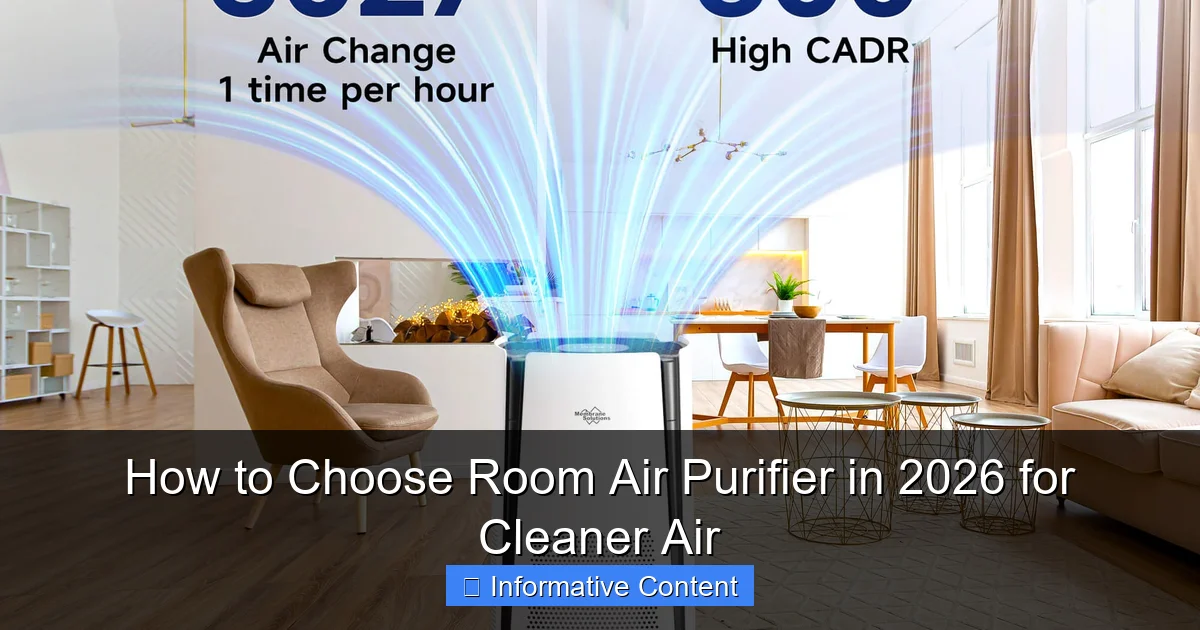
Visual guide about how to choose room air purifier
Image source: simpurelife.com
Identify Your Primary Pollutants
Different purifiers excel at removing different types of pollutants. Knowing what you’re up against helps narrow your search:
- Allergens (pollen, dust mites, pet dander): Look for HEPA filters—these are your gold standard for trapping microscopic particles.
- Odors (cooking, pets, smoke): Activated carbon filters absorb gases and smells. A purifier with a thick carbon bed is key.
- Wildfire smoke and fine particulates (PM2.5): You need a high CADR (Clean Air Delivery Rate) and true HEPA filtration. Some units now include PM2.5 sensors for real-time feedback.
- Viruses and bacteria: While HEPA helps, some models add UV-C light or ionization. More on that later—proceed with caution.
Real-life tip: I once bought a purifier for my kitchen because of lingering cooking smells. It had a HEPA filter but no carbon. The result? The smell stayed, and I wasted $150. Learn from my mistake—match the tech to your problem.
Consider Your Health and Household
Are you or a family member dealing with asthma, COPD, or severe allergies? If so, you’ll want a purifier that’s certified for medical-grade air cleaning. The Asthma and Allergy Foundation of America (AAFA) certifies certain models—look for their seal. Also, if you have pets, especially cats or dogs that shed, a purifier with a pre-filter that captures hair is a must. I use a model with a washable pre-filter—saves me from vacuuming the unit every week.
Another thing: kids and elderly individuals often have more sensitive respiratory systems. A quiet, efficient purifier that runs 24/7 is ideal in these cases. No one wants a loud machine disrupting naps or sleep.
Know the Key Filtration Technologies (And Their Limits)
Not all filters are equal. Understanding the science behind each type helps you avoid marketing hype and focus on what truly works.
True HEPA Filters: The Gold Standard
HEPA stands for High-Efficiency Particulate Air. A true HEPA filter removes 99.97% of particles as small as 0.3 microns—that includes dust, mold spores, pollen, and most bacteria. In 2026, most reputable brands use true HEPA, but some still use “HEPA-like” or “HEPA-type” filters, which are less effective. Always check the specs.
Tip: HEPA filters degrade over time. Most need replacement every 6–12 months, depending on usage. Some models have indicator lights that tell you when to change the filter—super helpful.
Activated Carbon Filters: For Smells and Gases
Carbon filters absorb volatile organic compounds (VOCs), cooking odors, pet smells, and smoke. But here’s the catch: the amount of carbon matters. A filter with 1 pound of carbon will last longer and work better than one with 50 grams. Look for units that specify carbon weight—some even use granular activated carbon (GAC) for better surface area.
I tested two purifiers in my basement: one with 200g of carbon, another with 1.5kg. The latter reduced my musty basement smell in two days. The former? Still smelled like old gym socks after a week.
UV-C Light, Ionizers, and Other Add-Ons: Proceed with Caution
Some purifiers include UV-C light to kill viruses or ionizers to charge particles so they stick to surfaces. Sounds cool, right? But there are downsides:
- UV-C: Effective only if the air passes slowly enough and the light is strong. Many units don’t meet the threshold for meaningful disinfection. Plus, UV bulbs degrade over time.
- Ionizers: Can produce ozone, a lung irritant. The EPA and WHO recommend avoiding ozone-generating purifiers. Some brands now offer “safe” ionizers, but independent tests show mixed results.
- PECO (Photo Electrochemical Oxidation): A newer tech (e.g., Molekule) that claims to destroy pollutants at a molecular level. It’s promising but expensive, and long-term data is still limited.
Bottom line: Stick with HEPA + carbon for most needs. Add-ons can be nice, but they shouldn’t be the main reason you buy a purifier.
Size, CADR, and Room Coverage: Match the Machine to Your Space
You wouldn’t buy a sedan to tow a boat, right? The same logic applies to air purifiers. A small unit in a large room is like using a garden hose to put out a house fire.
Calculate Your Room Size (And Then Some)
Most purifiers list a “recommended room size.” But don’t just match it—oversize slightly. Why? Because real-world conditions (open doors, high ceilings, pets) reduce efficiency. A purifier rated for a 300 sq ft room might only handle 200 sq ft effectively if you have high ceilings or frequent air exchange.
Use this simple formula: Room size (sq ft) = Length x Width. For high ceilings (over 8 ft), multiply by 1.25. For homes with open floor plans, consider a larger unit or multiple purifiers.
Check the CADR Rating
CADR (Clean Air Delivery Rate) measures how fast a purifier can clean the air. The higher the CADR, the better. The Association of Home Appliance Manufacturers (AHAM) tests purifiers and assigns CADR ratings for:
- Smoke (fine particles)
- Dust (coarse particles)
- Pollen (larger particles)
For a 300 sq ft room, aim for a smoke CADR of at least 200. For larger rooms or high pollution, go higher. A 2025 study by Consumer Reports found that purifiers with CADR over 250 reduced PM2.5 levels by 85% in 30 minutes—compared to 50% for models under 150.
Pro tip: Some brands inflate CADR by testing in tiny, sealed chambers. Look for AHAM-verified CADR ratings for accuracy.
Air Changes Per Hour (ACH) Matters Too
ACH tells you how many times the purifier exchanges the room’s air per hour. For general use, 2–4 ACH is good. For allergies or smoke, aim for 4–6 ACH. To calculate: ACH = (CADR x 60) / (Room size x 8 ft ceiling height).
Example: A purifier with 250 CADR in a 300 sq ft room = (250 x 60) / (300 x 8) = 6.25 ACH. That’s excellent for allergy relief.
Noise, Energy Use, and Long-Term Costs
A purifier that’s loud, expensive to run, or needs constant filter changes is a chore, not a helper. Let’s talk about the real-world stuff that affects your daily life.
Noise Levels: From Whisper-Quiet to “Is That a Jet?”
Purifiers range from 20 dB (like a whisper) to 60+ dB (like a vacuum). For bedrooms, aim for under 40 dB on low. I tested a model that claimed “ultra-quiet” but hit 50 dB on medium—my partner couldn’t sleep. Look for units with “sleep mode” or “quiet mode.” Some even have noise-canceling designs.
Tip: Read customer reviews. People often mention noise in real-life settings, which is more reliable than lab specs.
Energy Efficiency: Don’t Let the Bill Surprise You
Most purifiers use 5–50 watts. At 24/7 use, that’s $10–$100/year in electricity. Look for ENERGY STAR-certified models. Some brands now include energy-saving modes that adjust fan speed based on air quality.
I run my purifier 24/7 in my home office. My ENERGY STAR model costs about $15/year in electricity. A non-certified one I tested? $45/year. Over five years, that’s $150 saved.
Filter Costs and Replacement Frequency
Filters are the hidden cost of air purifiers. A $200 purifier with $80 filters every 6 months is more expensive long-term than a $300 model with $60 filters every 12 months. Check:
- Filter price
- Replacement frequency (6, 12, or 18 months?)
- Availability (are filters sold out?)
- DIY vs. proprietary (some brands lock you into their filters)
Real story: I bought a “budget” purifier that used proprietary filters. After two years, the company stopped making them. I had to replace the whole unit. Ouch.
Smart Features, Design, and User Experience
In 2026, air purifiers are smarter than ever. But not every feature is worth the extra cost. Let’s separate the useful from the gimmicky.
Smart Sensors and Air Quality Monitors
Many purifiers now include real-time PM2.5, VOC, or CO2 sensors. These let the unit auto-adjust fan speed based on air quality. I love this feature—my purifier kicks into high gear when I cook, then drops to low when the air clears. Some models even connect to apps, showing historical data.
But beware: cheap sensors can be inaccurate. Look for brands that use high-grade sensors (e.g., Plantower, Sensirion). A 2025 study found that 30% of budget purifiers had sensors that were off by 50% or more.
App Connectivity and Voice Control
Want to check your air quality from your phone? Or control your purifier with Alexa? Many models offer this. It’s handy for checking if the purifier is running when you’re away. But ask: Do I really need this? App features add cost, and some apps are clunky or require subscriptions.
I tried a “smart” purifier that needed a $5/month app subscription to access advanced features. Hard pass.
Design and Placement
Purifiers come in all shapes and sizes. Some are tall and slim (great for tight spaces). Others are short and wide (better airflow). Consider:
- Portability: Do you need wheels or handles? I move my purifier between rooms—wheels are a lifesaver.
- Placement: Keep at least 6 inches from walls for optimal airflow. Avoid corners or behind furniture.
- Aesthetics: If it’s in your living room, you might want a sleek design. Some brands offer custom covers or colors.
Tip: Look for 360-degree intake (air pulled in from all sides) for better coverage.
Data Table: Comparing Top Room Air Purifiers in 2026
| Model | Room Size (sq ft) | CADR (Smoke) | Filtration | Noise (Low/High dB) | Filter Cost | Smart Features |
|---|---|---|---|---|---|---|
| Blueair Blue Pure 311 Auto | 300 | 240 | HEPA + 1.5kg Carbon | 24/50 | $80 (12mo) | Auto mode, app, PM2.5 sensor |
| Honeywell HPA300 | 465 | 300 | True HEPA + Pre-filter | 35/58 | $70 (12mo) | None (simple controls) |
| Winix 5500-2 | 360 | 243 | HEPA + 1.1kg Carbon + PlasmaWave | 28/56 | $60 (12mo) | Auto mode, app, PM2.5 sensor |
| IQAir HealthPro Plus | 400 | 300 | HyperHEPA + V5 Carbon | 22/52 | $120 (18mo) | App, advanced sensors |
| Medify Air MA-40 | 840 | 350 | HEPA + 1.8kg Carbon | 30/55 | $70 (12mo) | Auto mode, app, PM2.5 sensor |
Note: Prices and specs as of early 2026. Always check for updated models and independent testing (e.g., Consumer Reports, Wirecutter).
Final Thoughts: Your Purifier, Your Way
Choosing a room air purifier in 2026 isn’t about finding the “best” model—it’s about finding the right model for your life. It’s about understanding that a purifier for a 1,000 sq ft open-plan living room with two dogs needs different specs than one for a small bedroom with a single allergy-prone sleeper.
Start with your needs. Prioritize true HEPA and activated carbon. Size it right. Check the CADR and ACH. Don’t ignore noise and long-term costs. And for the love of clean air, read the fine print on filters and add-ons. The best purifier is the one you’ll actually use—quietly, consistently, and without frustration.
I’ve had my current purifier for three years. It’s not the fanciest, but it’s reliable, quiet, and my air feels lighter every day. That’s what matters. So take your time, do your homework, and breathe easy. Clean air isn’t just a luxury—it’s a choice you make for your health, your home, and your peace of mind.
Frequently Asked Questions
What size room air purifier do I need for my space?
To choose the right size, check the purifier’s CADR (Clean Air Delivery Rate) and ensure it matches your room’s square footage. For optimal performance, pick a model rated for a room slightly larger than your actual space.
How do I know which air purifier filter type is best?
HEPA filters are ideal for trapping allergens and fine particles, while activated carbon filters excel at removing odors and VOCs. For 2026, many top models combine both for comprehensive air cleaning.
How to choose room air purifier based on noise levels?
Look for models with a decibel (dB) rating under 50 for quiet operation, especially for bedrooms or offices. Many newer 2026 air purifiers offer “sleep mode” for ultra-quiet nighttime use.
Are smart features worth considering when choosing an air purifier?
Yes—smart sensors, app controls, and real-time air quality monitoring help optimize performance and energy use. These features are increasingly standard in 2026 models, making them a smart investment.
How often do I need to replace the filters in a room air purifier?
Most filters last 6–12 months, but check your model’s manual for specifics. High-pollution areas or pet owners may need to replace them more frequently to maintain efficiency.
What’s the best way to compare air purifiers for different needs?
Identify your primary concern—allergens, smoke, or odors—and match it to the right filter type and CADR rating. For 2026, prioritize energy efficiency and long-term maintenance costs alongside performance.